By Yuliia Dysa
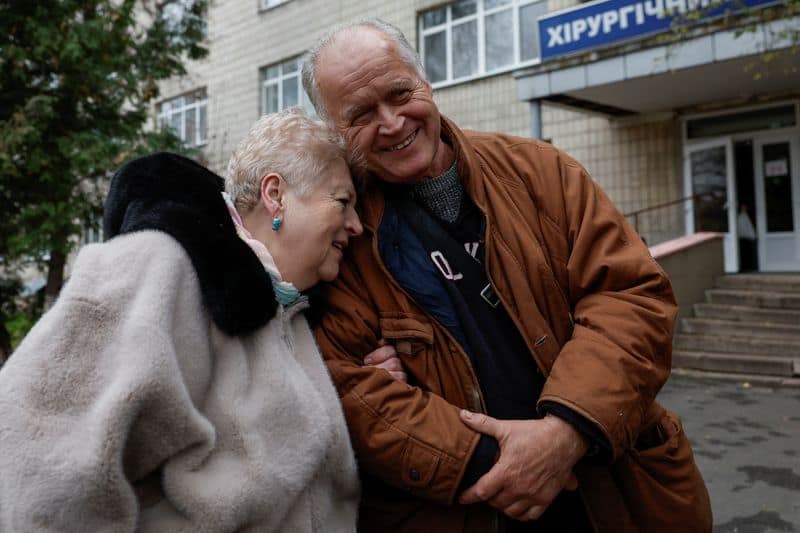
KYIV, Nov 9 (Reuters) - Larysa Ryndova hurried to see her husband as if they were going out on a first date — makeup on and perfume spritzed in the car.
It was the first time she had laid eyes on 68-year-old Serhiy in 4-1/2 years — time he had spent trapped with others in the Russian-held town of Oleshky in southern Ukraine.
"I can't believe you are here," Larysa, 72, kept repeating, her mascara smudged with tears after they embraced outside a hospital in Kyiv. "Honestly, I can't believe it myself," Serhiy replied.
They last saw each other in 2022 when Larysa fled to England to live with their son, three months into the occupation following Russia's all-out invasion of Ukraine.
Serhiy stayed to look after the family home, ending up stuck in the town peppered with Russian-laid landmines and facing a mounting humanitarian crisis.
"We hoped for better. Turned out, it got 'better'," he said sarcastically.
Oleshky's residents described living through constant drone attacks and without power and heating. Things got even worse this spring, when food deliveries stopped.
Serhiy got out on October 30 with hundreds of other residents, evacuated during a ceasefire that US first lady Melania Trump was involved in brokering, with the additional involvement of Pope Leo.
For all the joy of seeing Larysa — and the prospect of being reunited with his three children and six grandchildren — he had found his escape from Oleshky a devastating wrench.
"Your heart is torn apart at the thought of leaving everything behind. How can you? Your home, your family, the cemetery — all your relatives are there," he said.
"How will you ever visit their graves, keep them cared for?"
'IT'S HARD TO RECOGNISE HIM'
As Oleshky's evacuees were moved by buses and planes through occupied land, Russia and Belarus, Larysa set out on her own 2,000-km (1,200-mile) journey to meet Serhiy and bring him back with her to Britain.
"How haggard he looks," she said when she saw the first pictures of her husband crossing into Ukraine. "It's hard to recognise him."
Serhiy called Oleshky a "zone of death" where life under occupation could depend on the mood of an individual Russian soldier.
He survived on humanitarian aid that he had stockpiled during the occupation — noodles, grains, sometimes canned meat and fish. He tried frying up flatbreads with flour stored before the war, riddled with weevils.
"Sometime around April (this year), the people who used to bring us food died — two men. After that, all food deliveries stopped completely. There was nothing," Serhiy said over a cup of coffee in a Kyiv cafe.
Locals shared what they had. Some risked the dangerous 20-km journey on foot or bicycle to Radensk for supplies. Rare provisions were sold at severely inflated prices.
The local hospital ran out of supplies. Bodies were stacked up in the morgue, as forensic experts refused to risk the journey to the town to perform autopsies.
"Bodies are just lying there. Everything is leaking. When my neighbour died, I carried his body in there, and the smell was absolutely horrific," Serhiy said. "God forbid!"
Another neighbour asked him to bury her in her own courtyard if she ever got killed.
Serhiy said he probably would not have left the town himself had it not been for the evacuation. Landmines were laid out on all the roads and even in the town.
"They (Russian troops) had their own objective, as I understand it: to mine everything so they could keep everything under control," he added.
"A lot of people were killed in Oleshky. Someone would go out to pick a cherry plum and get blown up. Someone else would pick up a mushroom or a nut and step on a landmine."
Serhiy said Russian troops "had done a great job of cleaning up" to put on a show before the organised evacuations began. He didn't see a single burnt-out car on the way.
He said he felt sure he could have survived another winter, despite the ordeal of occupation and food shortages.
Larysa rolled her eyes, still wet with tears.
"I'll fatten him up with borscht and varenyky (dumplings)," she said.
(Reporting by Yuliia Dysa and Anna VoitenkoEditing by Daniel Flynn and Andrew Heavens)