By Lizzie Johnson, Marine Delrue and Marian Prysiazhniuk
KYIV, Nov 6 (Reuters) - In a sparsely furnished court room in western Ukraine, a clerk called up the defendant.
They were met with silence.
No one stepped up to face the charges. No one entered a plea. In fact, there was no sign at all of the defendant: Russia.
The plaintiff, Denys Katyukha, was embarking on an 11-month battle to prove Russia had seized his life's work. He alleged Moscow had stolen his hotel on the Sea of Azov and his apartment in nearby Melitopol, both within Russian-occupied southeastern Ukraine.
The 49-year-old's fight would play out in a Ukrainian civil court Russia doesn't recognize, culminating in a $5.1 million judgment Russia will likely never pay. Still, the businessman was determined to pursue justice, no matter how illusory.
"For now, I am the victim – a Don Quixote fighting windmills," Katyukha said.
The Admiral is among hundreds of hotels and resorts Russia has seized or identified for seizure on the inland Sea of Azov since its 2022 full-scale invasion of Ukraine, according to a Reuters examination of Russian and Ukrainian property records. The review provides the most comprehensive picture yet of Moscow's property seizures in the coastal region.
Russian authorities have identified more than 7,000 commercial and residential properties in the occupied Zaporizhzhia region, where the Admiral is located, as "ownerless," according to notices published by the Moscow-installed government. They include 521 hotels and resorts, Reuters found.
At least 77 of the hotels and resorts are now controlled by Russian businesses, including 20 by Russian state entities, tourism and corporate records show. Reuters couldn't establish what happened to all of the businesses.
The commercial transformation of the Azov coast reflects one of Russian President Vladimir Putin's top stated priorities: remaking Ukrainian lands as Russian. The Kremlin makes a historical claim to Ukraine — which Ukraine rejects — and aims to absorb its occupied regions with what it calls the Russian motherland.
The property seizures enable Russia to consolidate control over the areas and generate money for the war effort, said Karolina Hird, a national-security fellow at the Washington-based Institute for the Study of War.
Ukraine's Ministry of Foreign Affairs said Russia has introduced rigid new property laws in occupied areas to create "a legal smokescreen" for what it calls state-sponsored theft. The legislation strips Ukrainians of ownership rights unless they become Russian citizens.
Asked about the seizures, Kremlin spokesman Dmitry Peskov said: "Everyone who wished to do so was given the opportunity to re-register their property under Russian jurisdiction. Property that was not re-registered became ownerless."
The Russian-backed Zaporizhzhia occupation authorities didn't respond to queries.
In September 2022, Katyukha, who'd fled Ukraine to Germany, heard from his father that unidentified armed men had entered his hotel, declaring it "ownerless." If Katyukha wanted to stake a claim, he needed to prove ownership within three days.
His father, who'd stayed behind after the invasion, dropped off the proper paperwork, Katyukha said. Reuters couldn't independently verify all elements of his account.
But there was one problem: The state didn't recognize Ukrainian passports or property deeds.
Katyukha said occupation authorities told his father: "These are documents from a nonexistent country."
SALTED AIR AND WARM SEA
The Admiral Hotel began as a 3.7-acre patch of scrubland in Kyrylivka.
Though Katyukha's life was based in the nearby city of Melitopol, his fondest memories were of the seaside village. As a boy, he suffered respiratory issues that Ukraine's industrial interior exacerbated. He spent summers with his grandfather in Kyrylivka.
The air felt clean, salted. The sea was warm and blue. Beaches teemed with families. Katyukha resolved to build his own hotel and spent years seeking the perfect spot. Finally, in August 2014, he broke ground on a few bungalows. The modest start grew into a sprawling complex with 100 rooms, three bars, a restaurant, shop, swimming pool and children's water-play area.
Kyrylivka welcomed 2 million tourists in 2021, according to Ukrainian authorities, the last season before Russian forces occupied most of Zaporizhzhia.
That year, local officials recognized the Admiral with the "Hospitality of
"We'll be back!" reads one recent review.
NEW MANAGERS AT THE ADMIRAL
On September 28, 2022 – nine days after armed men seized the Admiral – a Russian-controlled commission appointed new ownership for the hotel, along with more than 100 other businesses, including medical centers, farms, postal facilities and a cannery, according to the commission's meeting minutes. The Zaporizhzhia commission has met regularly to name new owners for dozens of properties at a time, the minutes show.
The Admiral's new owner was named as "Resorts of Zaporizhzhia Region", which is a Russian state entity, according to corporate records. It reported a net revenue of 65.7 million roubles, or about $800,000, in 2023, the Russian records show. It hasn't publicly reported any financial figures for the years since, for reasons Reuters couldn't determine.
The entity, which was renamed the "Zaporizhzhia Region Investment Development Agency" in April, didn't respond to a request for comment.
As Katyukha rebuilt his life in Germany, teaching hospitality courses remotely for a Ukrainian university, the Admiral prepared for another season. By 2023, vehicles were visible in some hotel parking lots across Kyrylivka, along with umbrellas on pools and parts of the beach, satellite imagery showed.
Russian influencers offered Katyukha a glimpse of his beloved hotel. In one 2025 social-media video, a woman in a pink-striped bikini strolled through the Admiral, panning her camera over her family's hotel room, the beach cabanas and blooming flower gardens.
Still, a tourism-development plan published by the Zaporizhzhia occupation authorities in March showed just 150,000 people traveled to the Azov region in 2025 – or 5% of what Ukraine reported for just Kyrylivka and Berdiansk in 2021. Industry growth has been stifled by hotel disrepair, lack of utility infrastructure and the ongoing conflict, the plan said.
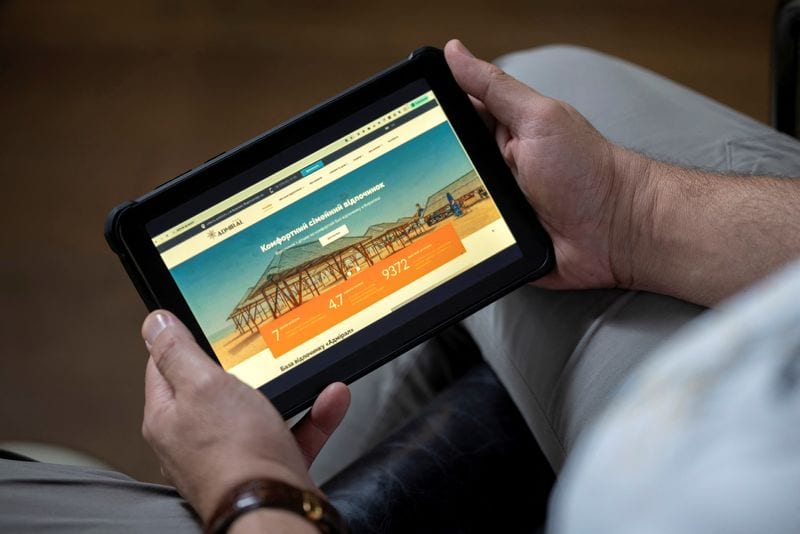
Katyukha isn't so upset about the hotel's new visitors. At least someone was enjoying what he'd worked to build, he said. But he was shocked by the Admiral's relaunched website: It was nearly identical to the one he'd built. Only the language had changed, from Ukrainian to Russian.
COUNTING CAN OPENERS AND CHANDELIERS
Angry and emboldened, in mid-2023, Katyukha started tallying his losses. His findings spanned 3,000 pages.
He determined that outfitting each single room at the Admiral had cost him several hundred dollars, from the microwave ($40) and chandelier ($41) to the oak bedside tables ($31 each) and even the can opener (20 cents). He counted materials and machinery to build the hotel, compiling receipts and bank statements in a giant spreadsheet, aided by his lawyer.
The litigation took nearly a year. No Russian representatives participated. Some court hearings were delayed by bombings or sirens. On April 30, presiding Judge Mykhailo Smokovych awarded Katyukha $5.1 million in damages, finding that Russia's actions were a "de facto expropriation."
Katyukha has also filed a claim with the EU-backed Register of Damage for Ukraine, headquartered in the Hague, which records evidence of loss, damage or injury caused by Russia in its war. He joins more than 195,000 seeking compensation. The Register says it expects to receive between 6 to 8 million claims. No funding mechanism has been established yet to pay them.
Katyukha knows Russia likely won't pay him a cent in his lifetime. He hopes his grandchildren will someday benefit from his fight for justice.
(Reporting by Lizzie Johnson, Marine Delrue and Marian Prysiazhniuk; Additional reporting by Filipp Lebedev and Gleb Stolyarov; Editing by Dan Flynn and Pravin Char)