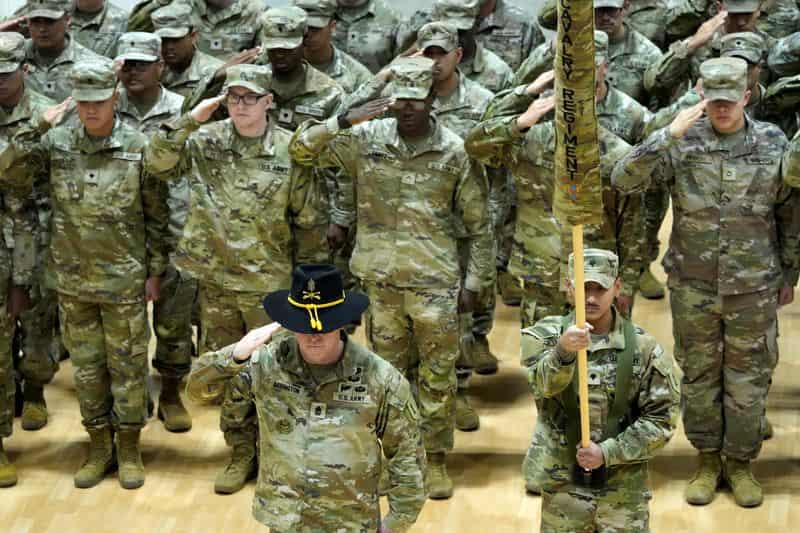
PABRADE MILITARY BASE, Lithuania, Nov 16 (Reuters) - Lithuanian President Gitanas Nauseda said on Monday that US troop rotations in Lithuania would continue beyond the current nine-month deployment, speaking at a ceremony marking the arrival of the latest two US battalions.
Washington first deployed troops to Lithuania, a NATO member bordering Russia and Belarus, in 2014 after Russia's annexation of Crimea.
Since 2019, it had maintained an armoured battalion of about 1,000 troops on overlapping rotations until the Pentagon paused it earlier this year pending a force posture review.
At the Pabrade military base near the Belarusian border, Nauseda said: "As far as I know, this is not a one-off or a temporary rotation. There is a certain rotation plan extending into the future."
The US Embassy in Lithuania did not immediately reply to a request for comment.
US Ambassador Kara McDonald, speaking at the same ceremony, did not directly comment on Nauseda's remarks but described the deployment as "a continuation of rotations" that have taken place since 2014.
"Our purpose here is very clear. It is a defensive purpose to project deterrence, to maintain readiness, to stand shoulder to shoulder with our allies. This very much is peace through strength, and this is how we preserve peace," she told reporters.
Lithuania has proposed expanding US presence or making it permanent, and has offered to cover the costs.
President Donald Trump told reporters last month his administration would "certainly look at" Lithuania's request.
Lithuania has tripled defence spending since Russia's full-scale invasion of Ukraine in 2022 and is NATO's biggest defence spender this year by share of gross domestic product at 5.33%.
Germany is due to station a combat-ready army brigade of about 5,000 troops in Lithuania by the end of next year as a deterrent to Russia.
(Reporting by Andrius Sytas; Editing by Xevi Fontdegloria)