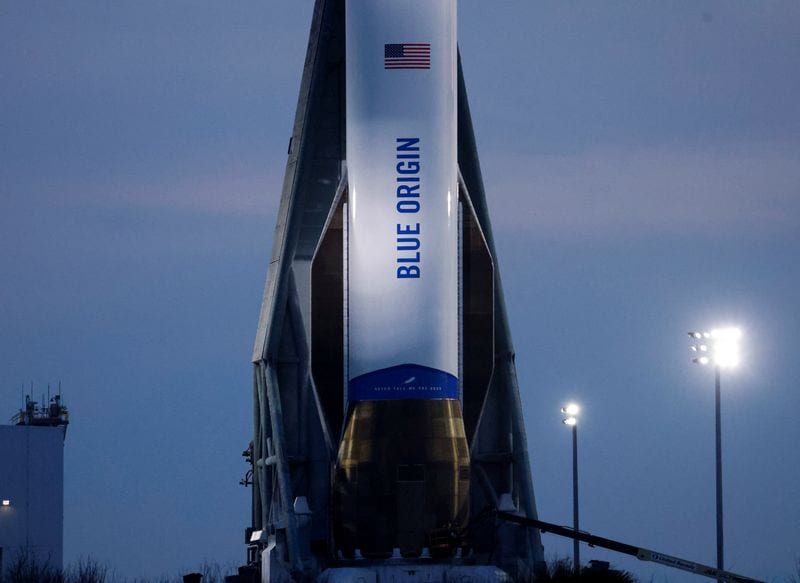
Nov 19 (Reuters) - Jeff Bezos' Blue Origin said on Thursday that Alphabet's Google had selected its New Glenn rocket to launch satellites for Project Suncatcher, an experiment aimed at running AI systems in space.
The planned mission advances efforts to move power-hungry AI computing beyond Earth, using sunlight in orbit to ease pressure on electricity grids, land and cooling systems.
Companies including Elon Musk's SpaceX and startup Starcloud are exploring data centers in orbit as growing AI use drives demand for computing capacity and strains infrastructure supporting facilities on the ground.
The launch, targeted for the first quarter of 2029, will be Google's first heavy-lift flight dedicated to Project Suncatcher and will carry several computing satellites aboard New Glenn.
Each satellite will carry Google's tensor processing units, the search giant's in-house chips built to run AI programs, with computing capacity roughly equal to a rack of servers in a conventional data center.
They will enter an orbit that provides near-continuous sunlight, allowing Google to examine whether solar energy can support intensive computing in space.
Thursday's agreement gives Blue Origin a major future mission for New Glenn as the company seeks to expand its launch business following delays and a launchpad explosion in May.
Google and Planet Labs launched the first Project Suncatcher prototype aboard a SpaceX rocket in October and said the satellite was operating as expected after establishing contact.
That mission is testing whether the chips can withstand launch forces, radiation and extreme temperatures, while engineers study how to cool them without the airflow available on Earth.
Radiation can damage electronics and corrupt data, while heat from powerful chips must be released through pipes and panels rather than conventional cooling systems.
Experts have also noted that high launch costs, engineering hurdles and limited satellite production can put data centers in orbit years away from commercial use.
(Reporting by Anhata Rooprai in Bengaluru; Editing by Shreya Biswas)