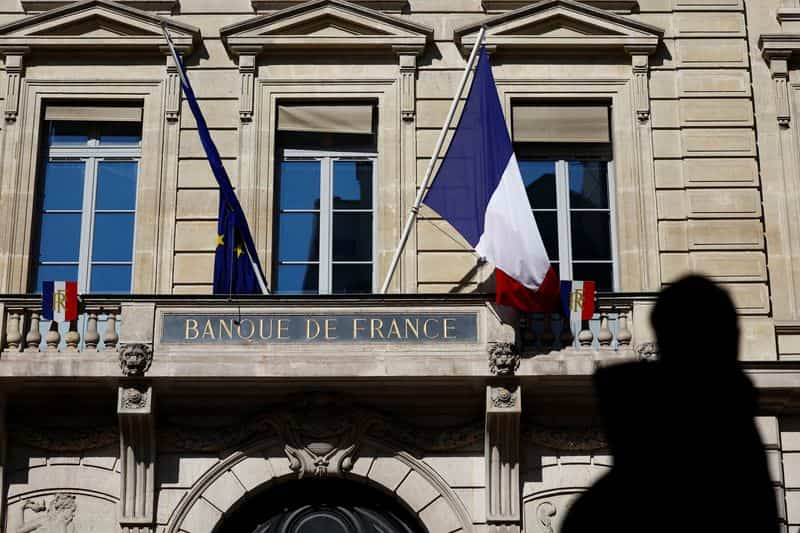
PARIS, Nov 9 (Reuters) - France is on course to avoid a recession in the final quarter of the year with business executives expecting activity to accelerate in November, the central bank said on Monday.
The euro zone's second-biggest economy is set to grow "moderately" in the fourth quarter after contracting 0.1% in the previous three months, the Bank of France estimated in its monthly outlook. A technical recession is defined as two consecutive quarters of economic contraction.
The central bank stopped short of providing a specific growth forecast so early in the quarter, citing uncertainty over the economic impact of recent protests and unrest as well as international developments following the US midterm elections.
France has seen a series of protests since September that began over underfunded schools but have since broadened as unions organised demonstrations over the cost of living, adding pressure on the minority government as it struggles to push spending cuts through France's deeply divided parliament.
The central bank's outlook was based on its monthly survey of 8,500 companies in which business executives reported that activity picked up in October in both industry and services, while remaining broadly flat in construction.
Manufacturing was supported by strong demand in aerospace and sectors linked to defence spending and data-centre construction, although automakers and several other industrial branches continued to struggle.
Companies surveyed said they expected industrial output to accelerate further in November, with activity rebounding in pharmaceuticals and autos and remaining buoyant in aerospace and technology-related industries.
Services activity was also forecast to grow, though at a slower pace, while construction was expected to remain broadly stagnant as weak demand continued to weigh on the sector.
The survey pointed to a sharp rise in uncertainty, especially in construction and services. Firms cited political and budget uncertainty, social unrest and higher fuel prices as key concerns. They said customers were delaying projects and investment decisions, reducing visibility on business prospects in the months ahead.
(Reporting by Leigh ThomasEditing by Ros Russell)