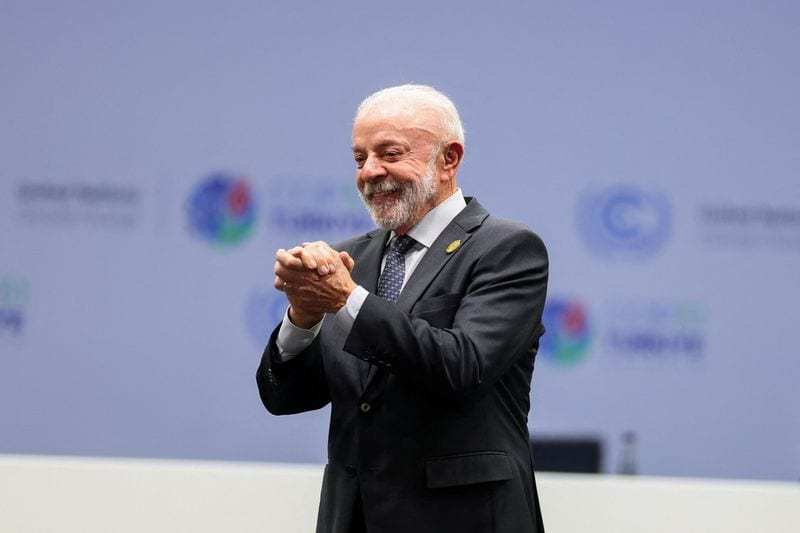
BRASILIA, Nov 12 (Reuters) - Brazilian President Luiz Inacio Lula da Silva's first package of public spending curbs since his reelection last month risks proving too little for financial markets and too much for some in his left-wing Workers' Party.
The veteran leftist leader — who is preparing for his fourth term in charge of Latin America's biggest economy — has said he wants to get Brazil out of its rut of slow growth and sky-high interest rates.
But so far, his administration is not rushing to take advantage of what looks like a small window of opportunity for reform before a new, more right-wing Congress convenes for the first time in February.
A package of public spending measures sent to the Senate on Wednesday was designed principally to keep the government on track to meet its fiscal targets rather than go beyond them. A Senate vote on the plan was expected later on Thursday.
The measures, including curbs on tax breaks and new tools to restrain growth in spending, would save the public finances up to 60 billion reais ($10.75 billion) in 2027, Planning Minister Bruno Moretti said.
That would be equivalent to 0.5% of gross domestic product, representing only a small tightening of the public purse strings although savings are set to grow in future years.
Some market analysts said further action on the public finances will be needed if Lula wants to turn around the outlook for the economy, which is forecast to see inflation rising and growth slowing sharply in 2027.
"The adjustment Brazil needs is larger than this 2027 proposal, so I think it falls short on helping to decrease medium-term concerns," Armando Armenta, senior economist and strategist at AllianceBernstein, said.
Brazil's real currency on Thursday was trading at its weakest level against the US dollar since mid-2025.
"The market will need to see measures that reduce permanently the growth in spending and real progress on reform in Congress," Maria Carolina Luchesi, investment specialist at Hike Capital, said.
Two sources close to government-allied lawmakers said sending the fiscal proposal to lawmakers now made sense ahead of the start of the next Congress in February, which will be dominated by opposition parties.
"That window of opportunity is there, provided there is a well-executed effort to build political support," one of the sources told Reuters.
But how much further Lula is willing to go remains unclear. He is expected to choose his next finance minister on his return to Brazil next week from international trips, potentially offering a clearer sign of his economic policy direction.
Moretti played down the prospect of any immediate push for bigger fiscal reforms on Wednesday.
Some economists say any lasting improvement in Brazil's fiscal outlook requires a slowdown in the growth in mandatory spending, such as smaller minimum-wage increases or changes to rules that link health and education expenditures to revenue growth.
SKY-HIGH RATES
With Brazil's public finances out of balance, there is little prospect of a sharp fall in official interest rates, which are among the highest in the world for a developing economy.
The central bank last week held its benchmark rate at 13.75%, ending a run of cuts.
The government points to its plan for a modest primary surplus in 2027 after three years of small deficits. But investors remain concerned about the overall budget deficit of nearly 10% of GDP, which is driven largely by huge debt costs.
Many economists say Brazil ultimately needs larger primary surpluses to stabilize debt and lower its borrowing costs.
While investors want to see more significant cuts to public spending, some members of Lula's Workers' Party say Brazil's problem is its high official interest rates, which they say should be capped at much lower levels.
Lindbergh Farias, a Workers' Party representative in the lower house of Congress, criticized Wednesday's package of measures and proposed spending cuts.
"I took part in the entire electoral campaign and no one talked about a fiscal adjustment," he said. "It was about (social) rights and the widening of those rights."
On Sunday in his first official address to the nation after winning the election, Lula suggested that he would try to bring down rates by tackling the public finance problem.
Whether that comes from significant spending cuts or more tax increases remains to be seen. Lula has previously relied heavily on revenue-raising measures, from curbing tax breaks to increasing levies on higher-income groups.
Critics say that strategy leaves untouched the drivers of Brazil's fiscal deterioration, chief among them the country's fast-growing mandatory spending.
William Jackson, chief emerging markets economist at Capital Economics, said three of the last four cycles of interest rate cuts in Brazil came shortly after major fiscal reforms had passed big congressional hurdles.
"This evidence would suggest that Lula needs to provide something far more tangible – such as more ambitious targets or a new fiscal rule – if he’s going to get his wish for lower interest rates any time soon," Jackson said.
($1 = 5.5833 reais)
(Additional reporting by Igor Sodre in Sao Paulo and Rodrigo Campos in New York; Editing by William Schomberg; and Aurora Ellis)