Key facts
- Guild Mortgage is urging Fannie Mae and Freddie Mac to adopt residual income analysis for loans.
- The lender uses a 12-month residual income analysis, comparing take-home pay to expenses, for its government loan program.
- Guild's method aims to reduce over-reliance on credit scores, which can disproportionately affect younger, lower-income, and minority borrowers.
- The company found its residual income analysis correlates strongly with loan performance, similar to industry averages.
- Current regulatory hurdles, including extensive paper documentation, limit the adoption of Guild's program.
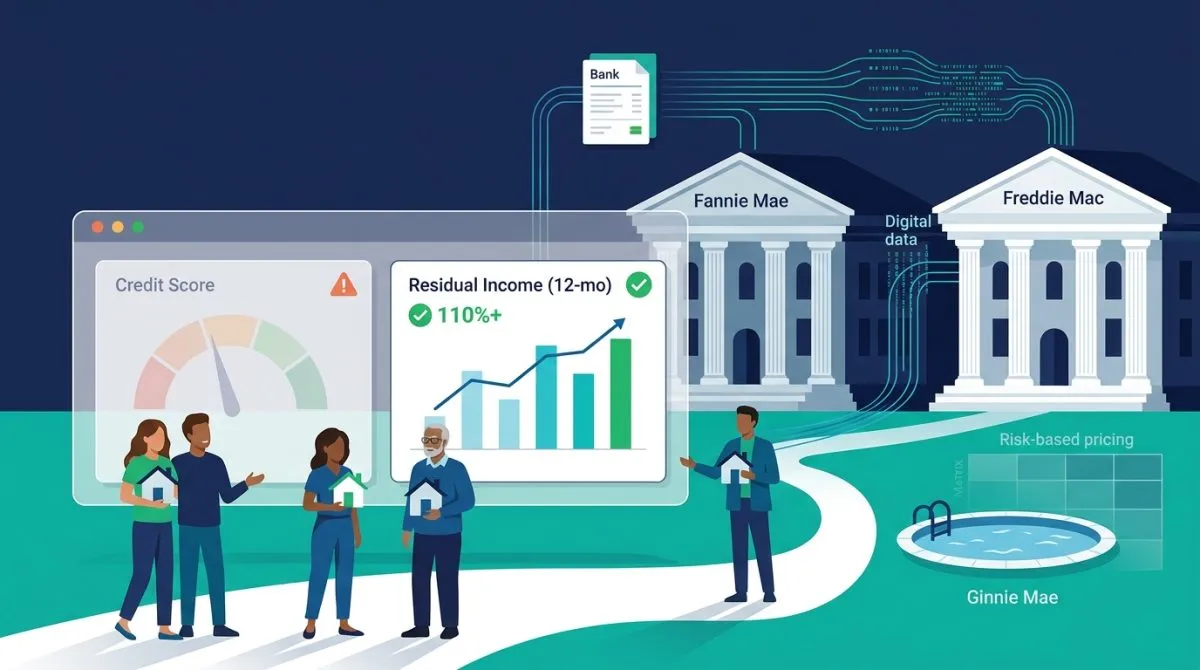
Guild Mortgage is actively encouraging Fannie Mae and Freddie Mac to implement residual income analysis on a large scale, aiming to lessen the industry's dependence on traditional credit scores. The California-based lender has utilized this method since 2022 within its 'Complete Rate Program' for government loans. Because Guild retains servicing and pools loans through Ginnie Mae, it can set its own risk-based pricing.
David Battany, Guild's executive vice president of capital markets, believes the residual income model has the potential for significant growth under the government-sponsored enterprises (GSEs). He noted that while Fannie and Freddie have begun incorporating alternative data like rent and utility payments, these are considered minor advancements. Battany views the recent removal of the minimum 620 FICO score requirement as a more substantial step.
Battany explained that if Guild were to offer residual income loans to the GSEs, it would receive the lowest tier of their risk-based pricing. He cited a Federal Reserve Bank of Kansas City study highlighting that younger, lower-income, and minority homebuyers often have lower credit scores due to limited financial access rather than poor financial habits.
Guild's residual income analysis assesses a borrower's actual take-home pay against their non-discretionary expenses over a 12-month period, using electronic bank data. The lender requires a residual income ratio of at least 110%, meaning take-home pay exceeds all essential expenses by at least 10%. This approach contrasts with the standard debt-to-income (DTI) ratio, capturing seasonality and variable income or expenses.
Guild's internal study of approximately 3,000 loans originated between 2015 and 2021 showed a strong correlation between the residual income ratio and loan performance, with default rates comparable to the industry average. Battany stated that borrowers using Guild's program are typically those who would otherwise undergo manual underwriting.
A primary obstacle is the requirement for hundreds of pages of paper documentation, despite Guild's ability to instantly access digital bank data. This cumbersome process discourages both borrowers and loan officers, leading to potential homebuyers not even applying. Consequently, Guild's residual income program constitutes less than 1% of its total business, a friction point the company aims to resolve by engaging the GSEs.