Key facts
- The United States and Japan conducted a joint intervention to support the yen.
- This was the first joint US-Japan currency intervention since 1998.
- The yen had fallen to 40-year lows prior to the intervention.
- The yen held gains above recent lows after the intervention.
- The intervention's impact on the yen's strength is limited by interest rate differentials.
- Japan is a major holder of US Treasurys.
- Direct sales of US Treasurys by Japan are considered unlikely.
- Rising Japanese government bond yields may reduce demand for US debt.
- Bitcoin remained steady near $63,600 during the intervention.
- Japan's Economy Minister stated cost pass-through to consumer prices has been limited.
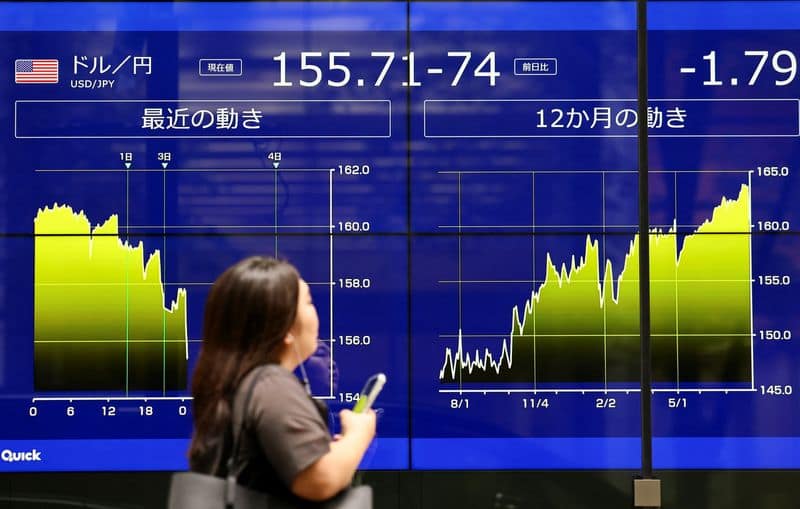
The United States and Japan have undertaken a rare joint intervention in currency markets to bolster the Japanese yen, a move not seen since 1998. This coordinated action was initiated to counter the yen's significant depreciation, which had pushed it to lows not observed in four decades. Following the intervention, the yen experienced a rebound and held gains above these recent lows. However, the impact on the yen's trajectory appears limited, as fundamental economic factors, particularly the substantial interest rate differential between the US and Japan, continue to favor the US dollar. This persistent gap encourages a carry trade strategy where investors borrow in low-interest yen to invest in higher-yielding dollar assets.
The intervention has also brought attention to Japan's substantial holdings of US Treasurys. While analysts deem direct sales of these US debt instruments by Japan as improbable, a sustained rise in Japanese government bond yields could potentially diminish Japan's demand for US debt. This situation presents a challenge for the US Treasury, which relies on foreign demand for its debt issuance. Separately, Japan's Economy Minister, Minoru Kiuchi, commented on domestic economic conditions, stating that the pass-through of rising costs, partly influenced by the Middle East conflict, to consumer prices has been limited thus far. He observed that overall consumer prices have risen moderately, but cautioned that vigilance is necessary for potential gradual increases in the prices of food and other goods.
The carry trade, a strategy that profits from interest rate differentials, has been a key factor influencing the yen's weakness. Investors have been borrowing the yen at low interest rates and investing in higher-yielding currencies like the US dollar. The recent intervention by the US and Japan aims to disrupt this trade and stabilize the yen. However, the underlying interest rate differential remains a powerful force, suggesting that the yen's gains may be temporary without a shift in monetary policy by either the Federal Reserve or the Bank of Japan. The situation also impacts other markets, with Bitcoin remaining steady near $63,600 amidst the currency market volatility.