Key facts
- The U.S. Central Command conducted strikes on over 80 sites in Iran.
- Strikes targeted air defense systems and IRGC boats.
- The U.S. revoked Iran's oil export license.
- Iran vowed a 'crushing response' to U.S. strikes.
- Iranian Parliament Speaker Ghalibaf accused the U.S. of violating a ceasefire.
- Kuwait and Bahrain reported power restoration after Iranian strikes.
- Iranian President Pezeshkian returned from Iraq following U.S. strikes.
- An Israeli strike in Gaza City killed Mohamed al-Wahidi and three others.
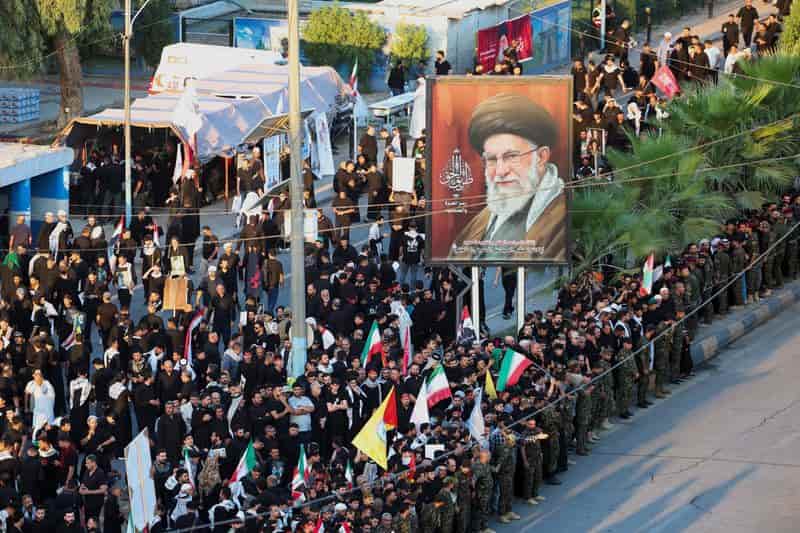
- Thousands marched in Najaf, Iraq, for the funeral of Ayatollah Ali Khamenei.
The U.S. Central Command announced it has completed strikes on more than 80 sites within Iran, including air defense systems and Islamic Revolutionary Guard Corps (IRGC) boats. These actions were taken in retaliation for recent tanker attacks. The U.S. has also revoked Iran's oil export license. Iran has responded by vowing a "crushing response" to what it termed a "blatant act of aggression."
Iranian Parliament Speaker Mohammad Baqer Ghalibaf accused the U.S. of violating a ceasefire agreement, citing the renewed attacks, reinstated oil sanctions, and ongoing Israeli actions in Lebanon. The Iranian foreign ministry issued a warning to regional states, cautioning them against allowing their territories to be used for attacks on Iran. Iranian President Masoud Pezeshkian has returned to Iran from Iraq following the U.S. military strikes on Iranian installations. These strikes targeted radar and drone sites, occurring amidst a fragile ceasefire and underscoring the continuing tensions between the U.S. and Iran.
Regional tensions have significantly increased following these developments. Kuwait and Bahrain reported that power has been restored to residential areas after Iranian missile and drone strikes impacted their infrastructure. These attacks, in retaliation for the U.S. strikes on Iran, have caused oil prices to jump. In a separate incident, an Israeli strike in Gaza City killed Mohamed al-Wahidi, a Palestinian official who was instrumental in organizing public World Cup screenings, along with three other individuals. This strike occurred shortly before a planned screening of the Egypt-Argentina match.
Amidst the escalating regional conflict, Turkish President Erdogan called for a two-state solution in the Middle East. He also announced Turkey's commitment to NATO's defense spending targets, including a significant investment in air defense systems. Thousands of mourners marched in Najaf, Iraq, for the funeral procession of Iran's late Supreme Leader Ayatollah Ali Khamenei, with the procession continuing amid the escalating conflict between the U.S. and Iran.