Key facts
- Bitcoin and ether prices declined due to a prolonged exploit of the Coldcard hardware wallet.
- The Coldcard exploit has led to the loss of $114 million in bitcoin.
- The incident has shaken confidence in self-custody, prompting some holders to move assets back to exchanges.
- Bitcoin futures open interest reached a one-month high, while the long-short skew in derivatives markets leaned bearish.
- NEAR Protocol announced its Intents system surpassed $24 billion in lifetime volume and introduced quantum-safe cryptography.
Bitcoin and ether experienced price declines as a significant exploit targeting the Coldcard hardware wallet continued for a fifth day, impacting market confidence in self-custody solutions. The hack, which resulted in the theft of $114 million worth of bitcoin, has prompted some holders to move their assets back to centralized exchanges, a move contrary to the core principle of self-custody in the cryptocurrency space.
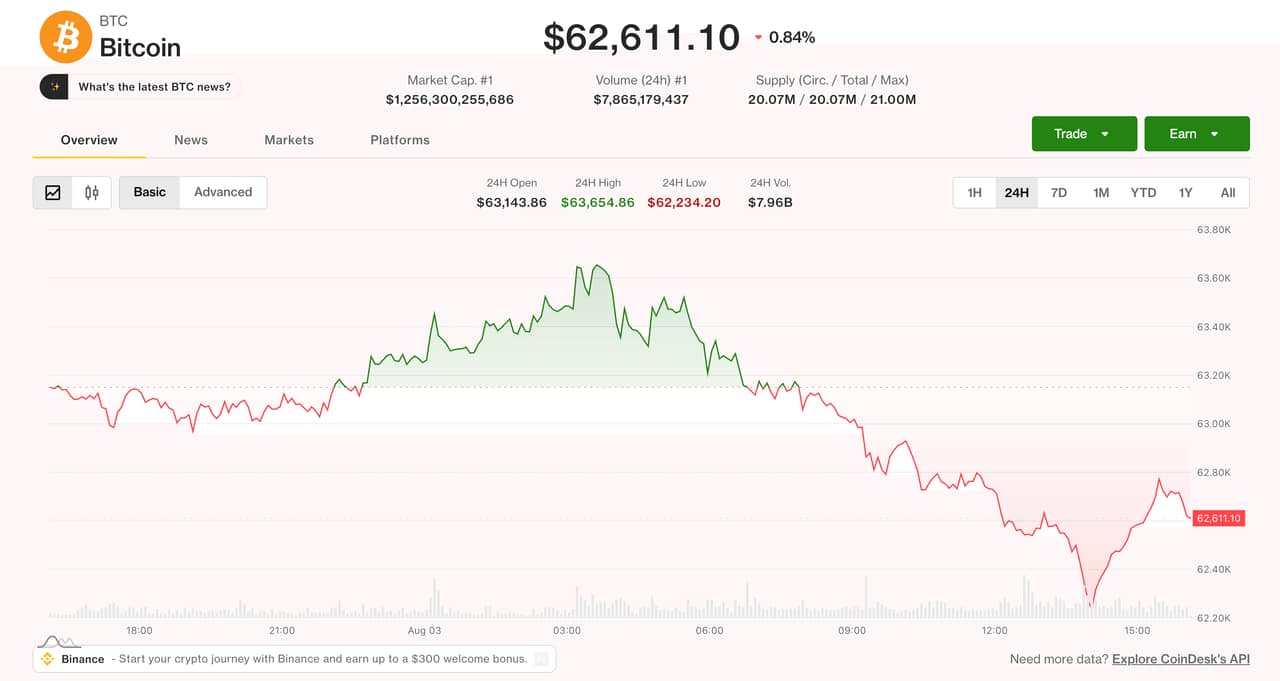
Analysts at Marex noted that the incident has spooked holders, impacting sentiment more broadly. Despite the gravity of the $114 million loss, the price reaction in bitcoin has been relatively contained, with BTC trading down 1.5% to $62,595 and ether down nearly 2% to $1,842. The CoinDesk DeFi Select Index also saw a 2.5% decrease.
In derivatives markets, bitcoin futures open interest has risen to a one-month high of 772,000 BTC, with annualized funding rates at a moderately positive 4%. However, the taker volume in BTC futures shows a bearish skew, with over 52% leaning towards shorts. The 30-day implied volatility index (BVIV) remained steady around 37%, indicating no widespread panic despite the exploit and rising Treasury yields. Options trading showed a concentration of call bets around $68,000 and $70,000.
Meanwhile, NEAR Protocol reported that its Intents system has processed over $24 billion in lifetime volume. The protocol has also rolled out significant upgrades, including quantum-safe cryptography to protect against future threats from quantum computing, dynamic resharding for automatic scaling, and a new feature for AI compute staking, allowing token holders to earn by provisioning computing power for AI applications.