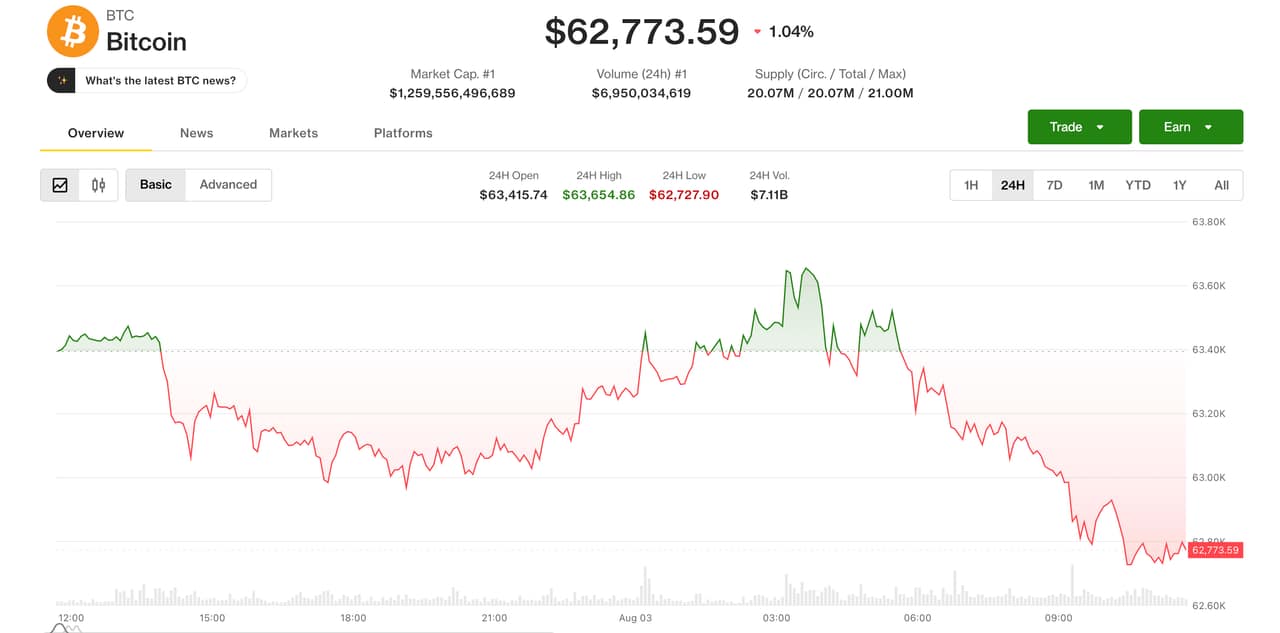
Key facts
- Bitcoin fell below $63,000 on Monday.
- A Coldcard hardware wallet exploit has resulted in losses of approximately $89 million.
- The exploit has affected around 4,585 addresses.
- Ether also declined, trading below $1,900.
- Positive macroeconomic indicators, including falling oil prices and Treasury yields, were ignored by the crypto market.
- President Donald Trump announced a potential deal with Iran and a halt to strikes.
Bitcoin and other major cryptocurrencies experienced a downturn on Monday, with bitcoin falling below $63,000 and ether dropping to $1,858. This decline occurred despite improving macroeconomic conditions, including a significant drop in oil prices and lower Treasury yields, suggesting that market-specific security concerns are outweighing broader economic forces.
The primary driver for the crypto market's weakness appears to be a widening exploit affecting Coldcard hardware wallets. This exploit has led to the loss of approximately 1,367 bitcoin, valued at nearly $89 million, across about 4,585 addresses. The attack has progressed through multiple waves, with the attacker seemingly moving from larger balances to smaller ones.
In contrast, traditional markets showed positive movement. Brent crude futures for October delivery fell as much as 7.3% to $81.55 a barrel following President Donald Trump's announcement of a potential deal with Iran and a willingness to engage in fresh talks. This eased inflation concerns, contributing to a rally in Treasuries across the curve, with the 10-year yield decreasing by four basis points to 4.69%. Stock futures, including the Nasdaq 100 and European shares, also saw gains of 0.8%, and gold prices edged up by 0.3% to around $4,060 an ounce.
The divergence between the crypto market's performance and the positive macro environment highlights the impact of the Coldcard exploit. While falling oil prices, lower yields, and rising stock futures typically provide a tailwind for cryptocurrencies, bitcoin and its peers have largely ignored these factors. Data also showed an unusual split in fund flows on Friday, with bitcoin funds experiencing outflows while ether funds saw small inflows, a departure from the usual trend where bitcoin dictates direction.