Key facts
- The US organic feed market was valued at around $3.89 billion in 2025 and is projected to reach $6.92 billion by 2032.
- The market is expected to grow at a CAGR of approximately 8.58% between 2026 and 2032.
- Consumer preference for organic meat, dairy, and poultry products is a primary market driver.
- Government initiatives, such as the USDA's Organic Transition Initiative, support the growth of organic feed production.
- Cereals and grains accounted for 48% of the market share by source in 2025.
- Pellets represent the leading form, holding a 54% market share in 2025.
The US organic feed market is experiencing robust growth, driven by increasing consumer demand for organic meat, dairy, and poultry products. This trend is encouraging livestock producers to adopt certified organic feeding practices. Government initiatives, such as the USDA's Organic Transition Initiative, further support this growth by aiding producers in transitioning to organic systems and providing guidance on sourcing organic inputs.
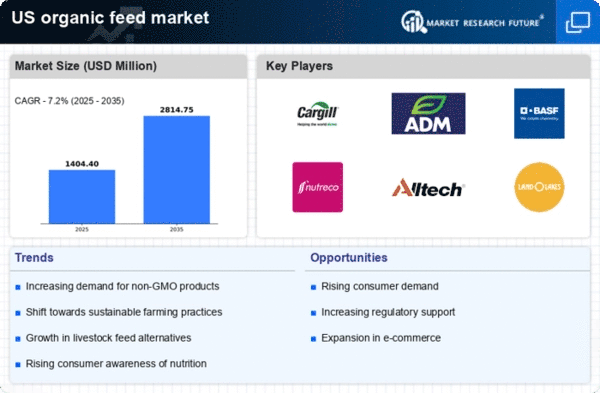
Market research indicates that the US organic feed market was valued at approximately $3.89 billion in 2025 and is projected to reach $6.92 billion by 2032, growing at a compound annual growth rate (CAGR) of about 8.58% from 2026 to 2032. Another report estimated the market size at $1.31 billion in 2024, with a projection to reach $2.81 billion by 2035, exhibiting a CAGR of 7.2% during the forecast period of 2025-2035.
Cereals and grains currently dominate the market by source, accounting for 48% of the market share in 2025. Pellets are the preferred form, holding a 54% market share due to their nutritional consistency, reduced feed wastage, and ease of handling and storage. Key players in this market include Cargill, Land O'Lakes, and Archer Daniels Midland.