All NewsEducationTV
Equities & FundsCrypto & Digital AssetsAI & TechnologyBusiness & CorporateUS Politics & PolicyGeopolitics & Global RiskMacro, Rates & FXCommodities & EnergyEuropean Politics & MarketsAsia-PacificReal Estate & Property
Story archiveAll categories
← All Stories

Scientists use sharks to gather ocean data for hurricane predictions

Created at 8 Aug · 9:13 AM1 source↑ Market-relevant
IN SHORT

Researchers are attaching sensors to sharks to measure ocean conditions, aiming to improve hurricane intensity forecasts. This method leverages sharks' abundance and wide distribution to collect data on ocean heat content, a key factor in hurricane strength.
✉Newsletter

PiQ Daily

Pick your topics. Get only what matters, on your cadence.

Key Numbers

30 to 40 milesoffshore distance for shark tagging
50 to 65 kmoffshore distance for shark tagging
two to three hourstypical wait time for a shark to take bait
less than five minutestime for shark tagging process

Who's Involved

Aaron Carlisle
Principal investigator and professor at the University of Delaware's School of Marine Science and Policy
Caroline Wiernicki
University of Delaware doctoral candidate in marine science
University of Delaware researchers
Conducting study on sharks as ocean-data observers
Scientists use sharks to gather ocean data for hurricane predictions

↳ Why This Matters

This research could lead to more accurate hurricane intensity forecasts, enabling coastal communities to better prepare for and mitigate the impact of severe storms.

Key facts

  • University of Delaware researchers are using sharks equipped with sensors to gather oceanographic data.
  • The sensors measure conductivity (related to salinity), temperature, and depth.
  • This data aims to improve predictions of hurricane intensity by assessing ocean heat content.
  • Sharks are favored for this research due to their abundance and wide distribution.
  • The project seeks to enhance coastal resilience by providing more reliable storm forecasts.
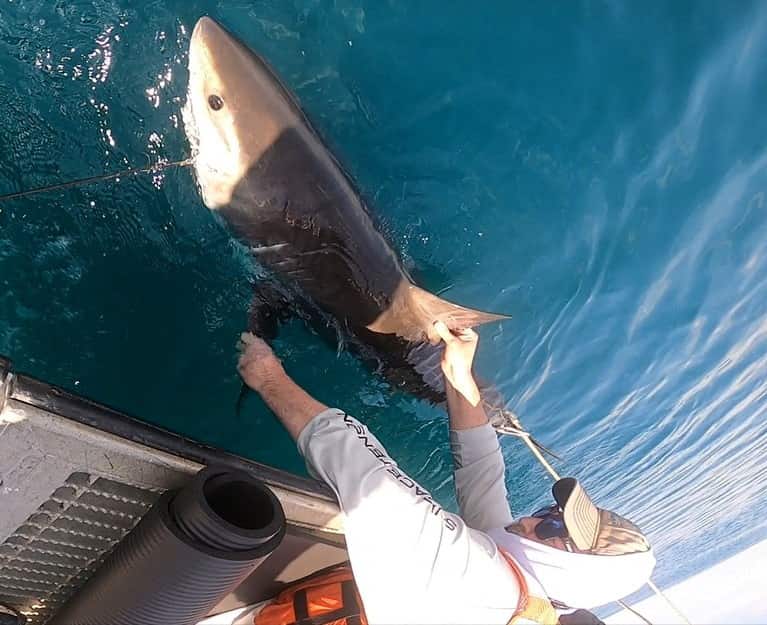
  • Scientists are exploring innovative methods to improve hurricane predictions, turning to sharks as mobile ocean-data observers. Researchers at the University of Delaware are attaching small electronic sensors, known as CTD tags, to sharks. These tags measure ocean conductivity, temperature, and depth, providing near real-time data on ocean conditions.

    Aaron Carlisle, a professor at the university, explained that animal-borne sensors have been used for years, but sharks offer a new opportunity due to their abundance and wide distribution. The collected data is crucial for understanding the heat content of the ocean's mixed layer, which directly influences hurricane intensity. Warmer waters provide more energy for storms to strengthen.

    The tagging process, which begins in early May, involves researchers heading offshore to deploy baited lines. Once a shark takes the bait, the tags are attached to its dorsal fin. As the shark swims, the tags transmit data to orbiting satellites. The tagging procedure is designed to be quick, resembling a "pit crew" operation, and is conducted under strict animal care oversight to minimize stress and ensure data accuracy.

    Caroline Wiernicki, a doctoral candidate, contrasted the scientific endeavor with popular, often dramatic, portrayals of sharks in films like "Jaws" and "Sharknado." She described the reality as more akin to an "accountant" clocking in data. If successful, this project could provide coastal communities with more reliable information to enhance their resilience against increasingly powerful storms.

    Frequently asked questions

    The sensors collect data on ocean conductivity (related to salinity), temperature, and depth.

    Sharks are abundant, widely distributed, and easier to access than many other marine animals, making them suitable for collecting data across large ocean areas.

    Warmer ocean waters in the mixed layer provide the heat energy that fuels hurricanes, leading to stronger storms.

    The tags are attached to the shark's dorsal fin using materials designed to corrode and fall off over time, and the process is conducted with animal welfare oversight.

    What Happens Next

    01Data collected by sharks will be analyzed to refine oceanographic, atmospheric, and climate models.
    02The project aims to provide more reliable information for coastal resilience planning.

    Get the newsletter.

    Pick the topics you actually care about. We'll email when there's news worth your time, on the cadence you choose. Cancel any time from your account.

    Cadence
    CME Headlines
    • WTI Crude Oil futures closed near 76.90 after choppy session.
      7 Aug · 9:09 PM
    • WTI Crude Oil futures closed near 76.90 after choppy session.
      7 Aug · 9:09 PM
    • Soybean futures slipped as traders prepped for WASDE report.
      7 Aug · 8:41 PM

    How It Developed

    University of Delaware researchers are testing sharks as mobile ocean-data observers.
    Sensors attached to sharks measure salinity, temperature, and depth.
    Sharks are chosen for their abundance, wide distribution, and frequent surfacing.
    Data collected will help inform oceanographic, atmospheric, and climate models.
    The goal is to improve hurricane intensity forecasts for the U.S. East Coast.

    Sources

    T1
    Scientists turn to sharks to improve hurricane predictionsReuters

    Related Stories

    US container imports surge ending as shippers manage tariffs, war
    7 Aug · 5:03 PM
    Rosatom permits seven Chinese vessels for Arctic route to Europe
    7 Aug · 1:13 PM
    Oil prices rise on Iran-Oman deal talks; Citi raises Brent forecast
    7 Aug · 4:36 PM
    China's Lab-Grown Diamonds Get AI Boost for Chip Cooling
    7 Aug · 11:35 AM
    Philippine rice farmers adopt climate-smart practices to cut methane emissions
    7 Aug · 9:06 PM