Key facts
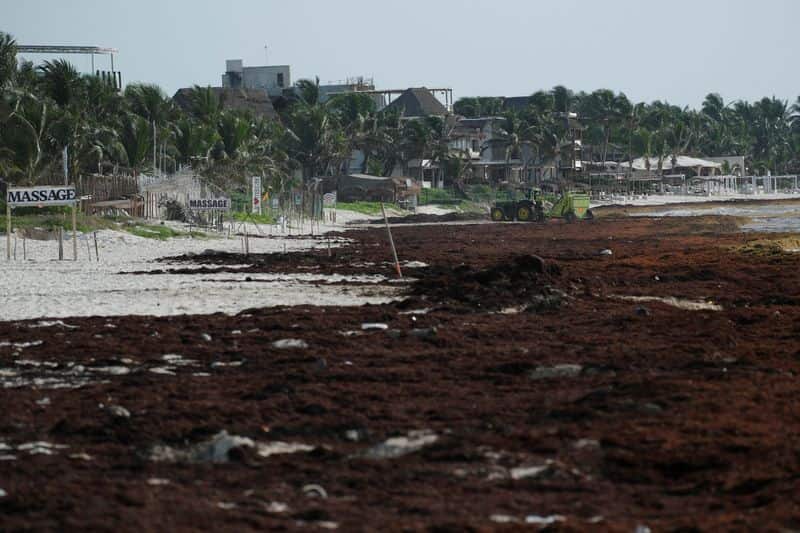
- Record masses of sargassum seaweed are accumulating on Caribbean coastlines, impacting tourism and local economies.
- Sargassum abundance is projected to remain high, with 2026 expected to be a significant year for its presence.
- Mexico is actively collecting sargassum, with plans to intercept it at sea using specialized vessels.
- Efforts are underway to convert sargassum into biofuels, fertilizers, and other commercial products.
- Concerns exist regarding the ecological impact of large-scale sargassum removal and the carbon credit practices.
Record masses of sargassum seaweed are accumulating on Caribbean coastlines, prompting a multi-pronged response from governments and businesses. The phenomenon, which began around 2010, involves brown seaweed forming floating mats that ride ocean currents into the Caribbean, feeding on nutrients from major rivers and warming sea temperatures.
The University of South Florida's Optical Oceanography Lab anticipates 2026 will be at least the second-largest year for sargassum abundance, with significant amounts expected to pile up around the Caribbean and southeastern Florida in the coming months. Brian Barnes, a research assistant professor at the university, noted the seaweed's mass could be doubling every five years.
In Mexico, authorities are investing in boats and floating barriers to intercept the seaweed at sea, aiming to protect tourist destinations like Cancun and Tulum. The country has collected over 96,000 metric tons this year, surpassing last year's figures. Governor Mara Lezama emphasized the importance of intercepting sargassum before it reaches the coast, and federal officials are expecting a new open-sea vessel soon.
Some companies are pursuing carbon credits by collecting and sinking sargassum, but this practice raises concerns about potential abuses and damage to deep-sea ecosystems, as offshore sargassum serves as a natural habitat for marine life. Barnes expressed skepticism about the positive outcomes of such carbon credit projects.
Amidst the challenges, entrepreneurs are exploring ways to transform sargassum into valuable products. Mexico's Environment Minister Alicia Barcena stated that out of nearly 200 projects, 11 have industrial scaling potential, and 39 are already producing items like fuel, fertilizers, laminates, bioplastics, and sandals. Carbonwave, a sargassum refiner, is selling fertilizer abroad and seeking domestic sales, while also exploring applications in the cosmetic and textile sectors. The Quintana Roo state government plans to expand a biofuel plant in Cancun.
Despite the scale of the crisis, Caribbean leaders encourage tourism, advising visitors to stay updated and opt for less-affected areas. Mexico is set to host a joint EU-Caribbean conference in October to discuss expanding sargassum collection methods while safeguarding beaches and coral reefs.