All NewsEducationTV
Equities & FundsCrypto & Digital AssetsAI & TechnologyBusiness & CorporateUS Politics & PolicyGeopolitics & Global RiskMacro, Rates & FXCommodities & EnergyEuropean Politics & MarketsAsia-PacificReal Estate & Property
Story archiveAll categories
← All Stories

World's largest solar telescope captures never-before-seen solar vortexes

Created at 7 Aug · 1:26 PM1 source↑ Market-relevant
IN SHORT

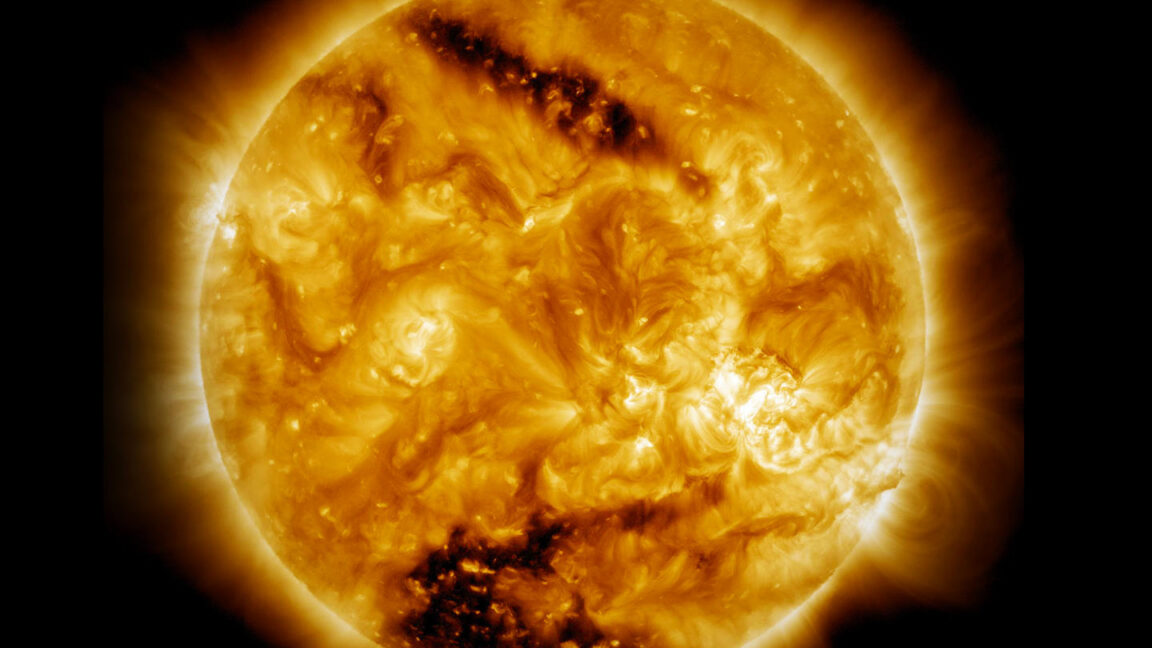
The Daniel K. Inouye Solar Telescope has captured images of Kelvin-Helmholtz instabilities, or vortexes, on the Sun's surface. These previously unobservable phenomena may alter understanding of energy and mass transfer in the Sun's atmosphere.

✉Newsletter

PiQ Daily

Pick your topics. Get only what matters, on your cadence.

Key Numbers

4 metersinouye solar telescope mirror size
416 nanometerswavelength observed
740 frames per secondcamera readout speed
100 microsecondsexposure time
19 kilometersspatial resolution achieved
47vortex-bearing interfaces identified
60 to 100 kilometersspacing between adjacent curls
25 to 170 kilometersindividual vortex diameter
0.67 to 3 kilometers per secondvortex propagation speed
6 megameterssimulated photosphere size
3.2 kilometerssimulation grid spacing

Who's Involved

David Kuridze
Lead researcher on the study of solar vortexes
Friedrich Wöger
Co-lead researcher at the National Solar Observatory
National Solar Observatory
Institution involved in the telescope and study
Max Planck Institute for Solar System Research
Institution involved in diagnostic camera setup
US National Science Foundation
Opened the Daniel K. Inouye Solar Telescope
World's largest solar telescope captures never-before-seen solar vortexes

↳ Why This Matters

The observation of previously unseen solar vortexes challenges existing models of solar atmospheric dynamics and energy transfer, potentially leading to a revised understanding of phenomena like sunspots and coronal heating.

Key facts

  • The Daniel K. Inouye Solar Telescope has captured images of Kelvin-Helmholtz instabilities on the Sun's surface.
  • These vortex-like structures were previously too small to be observed by telescopes with mirrors smaller than 2 meters.
  • The observations were made at a wavelength of 416 nanometers, achieving a spatial resolution of about 19 kilometers.
  • The vortexes measure between 25 and 170 kilometers in diameter and can double in size in under a minute.
  • The presence of these instabilities may alter current models of how heat, mass, and magnetic energy move through the Sun's atmosphere.

For decades, scientists have theorized that the same Kelvin-Helmholtz instability that causes ripples on water and shear in clouds must also occur with plasma on the Sun's surface. However, these solar vortexes were previously too small to be observed by telescopes with mirrors smaller than 2 meters.

The Daniel K. Inouye Solar Telescope, the world's largest solar telescope with a 4-meter mirror, has now provided the first direct observations of these phenomena. During a test run on April 14, 2025, a team led by David Kuridze and Friedrich Wöger of the National Solar Observatory pointed the telescope at an active region on the Sun.

Using a diagnostic camera setup, they recorded images at a wavelength of 416 nanometers. The goal was to achieve diffraction-limited performance, pushing the limits of the telescope's optics and compensating for atmospheric blurring. The resulting images, with a spatial resolution of about 19 kilometers, revealed structures never seen before.

These structures were identified as vortex-like formations and fine dark striations at the interfaces between concentrated magnetic fields and the surrounding granulation. The team found 47 such interfaces, with vortexes measuring 25 to 170 kilometers in diameter. They observed that these vortexes could double in size in under a minute and propagate at speeds of 0.67 to 3 kilometers per second.

The formation of these curls is linked to the direction of the magnetic field. When magnetic field lines run across the flow of plasma, they do not suppress the instability, allowing the vortexes to form and grow. The researchers confirmed their observations through computer simulations that accurately reproduced the appearance and dynamics of the vortexes.

The discovery of these previously hidden instabilities suggests a stirring mechanism where none was expected, potentially altering how heat, mass, and magnetic energy are transported through the Sun's atmosphere and influencing models of solar convection.

Frequently asked questions

Kelvin-Helmholtz instabilities are fluid dynamic phenomena that occur when two fluids slide past each other at different speeds, causing the boundary between them to buckle, curl, and roll up into vortexes. This is observed in phenomena like wind ripples on water and sheared clouds.

The solar vortexes were too small to be resolved by telescopes with mirrors smaller than 2 meters. The Daniel K. Inouye Solar Telescope, with its 4-meter mirror, is the first instrument capable of observing these fine details.

The discovery suggests that these instabilities are ubiquitous on the Sun and may play a significant role in the movement of heat, mass, and magnetic energy through the Sun's atmosphere, potentially altering current solar models.

Researchers ran computer simulations that accurately reproduced the appearance and dynamics of the observed vortexes, providing theoretical proof that the observations were real Kelvin-Helmholtz instabilities and not an artifact of image processing.

What Happens Next

01Further research will investigate the full extent and impact of these vortexes on solar activity.
02New models will be developed to incorporate these findings into solar convection theories.

Get the newsletter.

Pick the topics you actually care about. We'll email when there's news worth your time, on the cadence you choose. Cancel any time from your account.

Cadence

How It Developed

Scientists have long theorized about Kelvin-Helmholtz instabilities on the Sun.
The Daniel K. Inouye Solar Telescope, the world's largest solar telescope, was used to observe the Sun.
During a test run, the telescope captured images of vortex-like structures on the solar surface.
These structures, identified as Kelvin-Helmholtz instabilities, were previously too small to be observed.
The findings suggest these vortexes are ubiquitous and could change understanding of solar atmospheric dynamics.

Sources

T1
The world’s biggest solar telescope caught vortexes on the Sun’s surfacevar abtest_2166519 = new ABTest(2166519, 'impression');Ars Technica

Related Stories

Astronomers observe the full process of a massive star's death
7 Aug · 10:06 AM
AI models design novel bacterial viruses
6 Aug · 7:11 PM
South Korea shares Moon images after SpaceX rocket debris crash
6 Aug · 5:50 PM
Remembering the pre-Google web, when search was an experiment
7 Aug · 11:06 AM
ByteDance Develops Advanced AI Models Independently
7 Aug · 1:36 PM