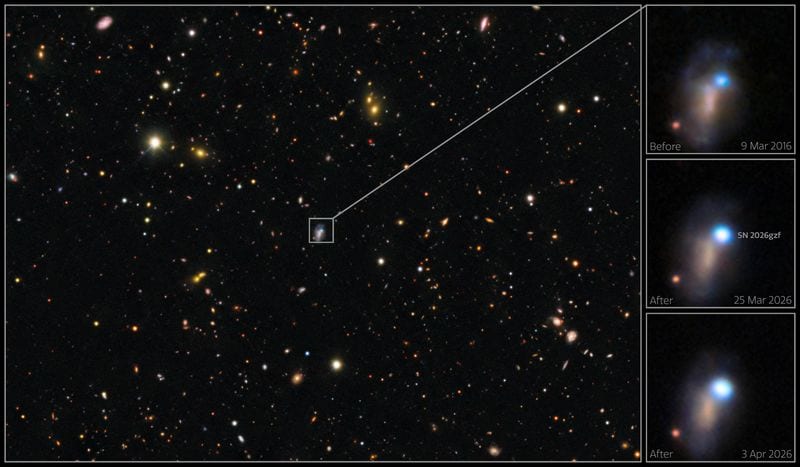
Key facts
- Astronomers observed the entire process of a massive star's death, from shock breakout to supernova.
- The event was detected by China's Einstein Probe space telescope and observed by multiple other facilities.
- The star was approximately 30 times the mass of the sun and was a Wolf-Rayet type.
- The supernova was classified as a broad-lined Type Ic, with ejected material traveling at extreme velocities.
- The observation provided the first instance of this supernova type without a gamma-ray burst, suggesting choked jets.
Astronomers have witnessed the complete lifecycle of a massive star's explosive death, a rare event that offers new insights into stellar evolution. The process began in March when China's Einstein Probe detected a momentary flare of X-rays, known as a shock breakout, caused by a powerful shock wave tearing through the star's surface as it collapsed.
This shock breakout, thought to occur in all supernovae but notoriously difficult to observe due to its brevity, was the first such event witnessed since 2008. Researchers quickly mobilized a fleet of telescopes, including the orbiting Chandra X-ray Observatory and ground-based facilities, to track the supernova for nearly three months. The star, located about 500 million light-years away, was estimated to be around 30 times more massive than the sun and was identified as a Wolf-Rayet star, which had shed its outer layers.
The explosion was classified as a "broad-lined Type Ic" supernova, characterized by stripped outer layers and ejected material moving at more than 10% of the speed of light. While exhibiting many characteristics of powerful stellar explosions associated with gamma-ray bursts, this event showed no evidence of one. Scientists theorize this could be due to a "choked" jet, prevented from escaping the star's surface or dense surrounding material.
This finding is significant as it represents the first observed supernova of its type without a gamma-ray burst, demonstrating that massive stars can die in more ways than previously understood. These extreme cosmic events serve as natural laboratories for astrophysicists to study the laws of physics under conditions of extreme density and temperature that cannot be replicated on Earth.