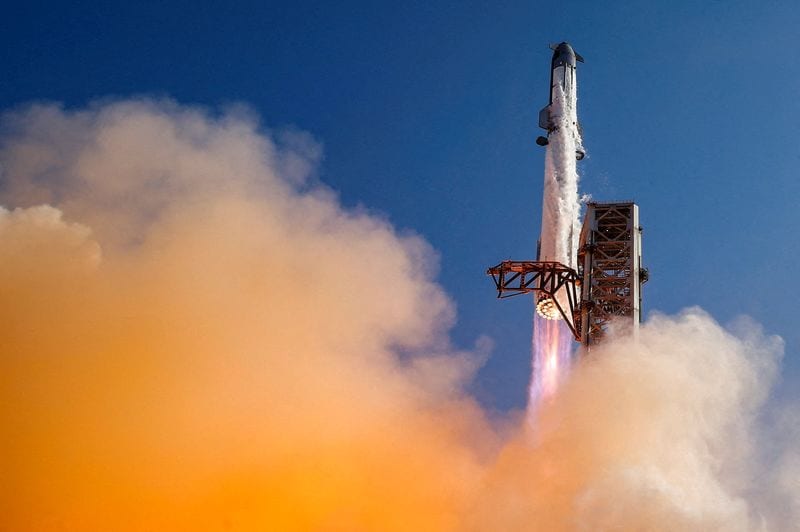
SpaceX aims for its next Starship flight test this month, targeting an August launch. The mission plans to send upgraded Starlink satellites into orbit and, for the first time, attempt to land the rocket's upper stage by catching it with mechanical arms.

This test flight is critical for SpaceX's goal of achieving full reusability for its Starship system, a key step towards expanding its Starlink satellite constellation and enabling future space missions, including NASA's lunar program.
SpaceX is preparing for its next Starship flight test, tentatively scheduled for the end of August, with CEO Elon Musk aiming for a significant advancement in the rocket's development. The upcoming mission, the 14th for the Starship program, will focus on sending the first batch of upgraded V3 Starlink satellites into orbit. Crucially, SpaceX plans to attempt the first-ever land recovery of the Starship upper stage by catching it with mechanical arms attached to the launch tower in Texas.
This maneuver represents a major leap from previous test flights, where the upper stage demonstrated improved landing capabilities over the Indian Ocean. The successful land recovery of the upper stage is vital for SpaceX's objective of creating a fully reusable orbital launch system, which Musk envisions for expanding its Starlink broadband network. NASA is also closely monitoring these developments, as the rocket is slated for use as a lunar lander.
While the Super Heavy booster has been recovered using the tower's arms multiple times, this will be the first attempt to catch the core 'ship' component. The Super Heavy booster is expected to land in the Gulf of Mexico, as it has in recent tests. Musk projected that Starship launch frequency will increase rapidly, potentially reaching at least one flight per day within a year.
The V3 Starlink satellites are designed to deliver ten times the broadband capacity and data density of current generations. SpaceX's strategy involves launching dozens of Starship missions carrying these satellites, with its own satellite launches increasingly dominating its launch schedule as Starlink revenue grows.