All NewsEducationTV
Equities & FundsCrypto & Digital AssetsAI & TechnologyBusiness & CorporateUS Politics & PolicyGeopolitics & Global RiskMacro, Rates & FXCommodities & EnergyEuropean Politics & MarketsAsia-PacificReal Estate & Property
Story archiveAll categories
← All Stories

Spacecom Raises $1.94 Billion for China's Starlink Rival

Created at 18 Aug · 6:26 PM1 source↑ Market-relevant
IN SHORT

Shanghai Spacecom Satellite Technology Ltd. has secured nearly 7 billion yuan ($1.94 billion) in funding, valuing the company at approximately 50.1 billion yuan. This investment supports China's development of a domestic low-Earth-orbit communications constellation aimed at competing with SpaceX's Starlink.

Key Numbers

7 billion yuanSpacecom's new funding amount
$1.94 billionSpacecom's new funding amount in USD
50.1 billion yuanSpacecom's valuation
15 billion yuanAdditional funds Spacecom seeks
$2.2 billionAdditional funds Spacecom seeks in USD
200Spacecom satellites deployed
324Spacecom satellites planned by end of 2026
10 millionChina's target for satellite communication users by 2030
6.7 billion yuanSpacecom's Series A fundraising amount in 2024
20%Maximum stake for new shareholders

Who's Involved

Shanghai Spacecom Satellite Technology Ltd.
Chinese commercial satellite operator raising funds for its SpaceSail constellation
SpaceX
Operator of the Starlink satellite internet constellation
Elon Musk
Owner of SpaceX and Starlink
CDB Manufacturing Transformation and Upgrading Fund
Led Spacecom's Series A fundraising
Shanghai Alliance Investment
Investment arm of the Shanghai municipal government
CAS Capital
Affiliated with the Chinese Academy of Sciences
Zhang Qi
Chairman of Spacecom
Shen Hongbo
Chief Executive of Spacecom
Spacecom Raises $1.94 Billion for China's Starlink Rival

↳ Why This Matters

This development signifies China's strategic push to create a state-controlled satellite internet alternative to Starlink, potentially reshaping global telecommunications infrastructure and geopolitical competition in space-based communication services.

Key facts

  • Shanghai Spacecom Satellite Technology Ltd. raised $1.94 billion in a new funding round.
  • The company is now valued at approximately 50.1 billion yuan.
  • The investment aims to build a Chinese low-Earth-orbit satellite constellation to rival SpaceX's Starlink.
  • Spacecom has deployed 200 satellites and plans to reach 324 by the end of 2026.
  • The fundraising excludes foreign investors, maintaining state control over the project.

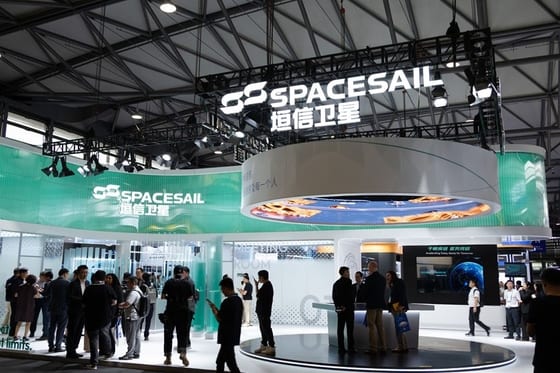
Shanghai Spacecom Satellite Technology Ltd. has secured nearly 7 billion yuan ($1.94 billion) in a new funding round, valuing the company at approximately 50.1 billion yuan. This significant investment fuels China's ambition to establish a domestic low-Earth-orbit communications constellation, branded internationally as SpaceSail and known in China as Qianfan, which aims to rival Elon Musk's Starlink.

The company is seeking an additional 15 billion yuan ($2.2 billion) to accelerate the construction of its SpaceSail constellation. This capital will be used for expanding the satellite network, advancing technology, broadening market reach, and supporting operations. The fundraising strategy deliberately excludes foreign investors, ensuring state control over what Beijing considers critical communications infrastructure, aligning with a broader national security objective.

Spacecom has already deployed 200 satellites into orbit as part of the Qianfan constellation and plans to increase this to 324 by the end of 2026, with a long-term goal of deploying thousands of satellites. The company's strategy includes targeting regions where Starlink has encountered political or regulatory challenges, mirroring the approach of Chinese electric car maker BYD in its market expansion.

While Spacecom is scaling up rapidly, it still lags significantly behind Starlink in terms of scale and commercial development. The company's initial fundraising was led by state-affiliated funds, including the CDB Manufacturing Transformation and Upgrading Fund and Shanghai Alliance Investment, underscoring its close ties to state capital. Leadership roles are held by individuals with extensive experience in state-backed investment and telecommunications operations.

China's Ministry of Industry and Information Technology has set a target of over 10 million satellite communication users by 2030, with direct satellite-to-smartphone services expected to become more prevalent. Spacecom's efforts are a key component of this national strategy to build sovereign satellite communication capabilities amidst growing global demand and intensifying competition.

Frequently asked questions

SpaceSail, also known as Qianfan in Chinese, is a low-Earth-orbit satellite constellation being developed by Shanghai Spacecom Satellite Technology Ltd. to provide broadband internet and communication services globally.

SpaceSail is significantly smaller than Starlink, with hundreds of satellites compared to Starlink's over 10,000. However, Spacecom is rapidly deploying satellites and aims to compete by targeting markets where Starlink faces challenges.

The recent funding round is primarily from Chinese state-backed entities, including the CDB Manufacturing Transformation and Upgrading Fund and Shanghai Alliance Investment. Foreign investment is excluded.

China aims to establish sovereign satellite communication capabilities, reduce reliance on Western infrastructure, and meet growing demand for low-Earth-orbit broadband, with a target of over 10 million users by 2030.

What Happens Next

01Spacecom plans to introduce up to three new investors or investor groups.
02New shareholders will collectively hold no more than 20% of the business.
03Spacecom aims to have 324 satellites in orbit by the end of 2026.
04The company plans for more than 15,000 satellites in the full constellation.

How It Developed

Shanghai Spacecom Satellite Technology Ltd. raised nearly 7 billion yuan ($1.94 billion) in a new funding round.
The company is valued at approximately 50.1 billion yuan.
The funding supports China's effort to build a domestic low-Earth-orbit communications constellation.
Spacecom is seeking up to 15 billion yuan ($2.2 billion) to accelerate its SpaceSail constellation construction.
The fundraising excludes foreign investors, preserving state control.
Spacecom has deployed 200 satellites in its Qianfan constellation.
The company plans to have 324 satellites in orbit by the end of 2026.
SpaceSail is deliberately targeting regions where Starlink has faced political or regulatory issues.

Sources

T1
Spacecom Raises $1.94 billion in Bet on China’s Starlink RivalCaixin Global
T2
What is China's SpaceSail, and could it rival Elon Musk's Starlink?chinastrategy.org
T2
Spacecom seeks billions to expand China's Starlink rivaltheinsight.asia

Related Stories

Velaura AI valued over $1B after $110M funding round
18 Aug · 12:07 PM
AI chip startup Etched doubles valuation to $21 billion
18 Aug · 4:33 PM
Pentagon pressure drives Smack's new funding round, CEO says
17 Aug · 6:44 PM
Pony.ai plans over 4,000 robotaxis in Europe and Middle East
18 Aug · 9:06 AM
CATL Invests $1.46 Billion in AI Data Center Energy Infrastructure
18 Aug · 3:26 PM