All NewsEducationTV
Equities & FundsCrypto & Digital AssetsAI & TechnologyBusiness & CorporateUS Politics & PolicyGeopolitics & Global RiskMacro, Rates & FXCommodities & EnergyEuropean Politics & MarketsAsia-PacificReal Estate & Property
Story archiveAll categories
← All Stories

Radiation-blocking vest tested on Moon mission, shows promise for astronaut safety

Created at 13 Aug · 1:52 PM1 source↑ Market-relevant
IN SHORT

A radiation-blocking vest designed by StemRad was flown to the Moon and back on NASA's Artemis I mission. Data from the flight, combined with simulations, suggests the vest could significantly reduce astronauts' radiation exposure during solar storms.

✉Newsletter

PiQ Daily

Pick your topics. Get only what matters, on your cadence.

Key Numbers

60 percenteffective dose reduction without head protection
5 percentmargin of error in Monte Carlo simulations
40 to 193 dayspotential extension of astronaut career based on NASA's lifetime dose limit
600-millisievertNASA's lifetime dose limit for astronauts

Who's Involved

Jacek Krywko
Author of the article
Jordan Houri
Lead researcher at StemRad
Oren Milstein
CEO of StemRad
NASA
U.S. space agency that conducted the Artemis I mission
Lockheed Martin
Partner in developing the AstroRad vest
DLR
German Aerospace Center, involved in illustration
Radiation-blocking vest tested on Moon mission, shows promise for astronaut safety

↳ Why This Matters

This development offers a potential solution to a critical safety challenge for future long-duration space missions, such as those to the Moon and Mars, by providing astronauts with personal protection against harmful space radiation.

Key facts

  • StemRad's AstroRad radiation-blocking vest was tested on NASA's Artemis I mission.
  • The vest aims to shield astronauts directly, rather than relying solely on spacecraft shielding.
  • Simulations indicate the vest can reduce radiation dose by 40-60% during solar storms.
  • The vest's design focuses on shielding sensitive tissues like bone marrow.
  • The vest utilizes hexagonal rods of high-density polyethylene (HDPE) for flexibility and protection.

A radiation-blocking vest developed by Israeli-American startup StemRad has successfully completed a lunar journey aboard NASA's uncrewed Artemis I mission. The vest, named AstroRad, is designed to protect astronauts from intense solar radiation, a significant challenge for deep-space missions where Earth's protective atmosphere is absent.

StemRad's approach focuses on personal shielding rather than solely relying on heavy spacecraft structures. The vest targets sensitive tissues like bone marrow, which are crucial for blood cell regeneration and survival after high radiation exposure. Engineers utilized high-density polyethylene (HDPE) formed into flexible hexagonal rods to create a garment that offers substantial protection without severely hindering astronaut mobility.

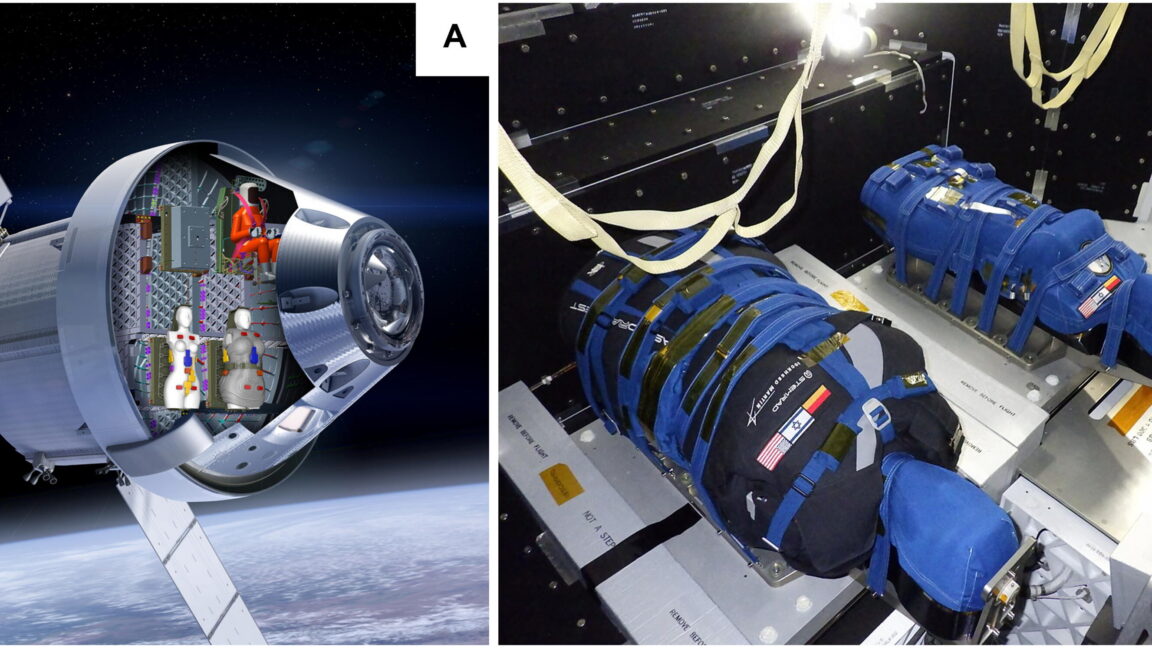
During the Artemis I mission, two torso-like phantoms, Helga and Zohar, were used to test the vest. Zohar wore the AstroRad vest, while Helga served as a control. Thousands of dosimeters tracked radiation exposure, particularly during the passage through the Van Allen radiation belts. Although no solar storm occurred during the mission, the data collected, combined with Monte Carlo simulations, allowed researchers to estimate the vest's effectiveness.

These simulations suggest that the AstroRad vest could reduce an astronaut's effective radiation dose by approximately 40% to 60% during a significant solar event, comparable to the protection offered by the Orion spacecraft's onboard shelter. This level of protection could potentially extend an astronaut's career by adding months to their permissible lifetime radiation exposure. The vest's design allows astronauts to continue performing mission operations, unlike the restrictive nature of a dedicated shelter.

Frequently asked questions

The AstroRad is a wearable radiation-shielding vest developed by StemRad, designed to protect astronauts from harmful space radiation by shielding their bodies directly.

The vest was flown on NASA's uncrewed Artemis I mission around the Moon, worn by a radiation-sensitive phantom torso named Zohar, alongside an unprotected phantom named Helga.

Simulations based on the flight data indicated that the vest could reduce an astronaut's radiation dose by 40-60% during solar storms, comparable to a spacecraft's shelter but allowing continued operation.

Astronauts in deep space lack Earth's atmospheric and magnetic field protection, exposing them to cancer risks and radiation sickness from solar storms.

What Happens Next

01Further testing and validation of the AstroRad vest in simulated or actual crewed missions.
02Integration of the AstroRad vest into astronaut equipment for future lunar and Martian expeditions.

Get the newsletter.

Pick the topics you actually care about. We'll email when there's news worth your time, on the cadence you choose. Cancel any time from your account.

Cadence

How It Developed

StemRad developed a wearable radiation-shielding vest called AstroRad.
The AstroRad vest was flown to the Moon and back aboard NASA's uncrewed Artemis I mission.
Flight data was used to simulate the vest's performance during solar storms.
The vest demonstrated it could reduce effective radiation dose by 40-60% in simulations.
This reduction is comparable to using the spacecraft's onboard storm shelter.

Sources

T1
We’ve flown a radiation-blocking vest to the Moon and back, and it workedArs Technica

Related Stories

Northrop's robotic vehicle to extend satellite lifespan
12 Aug · 9:11 PM
Physicists Find New Evidence for Elusive Glueball Particles
12 Aug · 9:21 PM
AI firms bulk buy rare books, sparking fears of destructive scanning
12 Aug · 3:26 PM
New font aims to poison AI training data by altering web page text
12 Aug · 10:06 PM
Chinese AI missile tracking system achieves over 90% accuracy on stealth fighter signatures
13 Aug · 2:06 PM