All NewsEducationTV
Equities & FundsCrypto & Digital AssetsAI & TechnologyBusiness & CorporateUS Politics & PolicyGeopolitics & Global RiskMacro, Rates & FXCommodities & EnergyEuropean Politics & MarketsAsia-PacificReal Estate & Property
Story archiveAll categories
← All Stories

Physicists Find New Evidence for Elusive Glueball Particles

Created at 12 Aug · 9:21 PM1 source↑ Market-relevant
IN SHORT

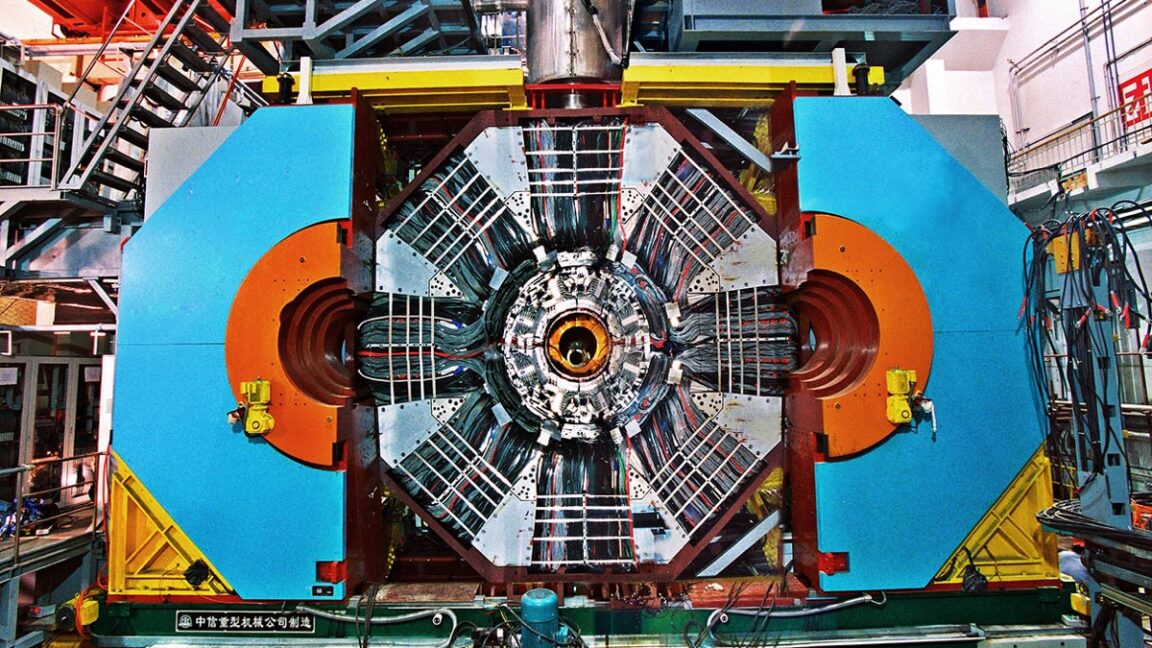
Physicists at the Beijing Spectrometer III experiment have uncovered compelling new evidence for glueballs, composite particles made entirely of gluons predicted by quantum theory. These findings, presented at a recent conference, could help explain the origin of mass in protons and neutrons.

✉Newsletter

PiQ Daily

Pick your topics. Get only what matters, on your cadence.

Key Numbers

2012year Higgs boson discovered
1974year J/ψ particle discovered

Who's Involved

Beijing Spectrometer III (BES III) experiment
physicists who uncovered new evidence for glueballs
Matthew Francis
author who wrote about glueballs and mass
Ethan Siegel
astrophysicist who outlined glueball properties
Physicists Find New Evidence for Elusive Glueball Particles

↳ Why This Matters

The discovery of glueballs would provide crucial experimental validation for quantum chromodynamics and offer a deeper understanding of how matter acquires mass, a fundamental question in particle physics.

Key facts

  • Physicists with the Beijing Spectrometer III (BES III) experiment have found new evidence for glueballs.
  • Glueballs are composite particles predicted by quantum theory, made entirely of gluons.
  • Gluons are the carriers of the strong nuclear force that bind quarks together.
  • Most of the mass of protons and neutrons comes from the energy of the gluons holding them together.
  • A potential glueball must have zero spin, no electric charge, and odd parity.

Physicists working with the Beijing Spectrometer III (BES III) experiment have announced compelling new evidence for the existence of glueballs, theoretical composite particles composed solely of gluons. These particles are a direct prediction of quantum chromodynamics, the theory governing the strong nuclear force.

Gluons are fundamental to the structure of matter, acting as the force carriers that bind quarks into protons and neutrons. While the Higgs boson explains how fundamental particles acquire mass, a significant portion of the mass of protons and neutrons originates from the immense energy of the gluons binding them together, as described by Einstein's E=mc².

The search for glueballs has long focused on the decay of J/ψ particles, discovered in 1974. These mesons, composed of a charm quark and antiquark, decay into numerous gluons and other hadrons, providing a fertile ground for detecting glueball signatures. According to astrophysicist Ethan Siegel, specific properties such as zero spin, no electric charge, and odd parity are considered indicators of a potential glueball.

Frequently asked questions

A glueball is a theoretical composite particle made entirely of gluons, the carriers of the strong nuclear force, predicted by quantum chromodynamics.

Glueballs are thought to contribute significantly to the mass of protons and neutrons, helping to explain a fundamental aspect of matter.

Potential glueballs must exhibit properties such as zero spin, no electric charge, and odd parity.

Researchers have been searching for glueball signatures in the decay products of J/ψ particles.

What Happens Next

01Further peer review of the preprint results is expected.
02Additional experimental verification may be sought by other research groups.

Get the newsletter.

Pick the topics you actually care about. We'll email when there's news worth your time, on the cadence you choose. Cancel any time from your account.

Cadence

How It Developed

Physicists have uncovered new evidence for glueballs, composite particles made of gluons.
The findings were presented at the International Conference on High Energy Physics (ICHEP).
Glueballs are predicted by quantum chromodynamics and are thought to contribute to the mass of protons and neutrons.

Sources

T1
Have physicists finally discovered glueballs? New evidence points to yes.var abtest_2167163 = new ABTest(2167163, 'impression');Ars Technica

Related Stories

China's glueball 'triumph'; SpaceX rocket debris caught on video
12 Aug · 7:36 AM
New font aims to poison AI training data by altering web page text
12 Aug · 10:06 PM
AI firms bulk buy rare books, sparking fears of destructive scanning
12 Aug · 3:26 PM
DEF CON attendees suspected of spoofing Delta flight Wi-Fi
12 Aug · 12:15 AM
AI Used to Discover Critical Zoom Vulnerabilities in One Day
12 Aug · 1:46 PM