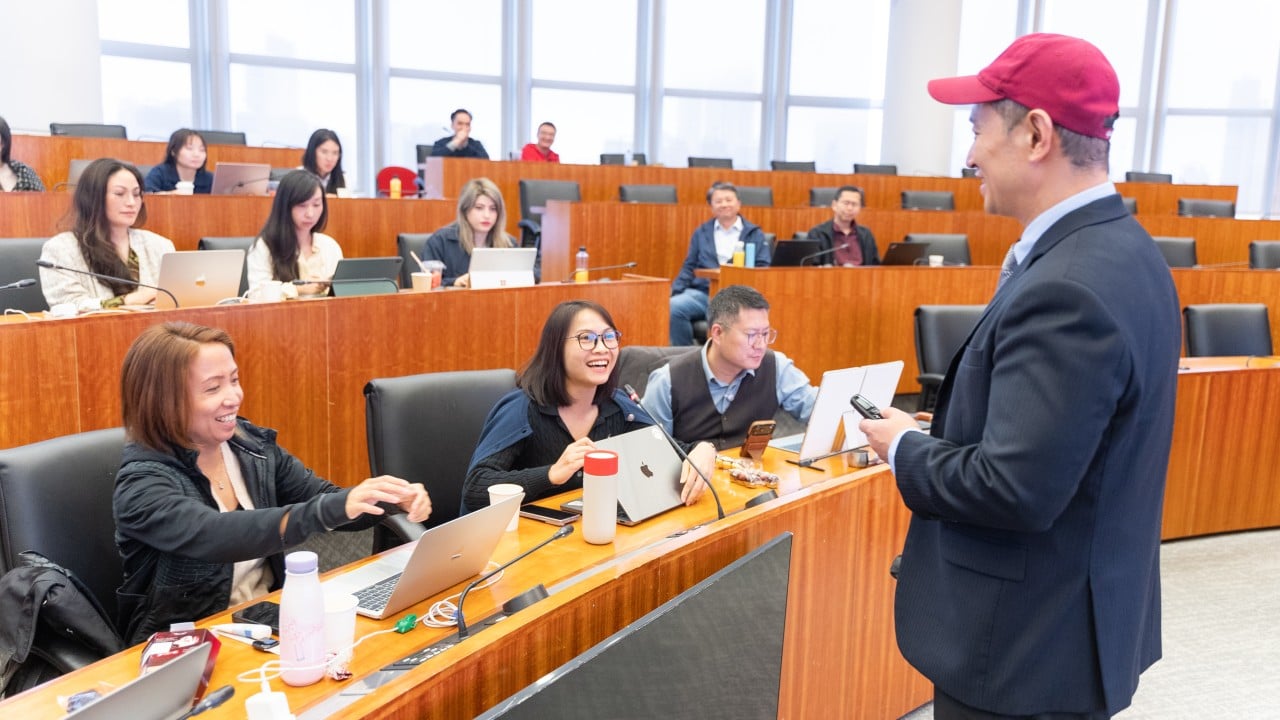
The Hong Kong Polytechnic University's Business School has introduced a Doctor of Business Artificial Intelligence (DBAI) program, aiming to bridge the gap in AI strategic leadership for senior professionals. The program is designed to move executives beyond simply using AI tools to developing AI-native business strategies, integrating the technology into core operations, organizational culture, and governance.
According to Prof Michael Xu, the program director, many companies struggle with AI transformation despite having AI pilots, lacking strategic deployment and board-level AI judgment. The DBAI program addresses this by combining taught modules, residential workshops, and a substantial applied thesis component, encouraging participants to define real business problems and evaluate measurable outcomes.
John Li, a cybersecurity executive and DBAI student, highlighted the necessity of deep AI understanding to remain competitive. He noted that AI transformation is not solely a technical issue but also strategic, organizational, governance, human, and leadership-related. The program emphasizes treating AI as part of the enterprise's core operating system rather than an add-on.
Students undertake industry-based projects, with examples including the development of virtual avatars for teaching and customer service, and AI-driven cybersecurity simulations. Prof Xu pointed out that AI does not necessarily lead to massive layoffs but necessitates a shift in skills and talent requirements. He cited an example of a media organization that achieved significant growth after introducing AI automation and retraining staff.
The launch coincides with increased Hong Kong government investment in AI education and training. Prof Xu views the DBAI as crucial for developing senior decision-makers who can translate AI capabilities into sector-level transformation, essential for Hong Kong to become an AI hub. The program attracts students from mainland China, Singapore, and Belt and Road countries, fostering diverse perspectives and potential collaborations.
Attention is also given to agentic AI, with leaders needing to design workflows, manage data access, and establish accountability. Risks such as cybersecurity, data leakage, and biased decisions are acknowledged. The program suggests that AI could lead to flatter organizational structures and the rise of 'one-person companies' or departments, empowered by AI agents, necessitating a redesign of teams around AI and empowering high-judgment staff.
Participants have access to computing facilities, including government-backed GPU resources. While acknowledging AI's potential for mistakes and hallucinations, Prof Xu stressed the leader's role in managing risks within controllable, auditable, and ethical limits, moving from AI awareness to AI-native execution to build high-value service capabilities in finance and professional services.