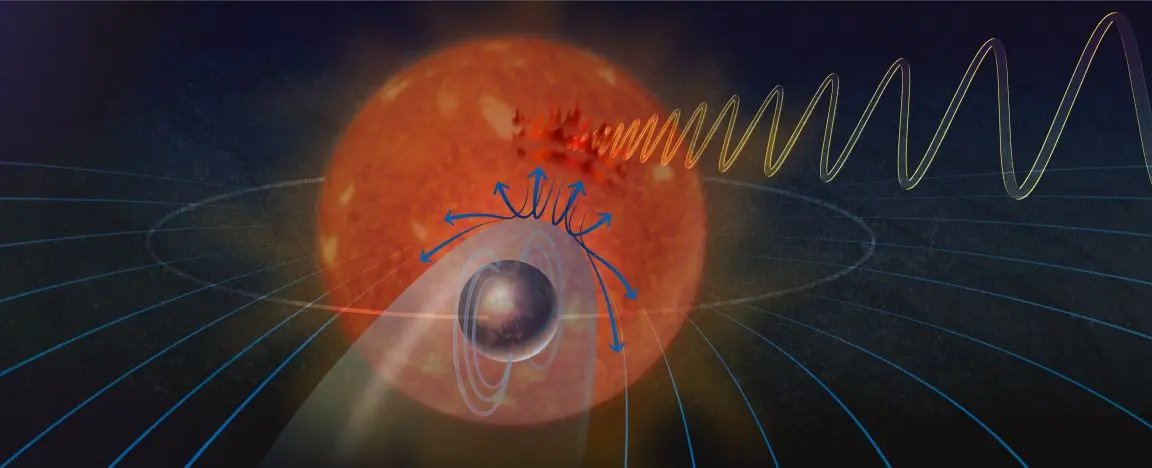
Researchers have identified a unique exoplanet system, GJ 436, where the planet orbits its star so closely that their magnetic fields are believed to connect. This interaction causes periodic brightening of the star's chromosphere, a layer near its exterior. The study, published in Science, analyzed years of observational data focusing on emissions from hydrogen and calcium ions.
The team found that the star's chromosphere brightens with a period related to the planet's 2.6-day orbit. This brightening is not constant, however, appearing only at intermediate levels of the star's activity cycle. Researchers theorize that during periods of high stellar activity, the planet's signal is overwhelmed, while during low activity, there isn't enough energy for the magnetic interactions to produce a noticeable effect.
A theoretical model suggests that loops of magnetic field connect the planet and star to generate the observed energy in the chromosphere. This model allowed researchers to estimate the planet's magnetic field strength at a minimum of 6 Gauss, which is over ten times that of Earth's, comparable to Jupiter's. The researchers noted that while this is the most comprehensive study of magnetic-driven flaring in an exosolar system, further examination of other close-in planet systems could make exoplanet magnetic field measurements commonplace.