Key facts
- A new infrared imaging system translates infrared light into full-color visible images.
- The system uses mercury telluride colloidal quantum dots and a dual-layer OLED.
- It encodes both the wavelength and intensity of infrared light into color.
- A prototype eyeglass weighs 23 grams and displays color-coded infrared images.
- The technology has shown potential for driving biological visual systems and for visual prosthetics.
Human eyes are unable to perceive infrared light because the photons do not carry enough energy to activate the light-sensing cells in the retina. While devices exist to visualize infrared, they typically translate it into monochrome shades of green, using brightness to indicate temperature. This approach underutilizes the human eye's superior ability to distinguish subtle color differences.
A team at the Beijing Institute of Technology, led by Xin Tang and Ge Mu, has developed a novel infrared imaging system that addresses this limitation. Their device translates different infrared wavelengths into distinct colors within the visible spectrum, offering a more naturalistic visual representation. This is achieved by combining mercury telluride colloidal quantum dots, which absorb infrared light, with a dual-layer OLED display that converts this energy into visible color.
The quantum dots are crucial because their small size creates discrete energy levels. Photons of varying infrared wavelengths and intensities excite different electronic transitions within these dots, generating charge carriers. Longer wavelengths and lower intensities excite fewer transitions, while shorter wavelengths and higher intensities trigger more, including the potential for multiple electron-hole pairs per photon. This variable output is then fed to the OLED.
The dual-layer OLED features a red-emitting phosphor layer and a cyan-emitting phosphor layer, separated by an energy barrier. When a small number of charge carriers arrive, they are captured by the red layer, producing a red glow. As the number of carriers increases (due to shorter wavelengths or higher intensity), they overcome the energy barrier and activate the cyan layer, resulting in a mixture of red and cyan light. This color shift is directly tied to the carrier number, encoding both the wavelength and intensity of the incoming infrared light, allowing for distinctions in infrared power approximately 200 times smaller than monochrome systems.
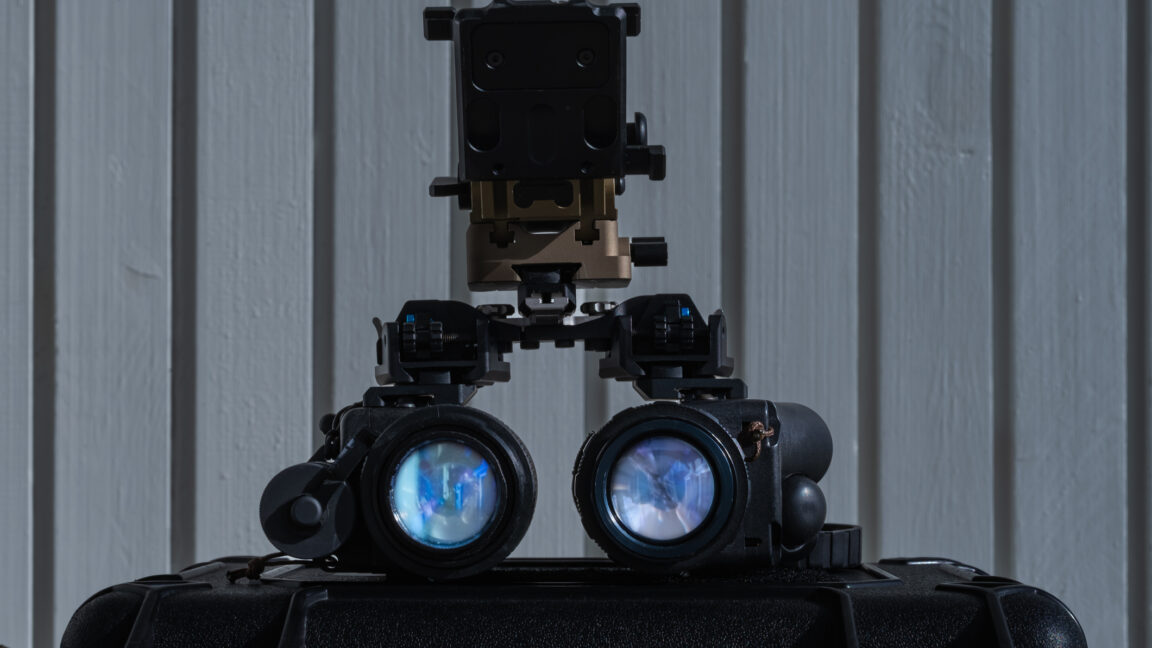
The researchers have demonstrated a prototype IR-vision eyeglass, weighing just 23 grams, which projects sharp, color-coded infrared images. This device can operate in an augmented-reality mode, overlaying infrared information onto normal sight, or in an immersive infrared-only mode. Furthermore, the team has shown that the upconverted infrared light can drive biological systems, triggering photocurrents in cells engineered to respond to light and producing measurable electroencephalogram and electroretinogram responses in mice and human volunteers, respectively.