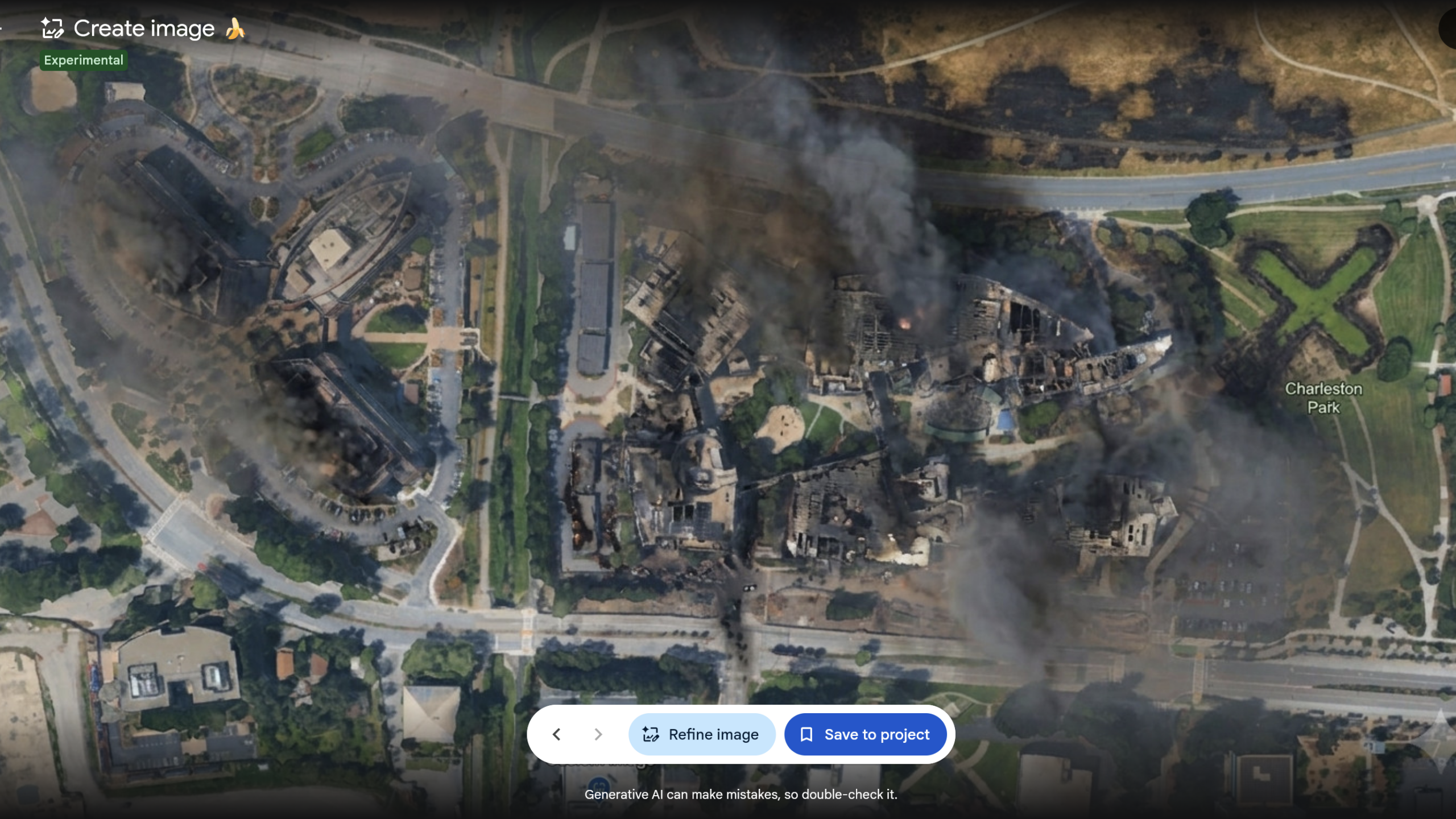
Google briefly allowed users to create AI-modified versions of satellite imagery within Google Earth using its Nano Banana 2 technology. The feature, launched on July 30, 2026, enabled users to generate custom scenes based on real-world locations, such as transforming ruins into historical views or placing planned buildings onto empty lots.
However, the tool quickly drew criticism from researchers and open-source intelligence experts who highlighted its potential for generating and spreading misinformation and disinformation. They demonstrated how easily convincing fake scenarios, like refugee columns or disaster scenes, could be overlaid onto Google Earth's authentic satellite imagery. Eliot Higgins of Bellingcat and independent investigator Henk van Ess were among those who voiced strong concerns, sharing examples of potential misuse.
Google acknowledged the backlash, stating that while geospatial professionals found useful applications, others shared screenshots violating its policies. The company announced on July 31, 2026, that it was rolling back the feature to implement stronger safeguards. The "create image" button was subsequently removed from Google Earth, with the company indicating it would not return until these protections were in place.