All NewsEducationTV
Equities & FundsCrypto & Digital AssetsAI & TechnologyBusiness & CorporateUS Politics & PolicyGeopolitics & Global RiskMacro, Rates & FXCommodities & EnergyEuropean Politics & MarketsAsia-PacificReal Estate & Property
Story archiveAll categories
← All Stories

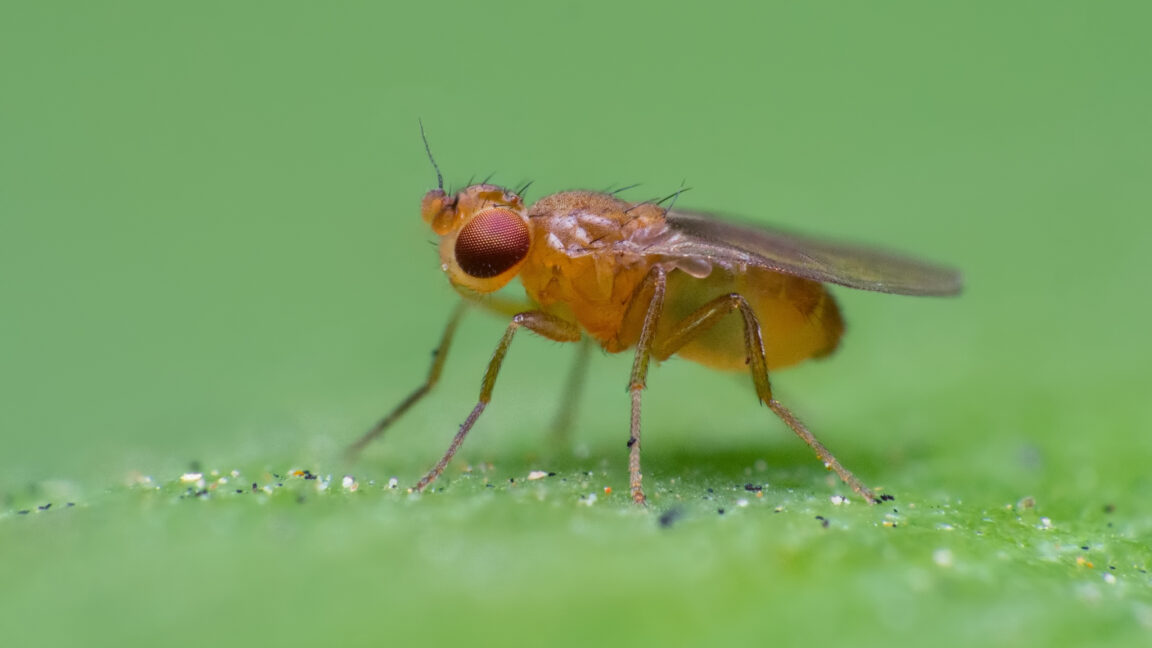
Fruit flies use advanced memory for olfactory navigation, not simple reflexes

Created at 1 Aug · 10:32 AM1 source↑ Market-relevant
IN SHORT

New research reveals fruit flies employ sophisticated olfactory memories and an "edge tracking" strategy, rather than simple reflexes, to navigate turbulent air currents and locate scent sources. Scientists used a virtual reality system to precisely control odor exposure and observed flies' complex navigation behaviors.

✉Newsletter

PiQ Daily

Pick your topics. Get only what matters, on your cadence.

Key Numbers

50 millimeterswidth of straight odor corridor tested
660-nanometerwavelength of red light used in experiments

Who's Involved

Vanessa Ruta
Neuroscientist at Rockefeller University leading the research
Drosophila
Fruit fly species used in the study
Fruit flies use advanced memory for olfactory navigation, not simple reflexes

↳ Why This Matters

This research fundamentally changes our understanding of insect navigation, revealing a level of cognitive complexity in fruit flies previously underestimated. It suggests that even small brains can support sophisticated memory-based strategies for survival, with implications for understanding biological computation and potentially inspiring new AI navigation algorithms.

Key facts

  • Fruit flies navigate by smell using an "edge tracking" strategy, not simple reflexes.
  • A virtual reality system allowed researchers to precisely control odor plumes and fly behavior.
  • Flies maintain orientation using a neural compass and update stored memories of scent locations.
  • The research challenges the long-held "surge and cast" model of insect olfactory navigation.

Fruit flies navigate complex olfactory landscapes by employing a sophisticated memory-based strategy rather than simple reflexes, according to new research led by Vanessa Ruta at Rockefeller University. Previously, scientists believed insects used a "surge and cast" model, involving flying upwind until a scent disappeared and then searching side-to-side. However, Ruta's team developed a unique experimental setup using a fly-sized treadmill in complete darkness. This system allowed researchers to precisely control odor delivery and simulate lifelike olfactory experiences, enabling them to observe the flies' behavior in detail.

In experiments with a straight corridor of apple cider vinegar, flies did not fly directly up the middle. Instead, they engaged in "edge tracking," hugging the boundary of the scent plume. Upon crossing into the odor, they would briefly turn back out into clean air before returning to the edge. This behavior occurred even when the odor concentration decreased along the direction of travel, ruling out simple gradient climbing.

Further investigation revealed that flies possess stored olfactory memories. When a plume vanished, the flies continued to head towards where the scent should have been, indicating they were guided by an internal map. Neurons in the central complex acted as a compass, maintaining the fly's orientation to the wind, while neurons in the fan-shaped body encoded memories of the plume's edge position. Silencing these neurons impaired the flies' ability to navigate. The research also demonstrated that flies could rapidly update these olfactory memories when the direction of the scent plume was altered, reinforcing the idea of a dynamic, memory-driven navigation system.

Frequently asked questions

Previously, scientists believed fruit flies used a "surge and cast" model, relying on hardwired reflexes to fly upwind and then search side-to-side for scent plumes.

They used a fly-sized treadmill where flies walked on a ball, steering a nozzle that delivered controlled odor streams, simulating a virtual olfactory landscape.

Edge tracking is the behavior observed where flies navigate along the boundary of a scent plume, briefly entering it to make progress towards the source.

Flies appear to store memories of scent locations, allowing them to navigate towards where a plume should be even when it is not currently detectable.

What Happens Next

01Further research may explore how these olfactory memories are formed and consolidated.
02The findings could inform the development of bio-inspired AI navigation systems.

Get the newsletter.

Pick the topics you actually care about. We'll email when there's news worth your time, on the cadence you choose. Cancel any time from your account.

Cadence

How It Developed

Scientists previously believed insects used a "surge and cast" reflex model for olfactory navigation.
Vanessa Ruta's team designed a fly-sized treadmill to precisely control odor exposure in a virtual environment.
Flies were observed to "edge track" scent plumes, moving along the boundary and briefly entering it to progress.
This edge tracking behavior persisted even when odor gradients were reversed.
Genetically engineered flies tracked edges of light plumes similarly, demonstrating a sensory-independent navigation strategy.
Flies demonstrated stored olfactory memories, heading to where a plume should be even when it vanished.
Neurons in the central complex acted as a compass, maintaining orientation to the wind.
Neurons in the fan-shaped body encoded olfactory memories, marking the intended destination.

Sources

T1
How fruit flies chase invisible ribbons of smell to get to their sourceArs Technica

Related Stories

Infrared imaging system translates heat into full-color vision
31 Jul · 6:06 PM
Ghost lineage in Africa left its mark on human DNA
31 Jul · 10:21 PM
Smallest.ai raises $13M for human-like voice AI
31 Jul · 3:06 PM
Sam Altman's ChatGPT Prompt Helps Non-Coder Build Website
1 Aug · 8:26 AM
Samsung: AI chip shortage to worsen through 2027, last until 2028
31 Jul · 4:06 PM