HomeEverythingEducation
Equities & FundsCrypto & Digital AssetsAI & TechnologyBusiness & CorporateUS Politics & PolicyGeopolitics & Global RiskMacro, Rates & FXCommodities & EnergyEuropean Politics & MarketsAsia-PacificReal Estate & Property
← All Stories

Dragonfly flight patterns inspire new drone navigation

Created at 7 Jul · 4:05 PM1 source↑ Market-relevant
IN SHORT

Research into male dragonflies' territorial "dogfights" reveals simple rules for maintaining tactical position, mirroring fighter pilot tactics. This could inform the development of smarter, vision-guided drones.

✉Newsletter

PiQ Daily

Pick your topics. Get only what matters, on your cadence.

Key Numbers

102paired male-on-male flight trajectories reconstructed
9prey-intercept trajectories reconstructed

Who's Involved

Samuel T. Fabian et al.
authors of the study published in the Journal of the Royal Society Interface
Dragonfly flight patterns inspire new drone navigation

↳ Why This Matters

Understanding the fundamental rules governing dragonfly territorial combat could lead to advancements in drone technology, enabling more agile and autonomous navigation systems inspired by natural behaviors.

Key facts

  • Male dragonflies engage in territorial "dogfights" using distinct maneuvers from prey hunting.
  • Research indicates simple rules, such as maintaining tactical position, govern these territorial flights.
  • The study utilized stereovideography to reconstruct 3D flight paths of dragonflies.
  • Findings suggest potential applications in developing autonomous drones with vision-based navigation.

Male dragonflies exhibit distinct aerial maneuvers when defending their breeding territories compared to when hunting prey, according to new research published in the Journal of the Royal Society Interface. The study suggests that these territorial "dogfights" are driven by relatively simple rules focused on maintaining a tactical position, a strategy that mirrors that of human fighter pilots. This insight could pave the way for the development of more sophisticated drones capable of navigation using simple, vision-based guidance systems, rather than relying on complex computational methods.

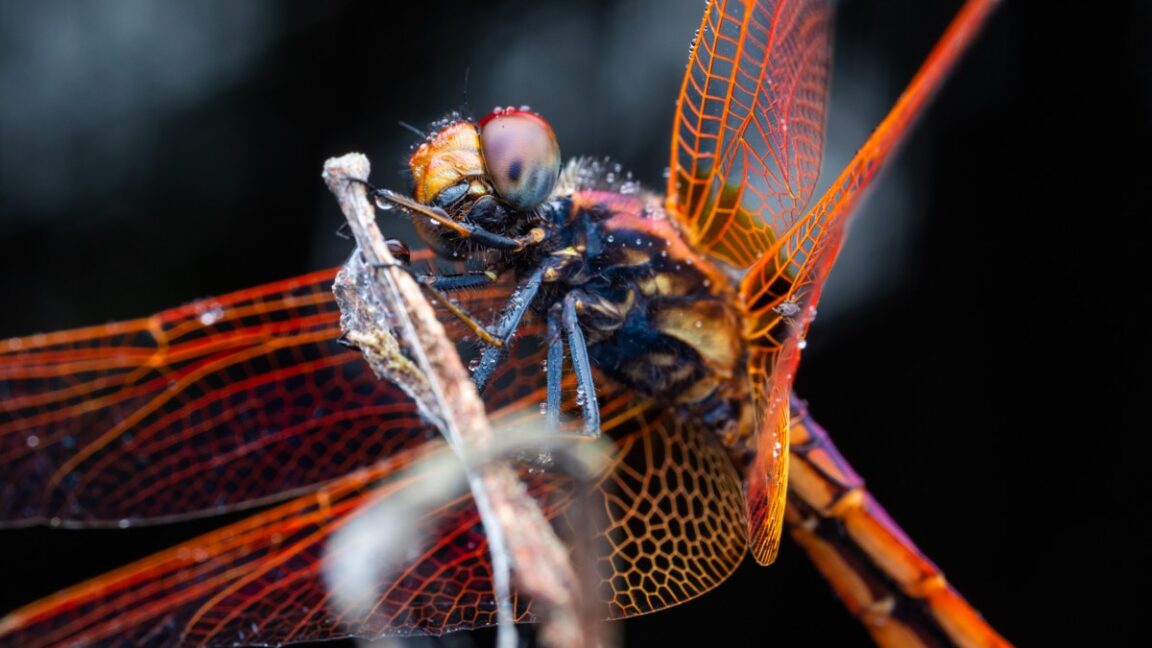
Unlike prey pursuits, which involve an asymmetric chaser-evader dynamic, male-on-male territorial interactions are characterized as mutual pursuits. Researchers chose the Trithemis Aurora species for its fiercely territorial males and ease of tracking due to their crimson coloration. Prior studies often relied on basic visual observations or single-camera recordings, but this research employed a portable stereovideographic rig with synchronized cameras to capture detailed 3D kinematics of 102 male-on-male flight trajectories and nine prey-intercept trajectories for comparison.

The analysis revealed significant differences in flight behavior. During territorial disputes, dragonflies displayed more convoluted flight paths and were often viewed against backgrounds of foliage or the ground, contrasting with prey hunting where they typically approached from below, silhouetting the prey against the sky.

Frequently asked questions

The study focused on the Trithemis Aurora species, known for its fiercely territorial males.

Researchers used a portable stereovideographic rig with two synchronized cameras to record and reconstruct 3D flight trajectories.

The findings could lead to the development of smarter drones capable of vision-based guidance, mimicking the simple rules observed in dragonfly territorial defense.

What Happens Next

01Development of new drone navigation systems based on these findings.

Get the newsletter.

Pick the topics you actually care about. We'll email when there's news worth your time, on the cadence you choose. Cancel any time from your account.

Cadence

How It Developed

Male dragonflies use different maneuvers for territorial defense than for hunting prey.
New research suggests simple rules, like maintaining tactical position, drive territorial flight behavior.
The study analyzed flight trajectories of Trithemis Aurora dragonflies using stereovideography.
Researchers reconstructed 102 paired male-on-male flight trajectories and nine prey-intercept trajectories.
Analysis showed convoluted trajectories in territorial disputes, often against foliage or ground.
Findings could lead to smarter drones with vision-based guidance.

Sources

T1
Dragonflies maneuver like fighter pilotsvar abtest_2161873 = new ABTest(2161873, 'impression');Ars Technica

Related Stories

Katalyst's Link satellite launched to rescue NASA's Swift observatory
6 Jul · 5:20 PM
AI-Generated Soldiers Flood Social Media Feeds
7 Jul · 9:10 AM
Anthropic accused of secret user tracking in China
6 Jul · 4:50 PM
Amazon's Project Kuiper faces launch delays as new rockets falter
7 Jul · 11:20 AM
Can China repeat its EV success with robotaxis?
6 Jul · 10:20 PM