All NewsEducationTV
Equities & FundsCrypto & Digital AssetsAI & TechnologyBusiness & CorporateUS Politics & PolicyGeopolitics & Global RiskMacro, Rates & FXCommodities & EnergyEuropean Politics & MarketsAsia-PacificReal Estate & Property
Story archiveAll categories
← All Stories

D-Wave tests entanglement on dual-rail qubits

Created at 5 Aug · 4:41 PM1 source↑ Market-relevant
IN SHORT

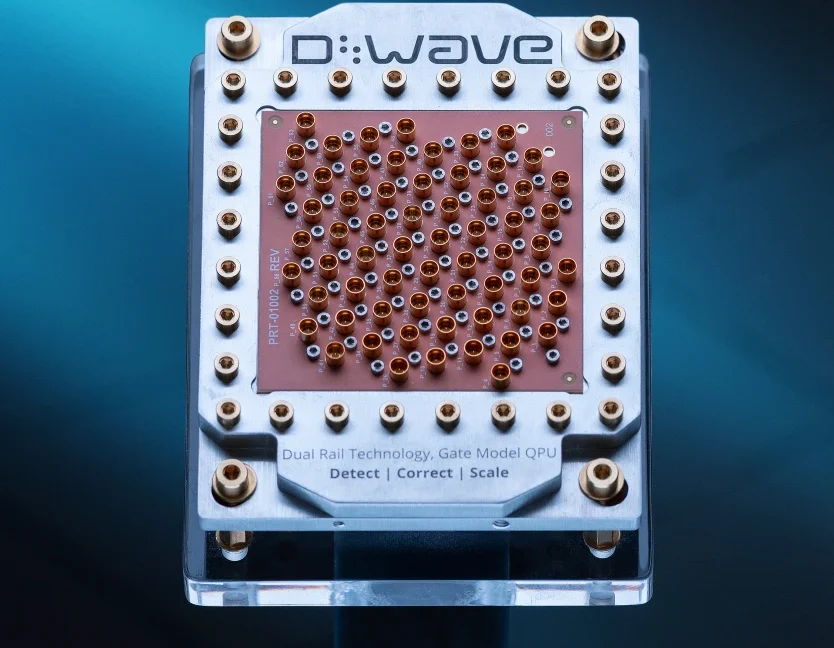
D-Wave has published research demonstrating entanglement of two dual-rail qubits, a key step in validating the technology for future quantum computers. The dual-rail qubit design aims to simplify error detection and correction.

✉Newsletter

PiQ Daily

Pick your topics. Get only what matters, on your cadence.

Key Numbers

500 nsentanglement operation time
200 nstime for qubit interaction during entanglement
0.5%photon loss rate per entanglement
10−6bit-flip error rate
181dual-rail qubits planned by 2028

Who's Involved

D-Wave
Quantum computing company testing dual-rail qubit technology
Trevor Lanting
D-Wave executive discussing dual-rail qubit research
D-Wave tests entanglement on dual-rail qubits

↳ Why This Matters

This development is significant as it demonstrates a key step in validating a novel qubit technology that promises to simplify error correction in quantum computers, potentially accelerating the path to practical quantum computation.

Key facts

  • D-Wave has demonstrated entanglement of two dual-rail qubits.
  • The dual-rail qubit technology simplifies error detection by making photon loss the most common error.
  • This error hierarchy is preserved during entangling operations, according to new research.
  • The company aims to use this technology to build more efficient quantum computers.
  • D-Wave plans to have 181 dual-rail qubits by 2028.
  • D-Wave, known for its quantum annealers, is advancing its work on gate-based quantum hardware by validating its dual-rail qubit technology. The company has published research in Nature demonstrating that two of these qubits can be entangled while maintaining their advantageous error detection properties. Dual-rail qubits, which utilize linked resonators, are designed such that the most common error is photon loss, easily detectable as an erasure. This simplified error hierarchy, with phase flips as the next most common error and bit flips being rare, is expected to streamline error correction, potentially reducing the hardware overhead for creating logical qubits.

    The research shows that entangling two dual-rail qubits can be achieved rapidly, within approximately 500 nanoseconds, and crucially, preserves the error hierarchy observed in single-qubit operations. Photon loss remained the dominant error, occurring at a rate of about 0.5 percent per entanglement, while bit-flip errors were found to be nearly non-existent. D-Wave plans to scale this technology, aiming for 181 dual-rail qubits by 2028, which could enable more efficient pathways to useful quantum computation.

    Frequently asked questions

    A dual-rail qubit is a type of qubit technology that depends on two linked resonators, left and right. A single photon in the system can exist in a superposition of being in either the left or right resonator, forming the basis of the qubit.

    The primary advantage is that the most common error, photon loss, is easily detectable as an erasure. This simplifies error correction compared to other qubit designs.

    The research demonstrated that two dual-rail qubits can be entangled without disrupting their error hierarchy, meaning photon loss remains the dominant error type.

    D-Wave plans to develop techniques for mid-circuit erasure detection and aims to have 181 dual-rail qubits by 2028, with the ultimate goal of building quantum computers with over a hundred logical qubits.

    What Happens Next

    01D-Wave plans to implement mid-circuit erasure detection techniques.
    02The company aims to reach 181 dual-rail qubits by 2028.
    03Further testing will focus on error detection theory for large error class differences.
    04D-Wave will work on linking enough hardware to host over a hundred logical qubits.
    Get the newsletter.

    Pick the topics you actually care about. We'll email when there's news worth your time, on the cadence you choose. Cancel any time from your account.

    Cadence

    How It Developed

    D-Wave is developing gate-based quantum hardware using fluxonium qubits.
    The company acquired Quantum Circuits, which developed dual-rail qubits.
    D-Wave published a paper in Nature detailing a step in validating dual-rail technology.
    The paper shows two dual-rail qubits can be entangled without altering their error detection properties.
    The dual-rail qubit design relies on two linked resonators, left and right.
    A single photon in the system can be in a superposition of both resonators, forming a qubit.
    The most common error in dual-rail qubits is photon loss, easily detected as an erasure.
    Phase flips are the next most common error, with bit flips being a distant third.

    Sources

    T1
    D-Wave on rails: Company tests entanglement on its dual-rail qubitsvar abtest_2166211 = new ABTest(2166211, 'impression');Ars Technica

    Related Stories

    EVgo to build Tesla Superchargers under license in US
    5 Aug · 5:06 PM
    Anthropic builds AI chip design team amid rising demand
    5 Aug · 2:36 PM
    Dark Matter CEO Vikas Rao on AI-first strategy and mortgage tech
    5 Aug · 10:06 AM
    Waymo opens Dallas robotaxi service to all residents
    4 Aug · 5:41 PM
    Google AI Leadership Shakeup: DeepMind Chief Shifts to Chief Scientist Role
    5 Aug · 4:04 PM