HomeEverything
Equities & FundsCrypto & Digital AssetsAI & TechnologyBusiness & CorporateUS Politics & PolicyGeopolitics & Global RiskMacro, Rates & FXCommodities & EnergyEuropean Politics & MarketsAsia-PacificReal Estate & Property
← All Stories

Artificial cells divide for several generations in lab experiment

Created at 2 Jul · 4:25 PM1 source↑ Market-relevant
IN SHORT

Researchers have developed artificial cells, dubbed SpudCells, that can feed, grow, and divide for a few generations. This system, while highly engineered, offers a new model for studying the origin of life and minimalistic cellular functions.

✉Newsletter

PiQ Daily

Pick your topics. Get only what matters, on your cadence.

Key Numbers

five generationsmaximum SpudCell divisions
90,000 basesSpudCell genome size
sevencircular DNA molecules in SpudCell genome

Who's Involved

Kate Adamala
Lead researcher at the University of Minnesota
University of Minnesota
Institution where the SpudCell research was conducted
Phi29 virus
Source of DNA copying proteins used in SpudCells
T7 virus
Source of RNA polymerase for SpudCells
University of Tokyo
Developed the purification system for translation proteins
Artificial cells divide for several generations in lab experiment

↳ Why This Matters

This development provides a novel experimental model for understanding how early life might have emerged, specifically addressing the challenge of how primitive cells maintained their internal environment and replicated. It opens new avenues for research into the fundamental requirements for life and the evolution of cellular complexity.

Key facts

  • Researchers have created artificial cells, named SpudCells, capable of self-division.
  • These SpudCells can import nutrients and replicate their genetic material.
  • The system relies on viral proteins and externally supplied translation machinery.
  • SpudCells can undergo several generations of division before genetic material is lost.
  • The research provides a model for studying the origin of life and minimal cellular functions.

Researchers at the University of Minnesota have developed artificial cells, termed SpudCells, that can perform a few rounds of cell division. These SpudCells are designed to enclose genetic material and continuously import necessary materials from their environment, addressing a key challenge in understanding the origin of life.

The system utilizes genetic components derived from viruses. For instance, the DNA replication mechanism is adapted from the Phi29 bacteriophage, and the RNA production system is based on the T7 virus. The translation machinery, responsible for converting RNA into proteins, was supplied externally by purifying the necessary proteins. The SpudCells' genome consists of approximately 90,000 bases spread across seven circular DNA molecules.

A significant limitation is the random distribution of these DNA molecules during division, leading to the loss of genetic material over successive generations. The SpudCells did not survive beyond five generations due to this issue. To facilitate feeding, the cells were engineered with a gene for a pore protein, allowing small molecules and ions to diffuse in. Larger components, like the translation machinery, were delivered through membrane fusion, a process facilitated by a tagged pore protein.

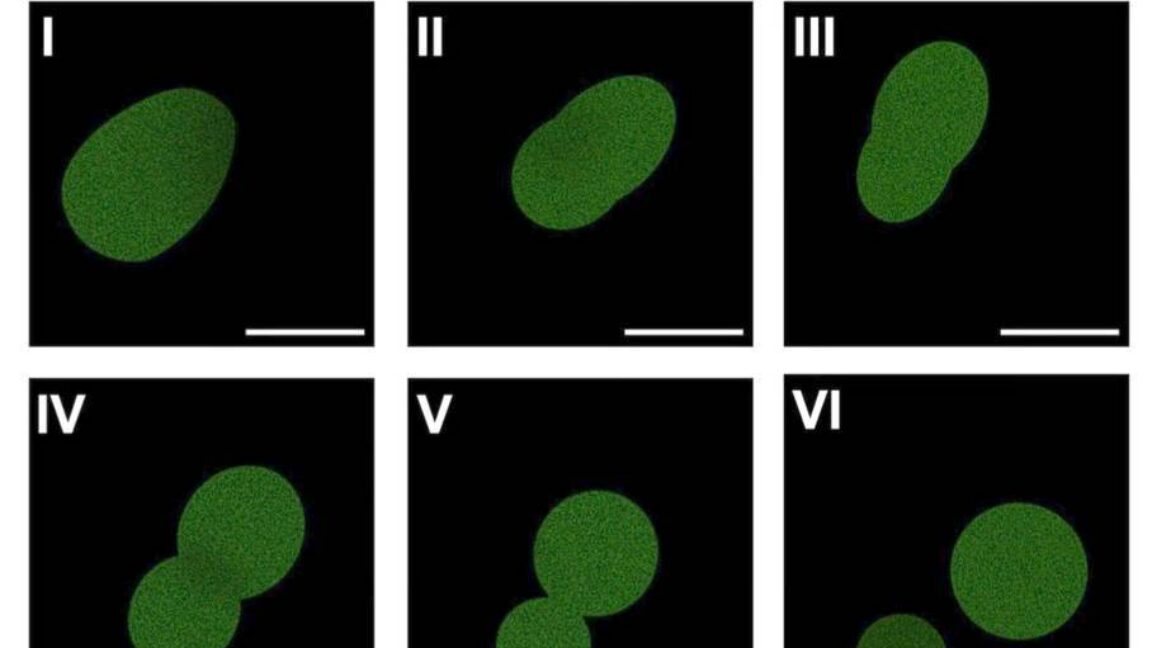
Cell division was initially induced mechanically but later achieved by adding chemicals that caused pore proteins to clump, leading to membrane budding. This process, though random, approximates cell division. The researchers demonstrated that natural selection could operate on these artificial cells by altering the pore protein levels, leading to faster growth in nutrient-limited conditions.

While the SpudCells are highly engineered and not a direct replica of early life, they offer a valuable analog for studying the origin of life and exploring minimalistic cellular systems. Future research could focus on improving genetic material distribution during division and developing more sophisticated pore proteins.

Frequently asked questions

SpudCells are artificial cells developed in a lab that can enclose genetic material, import nutrients, and undergo a few rounds of division.

Division is induced by chemicals that cause pore proteins to clump, altering the cell membrane's shape and leading to budding, though this process is random.

A major limitation is the random distribution of genetic material during division, causing loss of genome components and preventing survival beyond five generations.

It offers a new experimental model to study the origin of life, particularly how early cells might have maintained their internal environment and replicated.

What Happens Next

01Further research to improve genetic material distribution during cell division.
02Exploration of selection pressures on pore protein evolution.
03Development of more sophisticated artificial cell systems.

Get the newsletter.

Pick the topics you actually care about. We'll email when there's news worth your time, on the cadence you choose. Cancel any time from your account.

Cadence

How It Developed

Researchers developed artificial cells called SpudCells that can enclose genetic material.
SpudCells can import new materials and divide, producing a few generations of offspring.
The system uses proteins derived from viruses for DNA copying and RNA production.
Translation machinery was supplied externally to the SpudCells.
Pore proteins were engineered into the SpudCell genome to allow import of small molecules.
Larger materials were fed to SpudCells via membrane fusion.
Cell division was induced by chemicals that clump pore proteins, altering membrane shape.
SpudCells were lost after five generations due to random genome distribution.

Sources

T1
Artificial cell manages a few rounds of cell divisionvar abtest_2161710 = new ABTest(2161710, 'impression');Ars Technica

Related Stories

NASA chief praises Blue Origin progress after launch failure
1 Jul · 8:05 PM
T-Mobile sues Broadcom over VMware support for thousands of virtual machines
1 Jul · 9:25 PM
NASA's Artemis IV Moon mission faces delays as New Glenn rocket development lags
2 Jul · 4:55 PM
SpaceX reportedly developing AI device prototype
1 Jul · 7:20 PM
UN experts warn AI control window closing, risking wider inequality
2 Jul · 10:35 AM