HomeEverythingEducation
Equities & FundsCrypto & Digital AssetsAI & TechnologyBusiness & CorporateUS Politics & PolicyGeopolitics & Global RiskMacro, Rates & FXCommodities & EnergyEuropean Politics & MarketsAsia-PacificReal Estate & Property
Story archiveAll categories
← All Stories

An orbiting disco ball gave Einstein’s theory its most precise test yet

Created at 10 Jul · 4:16 PM1 source↑ Market-relevant
IN SHORT

A satellite designed to minimize non-gravitational forces has provided the most accurate measurement of Earth's frame-dragging effect, confirming Einstein's general theory of relativity with unprecedented precision.

✉Newsletter

PiQ Daily

Pick your topics. Get only what matters, on your cadence.

Key Numbers

0.2 percentuncertainty in frame-dragging measurement
1918year Lense-Thirring effect was modeled
40 centimetersLARES-2 diameter
294.8 kilosLARES-2 mass
12,265 kilometersLARES-2 orbital altitude
1 millimeterpositioning accuracy
200,000laser observations
180 degreessupplementary orbital inclinations
1,050-dayprecession cycle duration
61.3 milliarcseconds per yearmeasured spacetime twisting
one to two parts per thousandmargin of error

Who's Involved

Albert Einstein
whose general theory of relativity was tested
Lense-Thirring effect
phenomenon of frame dragging predicted by theory
Ignazio Ciufolini
physicist leading the research team
Wuhan Institute of Physics and Mathematics
institution where Ciufolini works
LARES-2
disco globe satellite used in the experiment
Italian Space Agency
developer of the LARES-2 satellite
John Archibald Wheeler
physicist who collaborated on the solution
LAGEOS
NASA satellite used in synchrony with LARES-2
An orbiting disco ball gave Einstein’s theory its most precise test yet

↳ Why This Matters

This experiment provides the most accurate confirmation to date of Einstein's theory of general relativity, a cornerstone of modern physics. It also helps to constrain alternative theories and offers potential new insights into Earth's gravitational field and tidal forces.

Key facts

  • A satellite called LARES-2 was used to measure Earth's frame-dragging effect.
  • The experiment achieved an uncertainty of just 0.2 percent in measuring the Lense-Thirring effect.
  • LARES-2's design minimized non-gravitational forces like photon pressure.
  • The experiment utilized two satellites, LARES-2 and LAGEOS, in supplementary orbits to cancel out Newtonian perturbations.
  • The measurement confirmed Einstein's general theory of relativity and placed limits on alternative theories like Chern-Simons theory.

Scientists have conducted the most precise test to date of Albert Einstein's general theory of relativity, specifically the phenomenon known as frame dragging or the Lense-Thirring effect. This effect predicts that a rotating mass, like the Earth, twists the fabric of space-time around it. Measuring this effect on Earth has been historically challenging due to the planet's relatively small mass and slow rotation compared to celestial bodies like black holes.

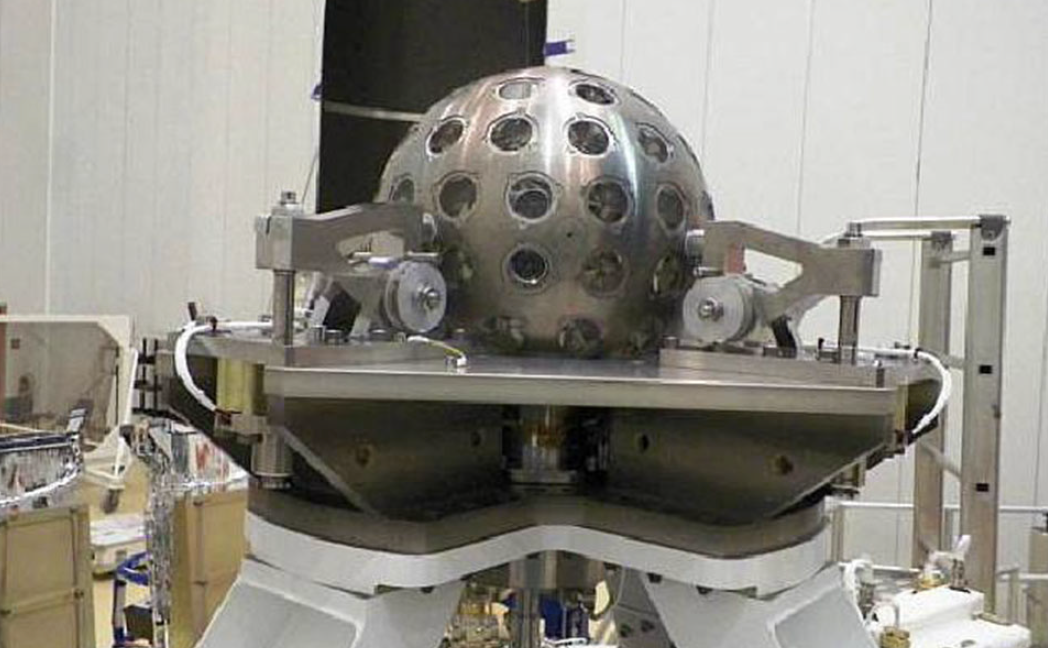
The research team, led by physicist Ignazio Ciufolini, utilized the LARES-2 satellite, developed by the Italian Space Agency. This satellite, resembling a disco ball, is a dense sphere designed to minimize non-gravitational forces, such as those from photons. Its low area-to-mass ratio and lack of propulsion or electronics make its motion primarily governed by gravitational fields, acting as a precise 'test particle'.

To achieve unprecedented accuracy, the team employed a dual-satellite strategy. LARES-2 was paired with NASA's LAGEOS satellite, launched in 1976. By using two satellites in supplementary orbits with inclinations summing to 180 degrees, the researchers could cancel out Newtonian perturbations caused by Earth's equatorial bulge. This cancellation allowed the subtle frame-dragging signal to emerge.

Further challenges included accounting for lunisolar tides, gravitational disturbances from the Moon and Sun that modulate Earth's gravitational field. The team collected data over a full 1,050-day precession cycle, enabling them to average out and remove these tidal effects. After meticulous data processing, they measured a steady drift in the satellites' orbits of approximately 61.3 milliarcseconds per year, which is the signature of spacetime twisting.

The measured value closely aligns with Einstein's predictions, with a tiny margin of error of one to two parts per thousand. Beyond confirming general relativity, the study also places significant constraints on alternative theories, such as Chern-Simons theory, by narrowing the range of its predicted frame-dragging magnitudes. As a bonus, the experiment yielded a more precise measurement of the K1 lunisolar tide's strength, offering potential new insights for earth science.

Frequently asked questions

Frame dragging, or the Lense-Thirring effect, is a phenomenon predicted by Einstein's general theory of relativity where a rotating mass drags the fabric of space-time around with it.

The LARES-2 satellite is a dense sphere with a low area-to-mass ratio, minimizing non-gravitational forces like photon pressure, which allows its motion to be governed almost entirely by gravity.

By using two satellites, LARES-2 and LAGEOS, in supplementary orbits with inclinations summing to 180 degrees, the Newtonian perturbations from Earth's equatorial bulge were canceled out.

The precise measurement of frame dragging places significant limits on the variations predicted by alternative theories like Chern-Simons theory, narrowing its potential scope.

What Happens Next

01Further analysis of the data may yield more precise measurements of Earth's gravitational field.
02The findings could inspire new experiments to test gravitational theories in different regimes.

Get the newsletter.

Pick the topics you actually care about. We'll email when there's news worth your time, on the cadence you choose. Cancel any time from your account.

Cadence

How It Developed

Albert Einstein's general theory of relativity predicts that a rotating mass like Earth drags space-time.
This phenomenon, known as frame dragging or the Lense-Thirring effect, is more significant around larger masses.
Measuring Earth's frame dragging has been challenging due to its relatively small mass and slow rotation compared to black holes.
A team led by Ignazio Ciufolini reports the most accurate measurement of the terrestrial Lense-Thirring effect to date.
The experiment used the LARES-2 satellite, a dense sphere with a low area-to-mass ratio, to minimize non-gravitational forces.
LARES-2 was placed in orbit at an altitude of roughly 12,265 kilometers by a Vega-C rocket in July 2022.
Researchers used ground-based lasers and retroreflectors on LARES-2 to pinpoint its position with millimeter accuracy.
Approximately 200,000 observations from July 2022 to June 2025 formed the dataset.

Sources

T1
An orbiting disco ball gave Einstein’s theory its most precise test yetvar abtest_2162483 = new ABTest(2162483, 'impression');Ars Technica

Related Stories

NASA Releases Draft Planning Document for Private Space Stations
10 Jul · 3:21 PM
OpenAI's ChatGPT Work aims to automate complex tasks for hours
9 Jul · 9:30 PM
Rocket Report: RFA One launch set for August; Isar Aerospace to build Canadian launch site
10 Jul · 11:05 AM
Humanoid robots perform world-first surgery on pigs under surgeon control
9 Jul · 8:16 PM
Galaxy Digital Pivots to AI Infrastructure, Secures $1.4B Debt Facility
10 Jul · 2:36 PM