HomeEverythingEducation
Equities & FundsCrypto & Digital AssetsAI & TechnologyBusiness & CorporateUS Politics & PolicyGeopolitics & Global RiskMacro, Rates & FXCommodities & EnergyEuropean Politics & MarketsAsia-PacificReal Estate & Property
Story archiveAll categories
← All Stories

Humanoid robots perform world-first surgery on pigs under surgeon control

Created at 9 Jul · 8:16 PM1 source↑ Market-relevant
IN SHORT

Humanoid robots have successfully removed gallbladders from live pigs in a preclinical trial, marking a world-first in surgical procedures. Surgeons remotely controlled the robots, demonstrating a potential future for expanding access to specialized surgical care.

✉Newsletter

PiQ Daily

Pick your topics. Get only what matters, on your cadence.

Key Numbers

$13,500starting price for baseline Unitree G1 robot
$67,000cost for upgraded Unitree G1 robot with dexterous hands
5-feetheight of Unitree humanoid robots
60 poundsweight of Unitree humanoid robots
$0.5M - $3Mcost range for specialized surgical robots like da Vinci
1,800 poundsweight of specialized surgical robots
450 millimetersarm span of Unitree G1 robot
1.6 - 1.8 metersarm span range for adult humans
150 millisecondsideal latency for surgical robots

Who's Involved

Shanglei Liu
Assistant Professor of Surgery at UC San Diego School of Medicine
Michael Yip
Professor of Electrical and Computing Engineering at UC San Diego
Unitree
Chinese robotics company that manufactures the G1 humanoid robot
Intuitive Surgical
Manufacturer of the da Vinci Surgical System
UC San Diego
Institution that conducted the preclinical trial
Humanoid robots perform world-first surgery on pigs under surgeon control

↳ Why This Matters

This research demonstrates a novel application of humanoid robots in surgery, potentially democratizing access to advanced medical procedures by offering a more affordable and deployable alternative to current specialized robotic systems, especially in underserved or remote locations.

Key facts

  • Humanoid robots have performed minimally invasive surgeries on live pigs.
  • Surgeons remotely controlled the robots, removing gallbladders in a preclinical trial.
  • The Unitree G1 robot, significantly cheaper than specialized surgical robots, was used.
  • Researchers developed custom adapters and software to enable robot-assisted surgery.
  • The experimental surgeries took longer than current specialized systems due to recalibration.

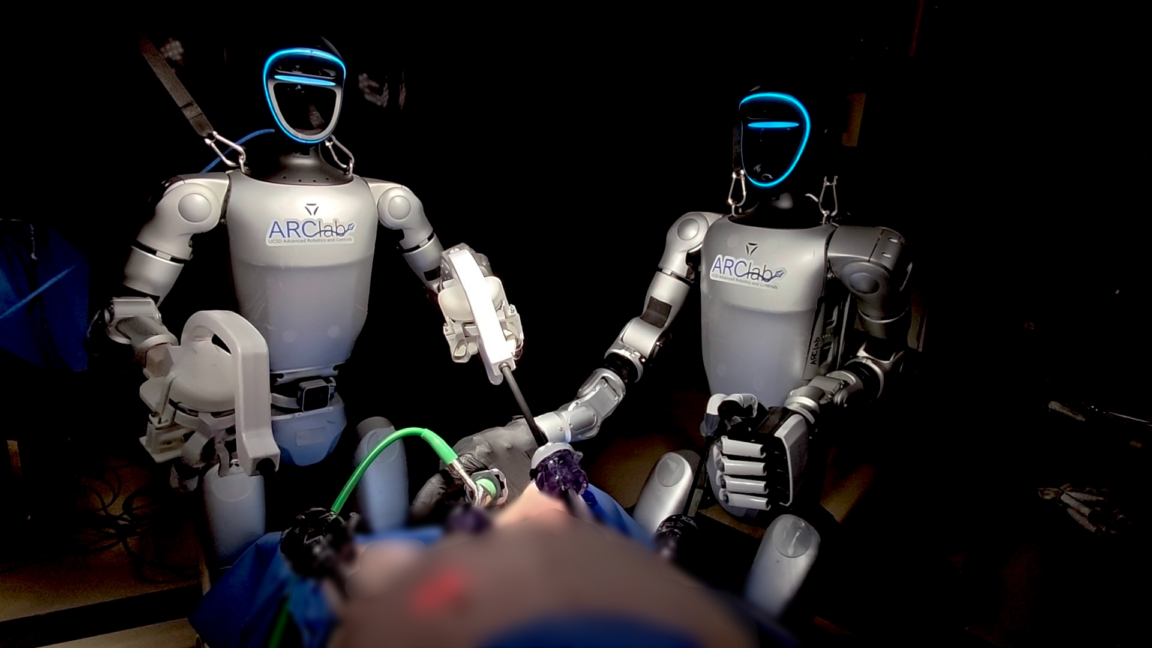
Humanoid robots have successfully performed minimally invasive surgeries on live pigs, removing gallbladders in a world-first preclinical trial. Surgeons remotely controlled the robots, demonstrating a potential future for expanding access to specialized surgical care in areas lacking resources.

The experiment utilized Unitree's G1 humanoid robot, which is significantly cheaper and more compact than existing specialized surgical systems like Intuitive Surgical's da Vinci. Researchers developed custom adapters and software to allow surgeons to intuitively control the robots' surgical instruments through hand motions. A stereo headset display and foot pedal were used for control, with one surgery involving a human assistant and another using two robots.

Despite the success, the teleoperated humanoid robots are still in the experimental phase. The surgeries took longer than with current systems due to the need for frequent recalibration and physical repositioning of the robots. Limitations in the robots' reach and range of motion, combined with latency issues, increased the workload for the surgical team. The researchers aim to develop these robots into autonomous surgical assistants capable of performing general tasks alongside human surgeons.

Frequently asked questions

Humanoid robots, controlled by surgeons, successfully removed gallbladders from live pigs in a world-first preclinical surgical trial.

The humanoid robots are significantly cheaper and more compact, making them potentially more accessible for smaller hospitals or remote areas, though they are still experimental and took longer to perform surgeries.

The surgeries took longer due to recalibration needs, and the robots have limitations in reach, range of motion, and latency, which can increase the workload for surgeons.

The researchers aim to develop these robots into autonomous surgical assistants that can work alongside human surgeons and potentially expand access to critical surgeries worldwide.

What Happens Next

01Further improvements to the teleoperated humanoid robot system are planned.
02Researchers are exploring the development of autonomous surgical assistants.
03The team aims to make the system clinically ready for human patients.

Get the newsletter.

Pick the topics you actually care about. We'll email when there's news worth your time, on the cadence you choose. Cancel any time from your account.

Cadence

How It Developed

Humanoid robots were used to perform minimally invasive surgeries on live pigs.
Surgeons remotely controlled the robots, removing gallbladders in a preclinical trial.
The Unitree G1 humanoid robot, costing under $70,000 with upgrades, was utilized.
Researchers developed adapters and software for intuitive control of surgical tools.
The surgeries took longer than with existing specialized systems due to recalibration needs.
The team aims to develop autonomous surgical assistants for tasks like fetching tools.

Sources

T1
Humanoid robots controlled by surgeons did world-first operation on live pigsvar abtest_2162474 = new ABTest(2162474, 'impression');Ars Technica

Related Stories

Mitsubishi Motors to produce humanoid robots for auto factories
9 Jul · 3:25 PM
Impulse Space developing kick stage for military launch competition
9 Jul · 1:15 PM
Biomni AI Agent Generates Biomedical Hypotheses From Data
9 Jul · 6:05 PM
Japan to test launch reusable rocket prototype
9 Jul · 8:50 PM
Uber embeds AI engineers in business units to build agents
9 Jul · 3:35 PM