Key facts
- Amazon has hundreds of built satellites waiting for launch into its low-Earth orbit constellation.
- Arianespace is a key partner, having completed two launches this year with more scheduled.
- Delays plague new rockets from Blue Origin (New Glenn) and ULA (Vulcan), which have yet to launch Amazon satellites.
- A recent test firing of Blue Origin's New Glenn rocket resulted in its destruction and damage to its launch pad.
- Amazon plans to begin commercial service for its constellation later this year despite launch delays.
Amazon is experiencing a significant bottleneck in launching its Project Kuiper satellites, with hundreds of flight-ready units awaiting deployment into orbit. The company's vice president of Leo Production Operations, Steve Metayer, stated that while satellite manufacturing is proceeding rapidly, launch availability is the limiting factor.
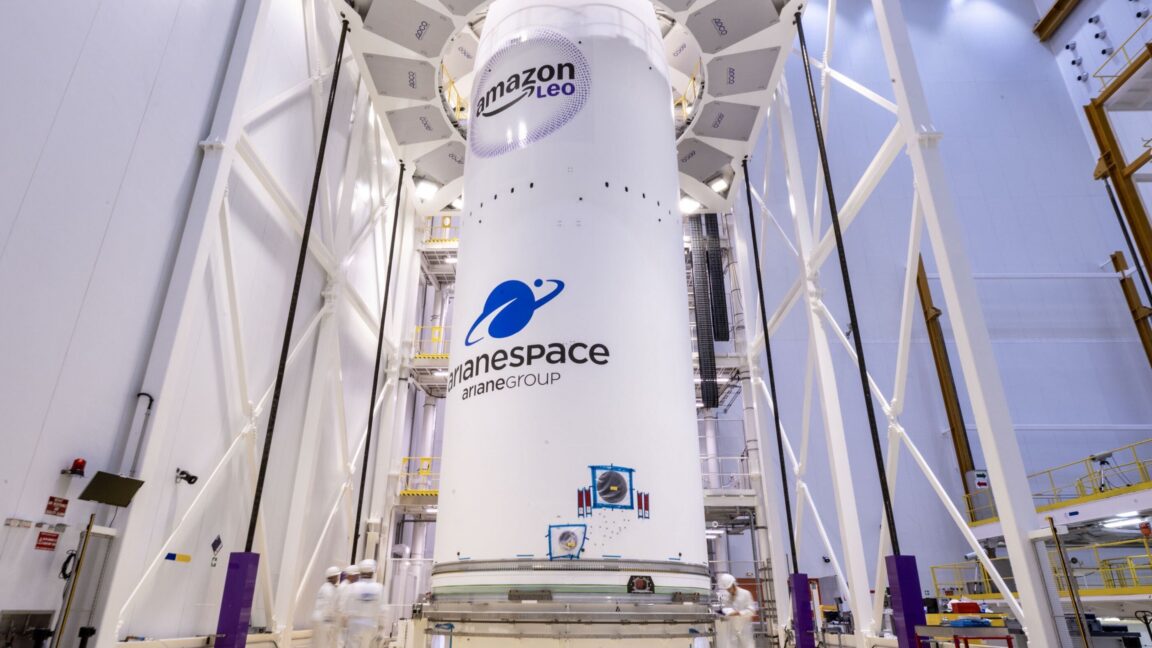
Arianespace has emerged as a reliable partner, having already conducted two launches this year and with another scheduled for Wednesday, carrying three dozen Amazon satellites. However, Amazon's plans are heavily reliant on new rockets from Blue Origin (New Glenn) and United Launch Alliance (Vulcan), neither of which has yet launched Amazon satellites. This reliance is compounded by recent setbacks, including an explosion during a test firing of Blue Origin's New Glenn rocket in late May, which destroyed the vehicle and damaged its launch pad. Industry observers estimate it could take 12 to 18 months to repair the launch pad. Furthermore, concerns exist regarding the BE-4 rocket engine, which powers both New Glenn and Vulcan, potentially complicating return-to-flight efforts for both.
Despite these challenges, Amazon remains on track to begin commercial service for its constellation later this year. Metayer indicated that the New Glenn rocket accounts for less than a quarter of Amazon's booked launches, and the company is actively seeking opportunities to increase its launch capacity through a diversified portfolio. The first Vulcan launch carrying Amazon satellites is tentatively slated for the late third quarter of this year.