South Korean Assembly to Vote on Prosecution Reform Bill Amid Filibuster | PiQ Markets
3 storiesUS Politics & PolicyUS Congress: House of Representatives & Senate
South Korean Assembly to Vote on Prosecution Reform Bill Amid Filibuster
window 24h
IN SHORT
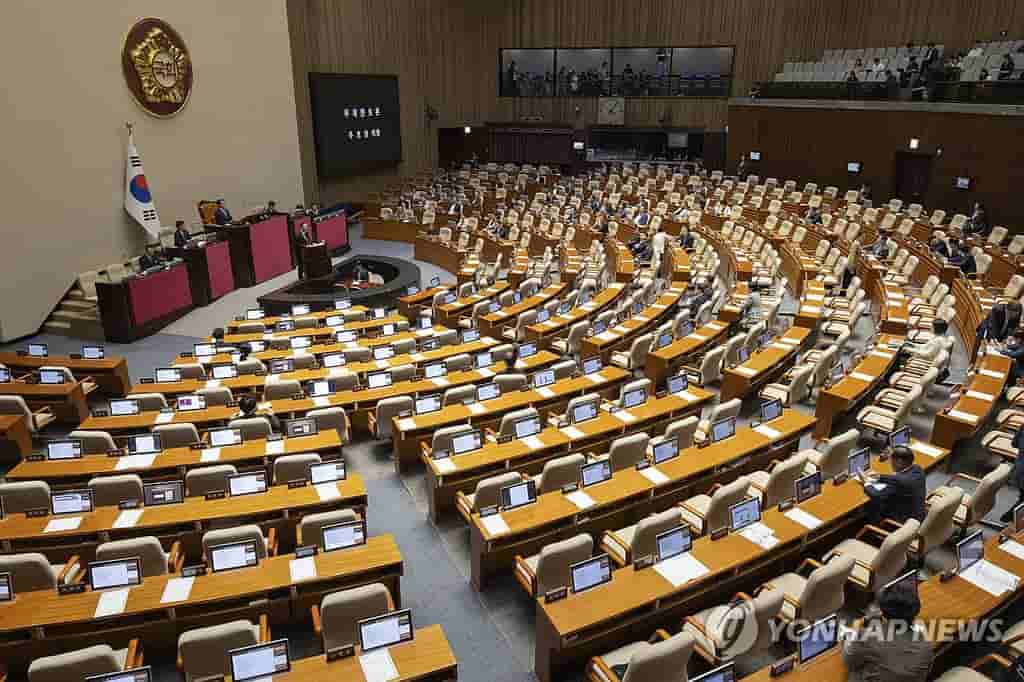
South Korea's National Assembly is poised to vote on a contentious prosecution reform bill that aims to limit the investigative authority of prosecutors. An opposition filibuster against the bill is approaching its 24-hour mark, with the ruling Democratic Party anticipating its conclusion to pass the legislation. Separately, concerns have arisen regarding potential manipulation of election data in Gyeonggi Province following the June 3 local elections, with investigations into ballot shortages possibly expanding. In a different development, former Korea Football Association president Chung Mong-gyu and ex-national team coach Hong Myung-bo were questioned in a parliamentary hearing about management issues and the national team's World Cup performance, with a focus on KFA transparency.
✉Newsletter
PiQ Daily
Pick your topics. Get only what matters, on your cadence.
Who's Involved
South Korea's National Assembly
legislative body set to vote on prosecution reform bill
Democratic Party
ruling party in South Korea's National Assembly
Gyeonggi Province
region in South Korea where election data manipulation is suspected
Korea Football Association (KFA)
governing body for football in South Korea
Chung Mong-gyu
former president of the Korea Football Association
Hong Myung-bo
ex-national team coach of South Korea
1 / 3
Key facts
South Korea's National Assembly is set to vote on a prosecution reform bill.
The bill aims to strip prosecutors of direct investigative powers.
An opposition filibuster against the bill is nearing 24 hours.
The ruling Democratic Party expects to end the filibuster and pass the bill.
Concerns about election data manipulation have emerged in Gyeonggi Province.
Patterns suggesting manipulation of voter turnout rates were observed during the June 3 local elections.
The investigation into ballot shortages may expand due to data manipulation suspicions.
Former KFA president Chung Mong-gyu was questioned in a parliamentary hearing.
Ex-national team coach Hong Myung-bo was questioned in a parliamentary hearing.
The parliamentary hearing focused on KFA management issues, World Cup performance, transparency, and governance.
South Korea's National Assembly is preparing for a vote on a significant prosecution reform bill that seeks to curtail the direct investigative powers of prosecutors. The bill has faced strong opposition, leading to a filibuster that is nearing its 24-hour duration. The ruling Democratic Party anticipates ending this filibuster and proceeding with the passage of the legislation. This reform aims to fundamentally alter the balance of power between investigative bodies and the prosecution service.
In parallel, allegations of election data manipulation have surfaced in Gyeonggi Province, South Korea. Reports suggest that patterns indicating the manipulation of voter turnout rates during the June 3 local elections have been observed across various polling stations. This development could lead to an expansion of the ongoing investigation, which initially focused on ballot shortages.
Furthermore, a parliamentary hearing has taken place involving prominent figures from the Korean football community. Former Korea Football Association (KFA) president Chung Mong-gyu and ex-national team coach Hong Myung-bo were questioned by lawmakers. The hearing addressed management issues within the KFA and the national team's performance in the World Cup. A key focus of the questioning was on improving transparency and governance within the football association.
↳ Why This Matters
South Korea's National Assembly is preparing for a vote on a significant prosecution reform bill that seeks to curtail the direct investigative powers of prosecutors. The bill has faced strong opposition, leading to a filibuster that is nearing its 24-hour duration. The ruling Democratic Party anticipates ending this filibuster and proceeding with the passage of the legislation. This reform aims to fundamentally alter the balance of power between investigative bodies and the prosecution service.
Frequently asked questions
The bill aims to strip the prosecution of its direct investigative powers and dismantle the current prosecution system, creating two new agencies for investigations and indictments.
A filibuster is a tactic used by the opposition to delay or block a vote on a bill by speaking for an extended period. It can be ended if three-fifths of parliament members vote to do so.
At least three-fifths of all parliament members, which equates to 180 lawmakers, must vote to end the filibuster.
What Happens Next
01The National Assembly is expected to vote on the prosecution reform bill.
02The PPP plans to filibuster a separate bill to shorten legislative review periods.
03The second bill is expected to be voted on next month.
Get the newsletter.
Pick the topics you actually care about. We'll email when there's news worth your time, on the cadence you choose. Cancel any time from your account.