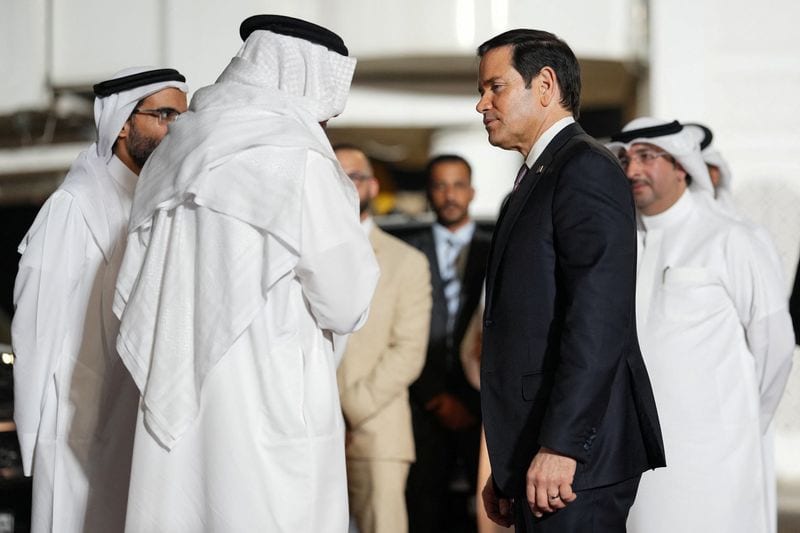
Rubio Tours Gulf Allies to Reassure on Iran Security Framework
window 24h
IN SHORT
U.S. Secretary of State Marco Rubio is touring Gulf allies, including the UAE, Kuwait, and Bahrain, to address security concerns arising from a preliminary US-Iran de-escalation framework. Rubio aims to reassure these nations that the agreement does not compromise their safety, even as details about concessions and future talks remain unclear. Meanwhile, President Trump has cast doubt on U.S. responsibility for a deadly strike on an Iranian primary school, suggesting the perpetrator may never be identified.
✉Newsletter
PiQ Daily
Pick your topics. Get only what matters, on your cadence.
Who's Involved
Marco Rubio
U.S. Secretary of State leading diplomatic tour of Gulf allies
United States
nation engaged in de-escalation framework with Iran
Iran
nation involved in de-escalation framework with the U.S.
UAE
Gulf ally visited by U.S. Secretary of State Marco Rubio
Kuwait
Gulf ally visited by U.S. Secretary of State Marco Rubio
Bahrain
Gulf ally visited by U.S. Secretary of State Marco Rubio
Donald Trump
U.S. President commenting on Iran school strike
1 / 2
Key facts
U.S. Secretary of State Marco Rubio is visiting the UAE, Kuwait, and Bahrain.
Rubio is addressing Gulf allies' concerns about a preliminary US-Iran de-escalation framework.
Rubio seeks to reassure allies that the framework does not undermine their security.
Conflicting accounts exist regarding concessions and future negotiations in the US-Iran framework.
President Trump stated he has seen no evidence implicating the U.S. in a deadly Iran school strike.
President Trump suggested the perpetrator of the school strike may never be known.
The U.S. is engaged in de-escalation efforts with Iran.
The U.S. is working to maintain trust with its Gulf allies.
U.S. Secretary of State Marco Rubio is undertaking a diplomatic tour of Gulf allies, visiting the United Arab Emirates, Kuwait, and Bahrain. The primary objective of this tour is to address and alleviate the security concerns of these nations regarding a preliminary de-escalation framework reached between the United States and Iran. Rubio's mission is to reassure these allies that the framework does not compromise their security interests, despite conflicting reports and differing interpretations of the concessions made and the scope of future negotiations. The specifics of the deal and the extent of any concessions remain a point of contention and uncertainty among the regional partners.
Concurrently, President Trump has commented on a separate incident involving a deadly missile strike on an Iranian primary school. He stated that he has observed no evidence that implicates the United States in the attack. President Trump further suggested that the true responsibility for the strike may remain unknown, indicating a degree of ambiguity surrounding the incident's origins and perpetrators. This statement adds another layer of complexity to the already tense geopolitical landscape involving the U.S. and Iran.
The ongoing diplomatic efforts by Secretary Rubio highlight the delicate balance the U.S. is attempting to strike in the Middle East, seeking to de-escalate tensions with Iran while maintaining the trust and security assurances of its traditional Gulf allies. The differing perspectives on the de-escalation framework underscore the challenges in achieving a unified regional security posture. President Trump's remarks on the school strike, meanwhile, reflect a cautious approach to attributing blame in incidents where U.S. involvement is alleged but unproven, potentially signaling a broader strategy of avoiding entanglement in regional conflicts or disputes where definitive evidence is lacking.
↳ Why This Matters
U.S. Secretary of State Marco Rubio is undertaking a diplomatic tour of Gulf allies, visiting the United Arab Emirates, Kuwait, and Bahrain. The primary objective of this tour is to address and alleviate the security concerns of these nations regarding a preliminary de-escalation framework reached between the United States and Iran. Rubio's mission is to reassure these allies that the framework does not compromise their security interests, despite conflicting reports and differing interpretations of the concessions made and the scope of future negotiations. The specifics of the deal and the extent of any concessions remain a point of contention and uncertainty among the regional partners.
Frequently asked questions
The tour aims to reassure U.S. allies in the UAE, Kuwait, and Bahrain about Washington's security commitments and to consult with them on the U.S.-Iran de-escalation framework and Iran's nuclear program.
Technical teams from the United States and Iran are scheduled to meet in Switzerland on June 29-30.
The upcoming discussions will focus on Iran's nuclear enrichment program. Issues concerning Iran's regional proxy network and financial incentives are also expected to be part of broader negotiations.
U.S. Secretary of State Marco Rubio stated that freedom of navigation through the Strait of Hormuz is a matter of international law.
What Happens Next
01U.S. and Iran technical teams to meet June 29-30 in Switzerland.
02Rubio to continue consultations with Gulf leaders and the GCC.
Get the newsletter.
Pick the topics you actually care about. We'll email when there's news worth your time, on the cadence you choose. Cancel any time from your account.