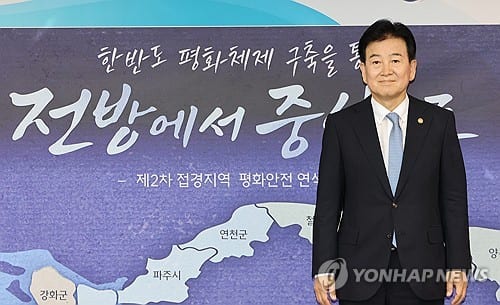
SEOUL, Aug. 5 (Yonhap) -- South Korea's Unification Ministry proposed on Wednesday that the country stop referring to North Korea as its "main enemy" as part of efforts to foster peaceful coexistence and revive long-stalled inter-Korean relations. The ministry briefed President Lee Jae Myung on its policy plan, which centers on building mutual respect, reciprocal cooperation, peaceful conflict resolution, crisis management, and a long-term push toward a nuclear-free Korean Peninsula and peace in Northeast Asia.
As a concrete step, the ministry suggested using North Korea's official name, the Democratic People's Republic of Korea, to build mutual trust. South Korea currently uses "North Korea" rather than its official name, as Seoul does not recognize the two Koreas as separate states under the 1991 inter-Korean Basic Agreement. This initiative effectively revives a peace regime framework previously floated under former President Moon Jae-in, which lost momentum after inter-Korean exchanges came to a standstill.
Regarding security, the ministry aims to revive the Sept. 19 inter-Korean military tension reduction pact signed in 2018 and utilize the Demilitarized Zone (DMZ) separating the two Koreas for peaceful purposes. A white paper published by the ministry in May outlined three guiding principles: respecting North Korea's system, ruling out unification by absorption, and avoiding hostile acts.
To lay the groundwork for inter-Korean exchange, the ministry plans to restart construction next year on the South Korean section of the Gyeongwon Line railway, connecting Seoul and Wonsan in the North, with a target completion of 2029. This project has been suspended for the past decade due to deteriorating ties. Additionally, the ministry intends to revise rules for the Inter-Korean Cooperation Fund, which has seen low usage, to permit spending on peace economic zones, private unification projects, and North Korea studies.