Key facts
- Activists are challenging the Indian government's use of AI-powered surveillance at a recent youth protest.
- A court case seeks to declare mass surveillance unconstitutional and compel the destruction of collected data.
- The government defends the surveillance as legal and necessary for maintaining law and order.
- India currently lacks specific laws governing the use of facial recognition technology by police.
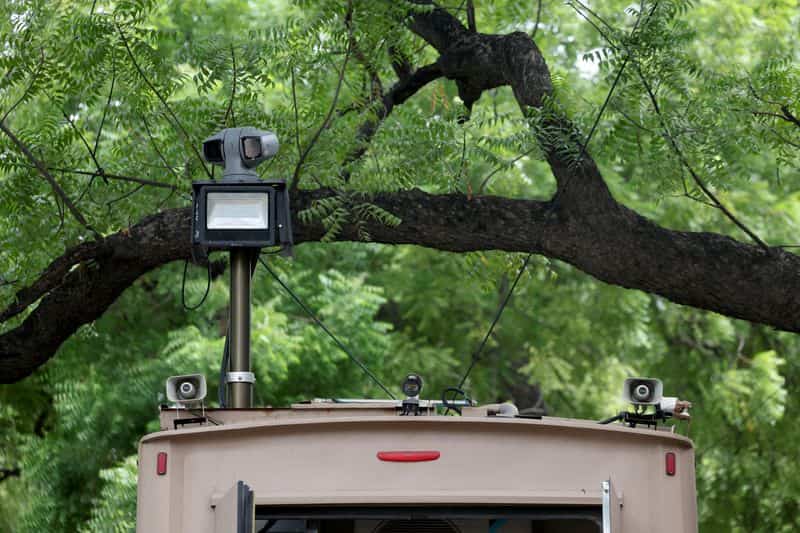
- Police used a surveillance van equipped with AI cameras, reportedly to identify individuals with criminal backgrounds and count protesters.
Indian activists are challenging Prime Minister Narendra Modi's government over the use of AI-powered surveillance during a large youth protest, with a court case aiming to establish constitutional limits on mass surveillance and data collection.
The controversy arose during recent student protests concerning exam paper leaks, where demonstrators shared images of a mobile police surveillance van equipped with advanced AI cameras on a telescopic mast offering a 360-degree view.
Student activist Aishe Ghosh has filed a petition in the Delhi High Court, seeking to declare mass surveillance of protesters unconstitutional, demanding the destruction of all personal data gathered, and requesting guidelines for the use of surveillance technology. She is pursuing the case despite the protest concluding after the resignation of Education Minister Dharmendra Pradhan and the government's announcement of a panel to reform the exam system.
Activists argue that India lacks specific legislation for police use of facial recognition technology and that the surveillance conducted at the protest site violated existing laws. The government, however, asserts that these checks were legal and served the public interest by ensuring law and order. This stance aligns with accusations from opposition parties and digital rights groups that Modi's administration has expanded surveillance powers.
During a court hearing, Solicitor General Tushar Mehta defended the police's actions, characterizing privacy claims at a public gathering as 'ironical' and deeming the surveillance 'absolutely necessary' and in the 'legitimate state interest.' Ghosh's legal team argued that intrusive mass surveillance is disproportionate and sought greater transparency regarding the state's surveillance policies during protests.
The Internet Freedom Foundation, a digital advocacy group, has also formally requested the deletion of biometric data collected at the protest site. Delhi police have stated they did not restrict freedom of expression through facial recognition technology. Legal experts emphasize the need for proportionality and accountability, suggesting that if facial recognition is used to track protesters, it should also be used to identify officers involved in alleged misconduct.
Police were observed recording the Instagram handles of protesters, with an inspector explaining this was to prevent individuals with criminal backgrounds from entering the demonstration. The surveillance van, branded 'Ikshana' (meaning 'vision' in Hindi), was developed in partnership with Indian CCTV company CP Plus and featured advanced AI cameras. A police officer inside the van demonstrated its capabilities, stating the system helps identify individuals with criminal histories and count the number of attendees.