Key facts
- Alan Greenspan, former Federal Reserve chairman, died at 100.
- He passed away at his home due to complications from Parkinson's disease.
- Greenspan served as Fed chair from August 1987 to January 2006.
- He oversaw the second-longest economic expansion in U.S. history.
- His policies were later criticized for contributing to the 2007-09 financial crisis.
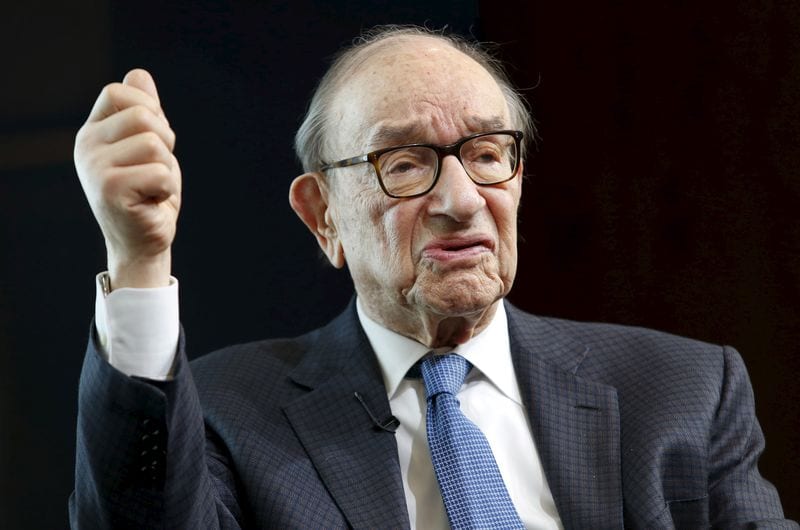
Alan Greenspan, the influential economist who served as Federal Reserve chairman for nearly two decades, has died at the age of 100. His death was reported by NBC News, citing his wife, Andrea Mitchell.
Greenspan led the Federal Reserve from August 1987 to January 2006, overseeing a period of significant economic growth in the U.S., including the second-longest expansion in history from March 1991 to March 2001. His tenure was marked by his prescient judgment regarding a mid-1990s productivity surge that kept inflation contained, a decision former Fed Chair Jerome Powell has cited as an example of judgment outperforming technical models.
However, Greenspan's legacy also includes criticism for policies that some argue fueled asset price bubbles and contributed to the 2007-09 financial crisis. He was also a strong advocate for light financial market regulation, a stance that drew criticism after the crisis. Greenspan himself admitted to being "shocked" that bankers' self-interest did not prevent them from taking actions that imperiled their institutions.
Greenspan's career began with an appointment by President Ronald Reagan in 1987, and he was subsequently reappointed by Presidents George H.W. Bush, Bill Clinton, and George W. Bush. He also served as chairman of the Council of Economic Advisers under President Gerald Ford and ran an economics consulting firm. His early life included a passion for mathematics and music, with a period studying clarinet at the Juilliard School and playing saxophone in a swing band.
Known for his pensive and often elliptical communication style, Greenspan was once referred to as the second most powerful person in the country after the president due to the Fed's influence on the economy. He continued his career as a consultant and adviser after leaving the Fed at age 80.