Key facts
- Prices for gallium and germanium are 9 to 10 times higher than in 2023.
- Gallium demand is projected to rise 12% annually through 2030.
- Germanium demand is projected to rise 3.3% annually through 2030.
- China is estimated to account for 98.9% of primary gallium supply and 68.6% of germanium supply in 2025.
- Ex-China gallium supply capacity is expected to reach 20 tons by the end of 2026, with a supply gap of 678 tons.
- Non-Chinese germanium production is seen at 31 tons in 2026, 177 tons short of demand.
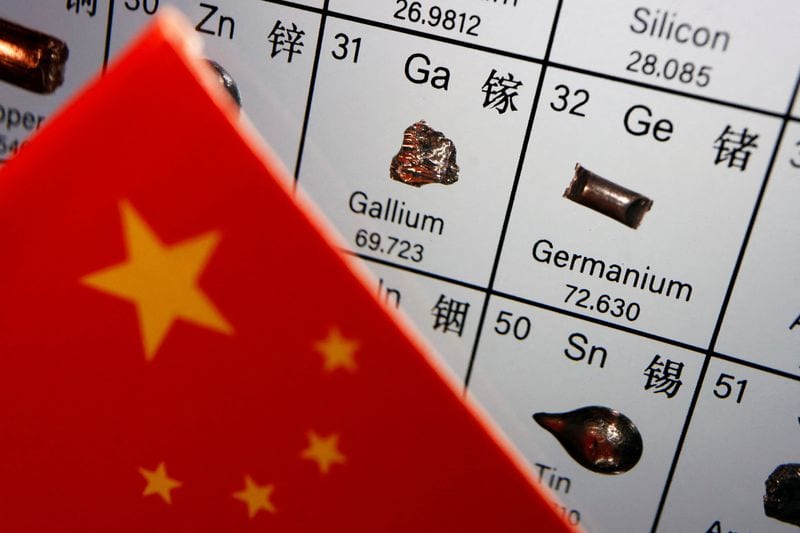
Three years after China imposed export controls on gallium and germanium, Western nations are still experiencing price pain and supply shortages for these critical metals. These metals are vital for the chipmaking, clean energy, and defense sectors. Western companies have resorted to stockpiling, seeking alternative suppliers, and exploring new designs and substitutes.
Prices for gallium and germanium have surged to 9 to 10 times their 2023 levels, according to Argus senior analyst Cristina Belda. Manufacturers of infrared optics, used in defense and thermal imaging, have been particularly affected by tight supply. While new production projects are emerging in the West, they face challenges in matching China's scale and cost efficiencies.
Demand for gallium is projected to rise by about 12% annually through 2030, reaching approximately 1,000 metric tons in 2025, according to S&P Global estimates. Germanium demand is expected to increase by 3.3% annually over the same period, from an estimated 343 tons in 2025. Despite efforts to diversify, consultancy Project Blue estimates that in 2025, China will still account for 98.9% of primary gallium supply and 68.6% of germanium supply.
Replacing these metals, which are byproducts of alumina and zinc processing, is difficult. Jessica DeGroote Nelson, senior vice president of precision optics at Edmund Optics, stated there is no one-to-one substitute for germanium, and redesigns would be required. Some companies have managed to reduce their germanium usage by switching to Western suppliers and accepting higher prices, but supply availability remains a key issue. Alternatives like indium phosphide for gallium arsenide in semiconductors, and zinc selenide, zinc sulphide, silicon, and chalcogenide glass for germanium in infrared applications, require costly technological adjustments.
Recycling is also a strategy being employed. Lattice Materials uses germanium to produce crystals for military equipment, and its president, Travis Wood, expects prices to remain high or trend upward. Belgium's Umicore is working to boost germanium recovery from mining waste in the Democratic Republic of Congo.
Several Western production projects are underway. In Greece, METLEN aims to produce 50 tons of gallium annually by 2028, but demand already exceeds this target. Australia and the US have pledged over $3.5 billion to support critical minerals projects. S&P Global expects ex-China gallium supply capacity to reach only 20 tons by the end of 2026, creating a significant supply gap. Similarly, non-Chinese germanium production is projected to fall short of demand. Jack Bedder of Project Blue noted that while government support is aiding diversification, China's established capacity and lower production costs present a challenge for new Western projects. Price floors may be necessary to ensure the commercial viability of new supply.