All NewsEducationTV
Equities & FundsCrypto & Digital AssetsAI & TechnologyBusiness & CorporateUS Politics & PolicyGeopolitics & Global RiskMacro, Rates & FXCommodities & EnergyEuropean Politics & MarketsAsia-PacificReal Estate & Property
All NewsHome
← Back to US Politics & Policy

Trump: Saudi Arabia must recognize Israel for nuclear deal

Created at 25 Aug · 10:41 PM1 source↑ Market-relevant
IN SHORT

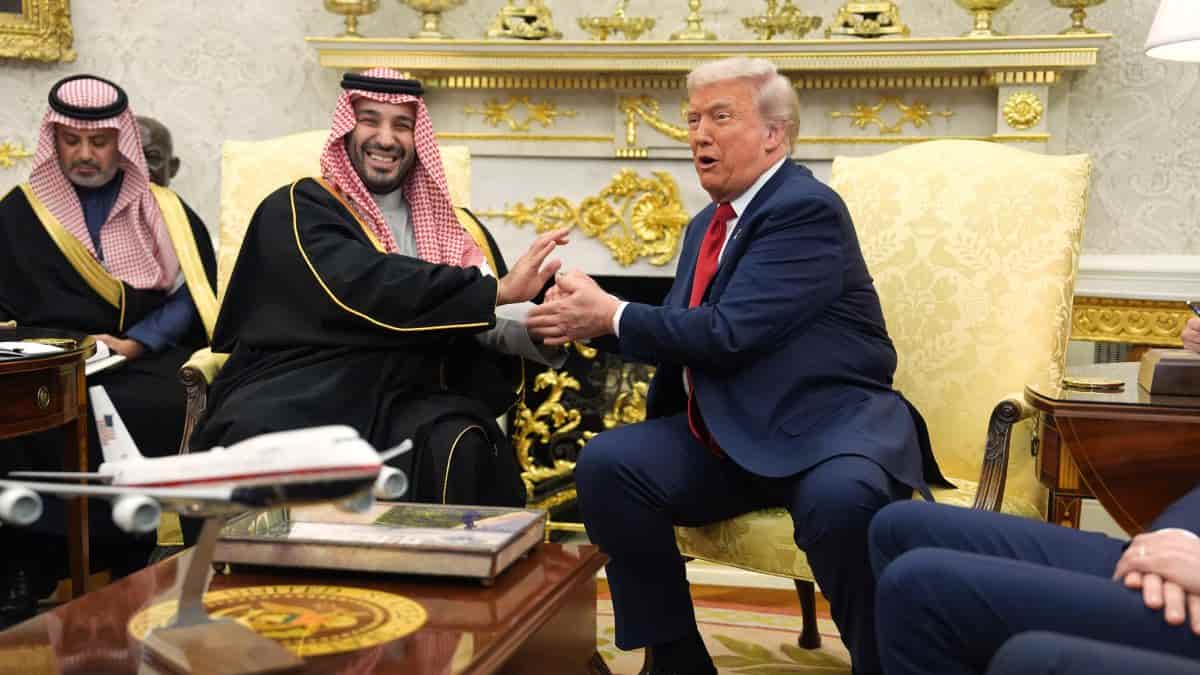
President Donald Trump stated that a civil nuclear energy deal with Saudi Arabia is contingent on the kingdom joining the Abraham Accords and recognizing Israel. The agreement, which prohibits uranium enrichment for military use, has been sent to Congress for review.

Key Numbers

30 yearsexpected duration of Saudi deal with US companies

Who's Involved

Donald Trump
US President linking nuclear deal to Israel recognition
Saudi Arabia
Kingdom seeking civil nuclear deal with US
Israel
Nation whose recognition is a condition for the deal
Benjamin Netanyahu
Israeli Prime Minister welcoming Saudi Arabia's potential accord entry
International Atomic Energy Agency (IAEA)
Aware of US-Saudi nuclear cooperation plans
US Department of Energy
Involved in the civil nuclear cooperation agreement
Trump: Saudi Arabia must recognize Israel for nuclear deal

↳ Why This Matters

The conditionality of the nuclear deal on Saudi Arabia's recognition of Israel highlights the complex geopolitical landscape of the Middle East and the potential for significant shifts in regional alliances, with implications for global energy security and diplomatic relations.

Key facts

  • President Donald Trump has linked a US-Saudi civil nuclear energy deal to Saudi Arabia recognizing Israel.
  • The deal requires Saudi Arabia to join the Abraham Accords.
  • The agreement prohibits uranium enrichment for military use.
  • The deal has been submitted to the US Congress for review.
  • Saudi Arabia's prior condition for recognizing Israel was the establishment of a Palestinian state.

US President Donald Trump has stated that a civil nuclear energy agreement with Saudi Arabia is contingent upon the kingdom joining the Abraham Accords and formally recognizing Israel. Trump clarified that the deal, which involves US companies in program development expected to last 30 years, pertains only to non-military uses and does not allow for uranium enrichment.

Trump conveyed this condition via Truth Social, emphasizing that the agreement would be approved but is "totally subject to Saudi Arabia joining the very respected and successful Abraham Accords." This stance was reiterated by White House press secretary Karoline Leavitt, who stated that Trump has previously informed Saudi leaders that the deal would be off if they did not join the accords.

Saudi Arabia has historically maintained that it would only formally recognize Israel upon the establishment of a Palestinian state, a condition that Israeli Prime Minister Benjamin Netanyahu has dismissed. Following Trump's remarks, Netanyahu welcomed the potential for Saudi Arabia to join the Abraham Accords, calling it an "historic leap forward for peace in the Middle East."

The deal has been sent to the US Congress for review. Experts and some lawmakers have expressed concerns about potential nuclear proliferation risks in the region, although Trump's party controls both chambers of Congress. The International Atomic Energy Agency (IAEA) has stated it is aware of the US and Saudi plans for a bilateral civil nuclear cooperation agreement and looks forward to implementing verification measures.

Frequently asked questions

President Donald Trump stated that Saudi Arabia must join the Abraham Accords and recognize Israel for the civil nuclear energy deal to proceed.

No, President Trump clarified that the agreement pertains only to non-military uses and does not allow for uranium enrichment.

Saudi Arabia has previously stated that it would formally recognize Israel on the condition that a Palestinian state is established.

The Abraham Accords are a series of US-brokered agreements that normalized relations between Israel and several Arab nations, including the UAE, Bahrain, Morocco, Sudan, and Kazakhstan.

What Happens Next

01The civil nuclear deal will be sent to the US Congress for review.
02Further conversations are expected between the US administration and Saudi counterparts regarding the condition.

How It Developed

President Donald Trump sent a civil nuclear energy deal with Saudi Arabia to Congress.
Trump stipulated that the deal requires Saudi Arabia to join the Abraham Accords and recognize Israel.
The agreement pertains to non-military uses of nuclear energy, such as those held by Iran and the UAE.
Trump clarified that the deal does not permit uranium enrichment for military purposes.
Saudi Arabia has previously stated it would only recognize Israel if a Palestinian state is established.
Israeli Prime Minister Benjamin Netanyahu welcomed the prospect of Saudi Arabia joining the Abraham Accords.
The US administration has previously communicated this condition to Saudi leaders.
Concerns have been raised by experts and lawmakers regarding potential nuclear proliferation risks in the region.

Sources

T1
Trump says Saudi Arabia must recognise Israel to move forward with nuclear pactMiddle East Eye
T2
Saudis must recognise Israel for nuclear deal, says Trumpbbc.co.uk
T2
Saudis must recognise Israel for nuclear deal, says Trump - BBCbbc.com
T2
Will Saudi Arabia recognise Israel? Trump says nuclear deal totally ...theweek.in

Related Stories

Trump reiterates call to cut S. Korea-U.S. military exercises
25 Aug · 7:21 PM
Trump administration argues Kennedy Center renaming doesn't violate court order
25 Aug · 3:52 PM
US Lawmakers Urge Trump Administration to Block Aid to Chinese, Russian Agencies
25 Aug · 10:07 AM
Trump denies pushing Canada on French language
25 Aug · 1:51 PM
FAA relocates antenna after Marine One safety incident
25 Aug · 6:17 PM