Key facts
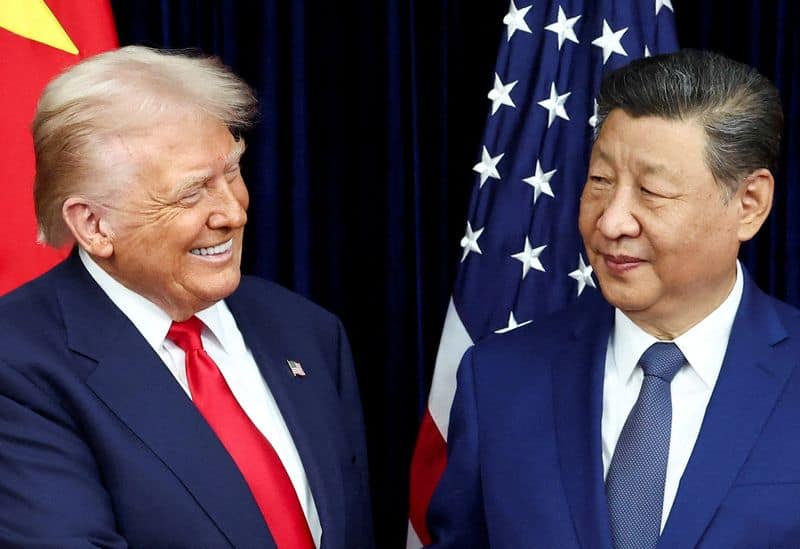
- U.S. President Donald Trump will host Chinese President Xi Jinping this week in Washington.
- The summit agenda includes trade, tariffs, and artificial intelligence.
- US, Japan and South Korea agreed to resist "economic coercion" and emphasized Taiwan Strait stability.
- US Treasury Secretary Scott Bessent and Chinese Vice Premier He Lifeng discussed setting up a US-China AI dialogue.
U.S. President Donald Trump will host Chinese President Xi Jinping this week in Washington for discussions that will include trade, tariffs, and artificial intelligence, as a trade truce between the two nations nears its expiration. The meeting comes amid a complex financial landscape where investors continue to engage with both U.S. and Chinese technology sectors despite geopolitical tensions.
Wall Street banks have acted as bookrunners on numerous Chinese high-tech equity capital market deals, totaling billions of dollars, while U.S. stocks, particularly semiconductors, are a favored destination for China's outbound mutual funds. The value of U.S. equity held by Hong Kong residents and mainland Chinese has increased significantly in the past year.
Analysts liken the U.S.-China rivalry to a Cold War space race, with AI likely to be a focal point of the summit. This mutual exposure between the two economic powers serves as a safety net, giving both sides an interest in maintaining stable relations. However, this financial connectivity is at risk of unraveling if U.S.-China relations deteriorate further, potentially cleaving AI development into separate spheres.
Despite U.S. restrictions on chip technology and investment in sensitive AI sectors in China, a carve-out for publicly-traded securities has allowed Wall Street's continued involvement in China's AI listing boom. Some observers note that U.S. technology restrictions might even fuel interest in China's domestic tech players, leading to a scenario where portfolios require exposure to both distinct technological ecosystems.
Chinese investment in the U.S. also remains strong, with U.S. stocks comprising a significant portion of assets managed by China's outbound mutual funds. While there are frictions, such as U.S. lawmakers criticizing banks for underwriting certain Chinese companies, investors on both sides of the 'Silicon Curtain' are currently spreading their bets, anticipating that politicians may not fully sever ties.
Separately, the United States, Japan and South Korea agreed to resist "economic coercion" and emphasized the need for stability in the Taiwan Strait, taking an implicit shot at China just days before President Xi Jinping’s White House summit. The three countries plan new talks on economic security and enhancements to a trilateral supply chain early warning system.