All NewsEducationTVBrokers
Equities & FundsCrypto & Digital AssetsAI & TechnologyBusiness & CorporateUS Politics & PolicyGeopolitics & Global RiskMacro, Rates & FXCommodities & EnergyEuropean Politics & MarketsAsia-PacificReal Estate & Property
All NewsHome
← Back to Asia-Pacific

Taiwan leverages chip diplomacy amid pressure to share AI tech with allies

Created at 7 Sep · 4:27 AM1 source↑ Market-relevant
IN SHORT

Taiwan is using its semiconductor strength as a diplomatic tool, showcasing its role in the AI revolution and signaling a willingness to share benefits with partners. The island faces pressure from the U.S. to increase chip manufacturing domestically, while also seeking deeper ties with the European Union.

Key Numbers

$265 billionTSMC investment in Arizona
$20 billionadditional planned Taiwanese investment

Who's Involved

Lai Ching-te
Taiwanese President speaking at SEMICON Taiwan
Kung Ming-hsin
Taiwanese Economy Minister opening U.S. pavilion
Howard Lutnick
U.S. Commerce Secretary discussing semiconductor tariffs
Bill Frauenhofer
Commerce Department official overseeing Taiwan tariff agreement
Young Liu
Chairman of Foxconn, Nvidia's largest AI server maker
Tien Wu
Chief Operating Officer of ASE, world's largest chip packaging provider
Kilian Gross
European Commission official pitching EU's Chips Act 2.0
Francois Wu
Taiwan's Deputy Foreign Minister
Taiwan leverages chip diplomacy amid pressure to share AI tech with allies

↳ Why This Matters

Taiwan's strategic use of its semiconductor dominance as diplomatic leverage highlights its critical role in global technology supply chains and its efforts to secure international alliances amidst rising geopolitical tensions, particularly concerning China.

Key facts

  • Taiwan is leveraging its semiconductor industry as a diplomatic tool, particularly in the context of the AI revolution.
  • The island faces U.S. pressure to increase domestic chip manufacturing, with TSMC investing significantly in Arizona.
  • Taiwanese companies are exploring global expansion, aiming to "make with Taiwan" rather than solely "in Taiwan."
  • The European Union is also seeking increased investment from Taiwanese chip firms.
  • Taiwan emphasizes its democratic values and rule of law as foundations for its chip strength.

Taiwan is actively employing its significant semiconductor capabilities as a form of "chip diplomacy," aiming to bolster international support and partnerships amidst geopolitical pressures. At the SEMICON Taiwan trade show, the island positioned itself as a reliable and democratic supplier crucial for the ongoing AI revolution.

President Lai Ching-te highlighted that Taiwanese companies are expanding globally to foster "shared prosperity," emphasizing that the island's chip strength is rooted in its democratic values and rule of law. This strategic outreach comes as Taiwan faces pressure from the United States, its key international backer, to increase chip manufacturing within the U.S. TSMC, a cornerstone of Taiwan's semiconductor industry, is already investing substantially in new facilities in Arizona.

Economy Minister Kung Ming-hsin announced that Taiwanese firms are planning an additional $20 billion in investments within Taiwan. Earlier this year, Taiwan secured a deal with Washington to boost U.S. investment in exchange for reduced export tariffs, though uncertainties remain regarding potential U.S. semiconductor tariffs for companies not manufacturing domestically, as indicated by U.S. Commerce Secretary Howard Lutnick.

Industry leaders acknowledge the necessity of diversifying manufacturing bases. Young Liu, chairman of Foxconn, suggested a shift towards "making with Taiwan, not in Taiwan," a sentiment echoed by Tien Wu, COO of ASE, who stated that expanding manufacturing abroad is politically prudent and practically unavoidable.

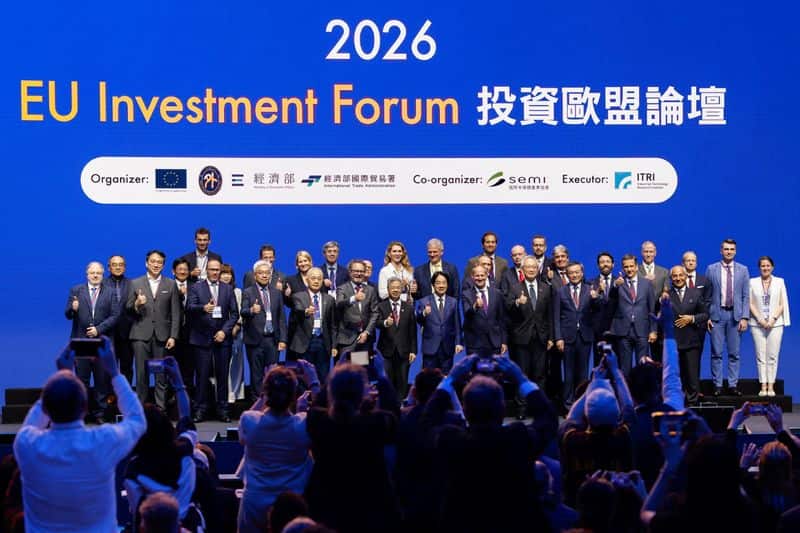
Beyond the U.S., Taiwan is also pursuing deeper engagement with the European Union, which seeks greater investment from Taiwanese companies. This aligns with shared geopolitical interests, including mutual support for Ukraine and ongoing trade and diplomatic challenges with China. Taiwan's Deputy Foreign Minister Francois Wu underscored shared democratic values with France, stating, "We use technology to connect with the world, not to control it."

Frequently asked questions

Taiwan is home to companies like TSMC, whose advanced semiconductors are essential for powering AI applications and servers.

The U.S. is pressuring Taiwan to shift more chip manufacturing to the United States, with TSMC already investing heavily in Arizona.

Taiwan agreed to increase investment in the U.S. in exchange for reduced export tariffs on its semiconductor products.

Both Taiwan and the EU share values, have supported Ukraine, and face trade and diplomatic disputes with China.

What Happens Next

01Further details on potential U.S. semiconductor tariffs are expected.
02Taiwanese companies are anticipated to announce specific investment plans in the EU.
03Ongoing discussions are expected regarding the balance of domestic versus international chip manufacturing for Taiwanese firms.

How It Developed

Taiwan showcased its semiconductor capabilities at a trade show, emphasizing its role in the AI revolution.
President Lai Ching-te stated Taiwanese companies are expanding globally for shared prosperity.
Economy Minister Kung Ming-hsin announced plans for an additional $20 billion in Taiwanese investment.
Taiwan struck a deal with Washington for increased U.S. investment in exchange for reduced export tariffs.
U.S. Commerce Secretary Howard Lutnick indicated upcoming semiconductor tariffs for companies not manufacturing in the U.S.
Foxconn chairman Young Liu suggested companies should "make with Taiwan, not in Taiwan."
ASE chief operating officer Tien Wu agreed that expanding manufacturing beyond Taiwan is politically necessary.
The European Union is seeking greater investment from Taiwanese companies, pitching its Chips Act 2.0.

Sources

T1
Taiwan flexes chip diplomacy muscles as it faces pressure to share AI wealth with alliesReuters

Related Stories

Belgium detains dual national on suspicion of semiconductor espionage for China
7 Sep · 9:18 AM
South Korean economy improves on AI-driven exports and investment
7 Sep · 4:39 AM
China August export growth seen accelerating to 25%
7 Sep · 5:41 AM
Huawei unveils triple-fold phone with 'US-free' Kirin chip
7 Sep · 7:43 AM
Thai PM Anutin seeks Chinese investment to boost economy
7 Sep · 4:38 AM