All NewsEducationTV
Equities & FundsCrypto & Digital AssetsAI & TechnologyBusiness & CorporateUS Politics & PolicyGeopolitics & Global RiskMacro, Rates & FXCommodities & EnergyEuropean Politics & MarketsAsia-PacificReal Estate & Property
All NewsHome
← Back to US Politics & Policy

Supreme Court temporarily allows White House ballroom construction to continue

Created at 21 Aug · 6:16 PM1 source↑ Market-relevant
IN SHORT

The U.S. Supreme Court has granted an administrative stay, temporarily pausing a judicial order that would halt construction of a new White House ballroom. The justices will consider the administration's request to continue the project while a lawsuit by a historic preservation group proceeds.

Key Numbers

$400 millioncost of White House ballroom project
90,000-square-footsize of ballroom
8,360-square-metersize of ballroom
65%completion of East Wing project

Who's Involved

Supreme Court
temporarily allowed White House ballroom construction to continue
Donald Trump
administration seeking to continue White House ballroom project
National Trust for Historic Preservation
group suing to stop White House ballroom project
Richard Leon
U.S. District Judge who issued an order to halt construction
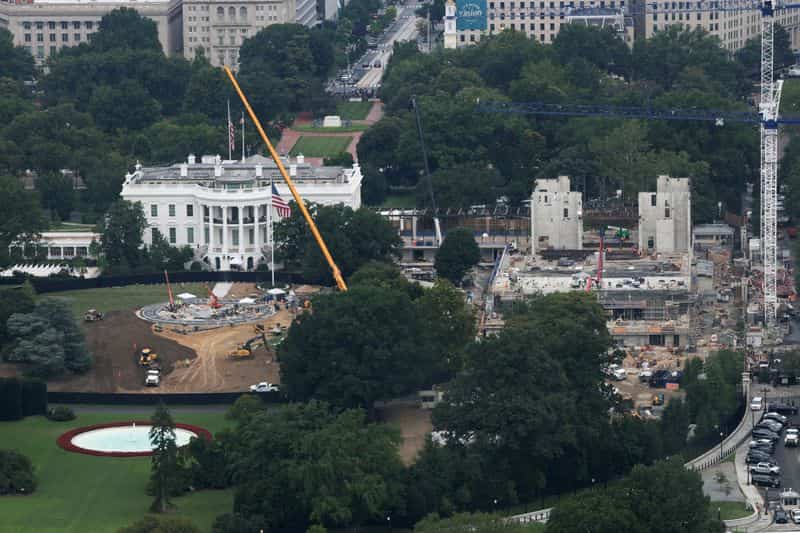
Supreme Court temporarily allows White House ballroom construction to continue

↳ Why This Matters

The Supreme Court's decision impacts the ongoing legal battle over the construction of a significant White House expansion, raising questions about presidential authority, national security justifications, and the need for congressional oversight in altering federal landmarks.

Key facts

  • The Supreme Court has issued a temporary stay on a judicial order halting White House ballroom construction.
  • The administrative stay allows construction to continue while the court considers the administration's request.
  • The project, estimated at $400 million, includes a ballroom and an underground complex with security features.
  • A historic preservation group is suing to stop the project, arguing it lacks congressional approval.
  • Previous court rulings had ordered a halt to above-ground construction.

The U.S. Supreme Court has granted an administrative stay, temporarily halting a judicial order that would stop the construction of a new White House ballroom. This action provides the justices with more time to consider the Trump administration's formal request to proceed with the $400 million project while a lawsuit filed by the National Trust for Historic Preservation moves forward.

The Justice Department argued in a filing that the project is a critical national security necessity, citing threats against the president. The National Trust sued last year, asserting that the administration demolished the East Wing and began building the 90,000-square-foot ballroom without specific congressional approval.

Previously, the U.S. Court of Appeals for the District of Columbia Circuit upheld a district judge's order to halt above-ground construction, stating that presidents are temporary tenants and cannot fundamentally reshape the White House without congressional consent. The administration contends that the overall East Wing project is 65% complete, including underground facilities and security features.

Trump has described the project as a "military center" and called the D.C. Circuit's decision "horrendous" and politically motivated. The National Trust urged the Supreme Court to reject the administration's bid, emphasizing that no court has granted the administration unilateral authority to build the ballroom without express approval from Congress.

Frequently asked questions

It is a $400 million project to construct a new 90,000-square-foot ballroom at the White House East Wing, which also includes an extensive underground complex with security features like bomb shelters and drone shielding.

A historic preservation group argues the Trump administration lacks the legal authority to build the ballroom without specific approval from Congress, as presidents are considered temporary tenants of the White House.

The U.S. Court of Appeals for the District of Columbia Circuit upheld a lower court's order to halt above-ground construction, while allowing below-ground work and essential security measures to continue.

An administrative stay is a temporary pause granted by a court, in this case the Supreme Court, to give justices more time to consider a formal request without immediately enforcing a lower court's order.

What Happens Next

01The Supreme Court will consider the administration's formal request to continue ballroom construction.
02The lawsuit by the National Trust for Historic Preservation will proceed.

How It Developed

The U.S. Supreme Court granted an administrative stay on construction of a White House ballroom project.
The stay temporarily pauses a judicial order that would halt much of the development.
The court will consider the administration's request to continue the $400 million ballroom project.
A lawsuit by the National Trust for Historic Preservation seeks to stop the project.
The D.C. Circuit previously upheld a lower court order to halt above-ground construction.
The National Trust argued the administration lacks unilateral authority to build the ballroom without congressional approval.

Sources

T1
Supreme Court lets Trump continue work on White House ballroom for nowReuters

Related Stories

Appeals court upholds block on DOJ subpoenas to NY AG James' office
21 Aug · 1:38 PM
DOJ seeks interviews with FBI officials tied to Mar-a-Lago search
20 Aug · 11:45 PM
Trump signs memo to boost US space launches
20 Aug · 10:01 PM
Trump Eases Ground Beef Import Quotas to Lower Prices
21 Aug · 11:21 AM
US plans $725 million payment towards UN debt
21 Aug · 5:02 PM