Key facts
- Two China-owned tankers, Xin Long Yang and Cosnew Lake, are traveling through the Red Sea toward the Bab el-Mandeb Strait.
- The Houthi militia announced an expanded campaign against maritime traffic, targeting Saudi oil shipments.
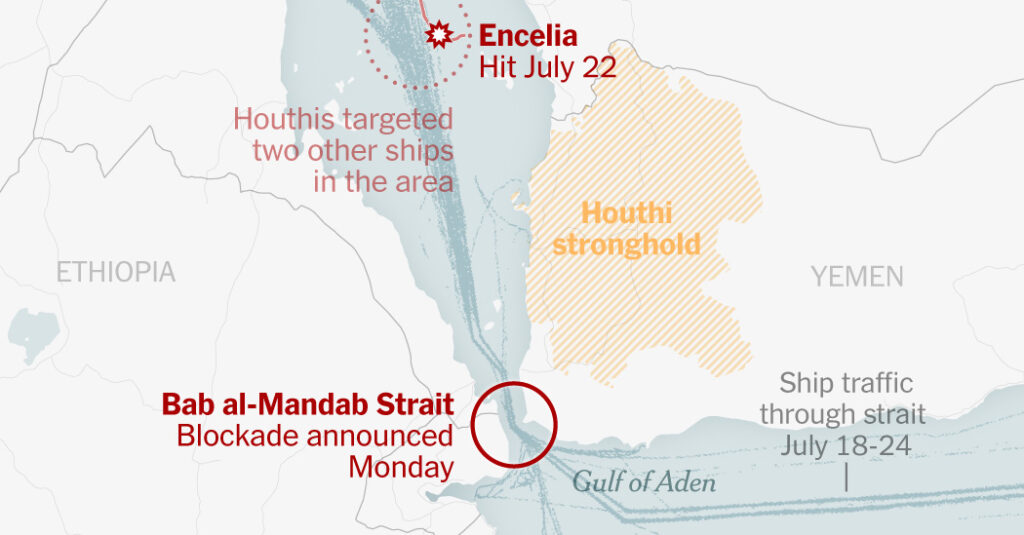
- The Houthi forces spokesman claimed responsibility for attacks on two Saudi tankers, Encelia and Layla.
- The Houthis claim to have forced at least nine ships to turn back from the Bab el-Mandeb Strait.
- The Houthi blockade threatens up to 4 million barrels per day of Saudi crude exports rerouted to bypass the Strait of Hormuz.
Two China-owned tankers loaded with Saudi crude continued through the Red Sea toward the Bab el-Mandeb Strait on Thursday, despite Houthi threats and attacks on Saudi vessels. The Houthi militia announced an expansion of their campaign against maritime traffic, specifically targeting Saudi oil shipments through the key chokepoint. The group claimed responsibility for striking two Saudi tankers, Encelia and Layla, stating they violated the declared blockade. The Houthis also claim to have forced at least nine ships to turn back from the strait.
The Houthi blockade threatens up to 4 million barrels per day of Saudi crude exports that have been rerouted to bypass the Strait of Hormuz. This redirection had previously eased fears of oil shortages, making the potential success of the Houthi blockade a significant factor for oil prices. Analysts warn that if traffic through the Bab el-Mandeb Strait is hindered, tankers will face longer and more expensive routes via the Suez Canal, particularly impacting voyages to Asia. This situation occurs as global oil prices are already elevated, and the Bab el-Mandeb Strait is a critical chokepoint for approximately 7 million barrels of oil daily.