Key facts
- Seven American aid workers are quarantining in Kenya after assisting with the Ebola outbreak in Congo.
- The quarantine is a result of new U.S. travel restrictions requiring a three-week stay in a third country for returning citizens.
- The U.S. government built the isolation facility on a Kenyan air force base.
- The facility has faced local opposition and legal challenges.
- Kenyan authorities are monitoring the quarantined individuals, who are asymptomatic.
- Another American aid worker who contracted Ebola is receiving treatment in Germany.
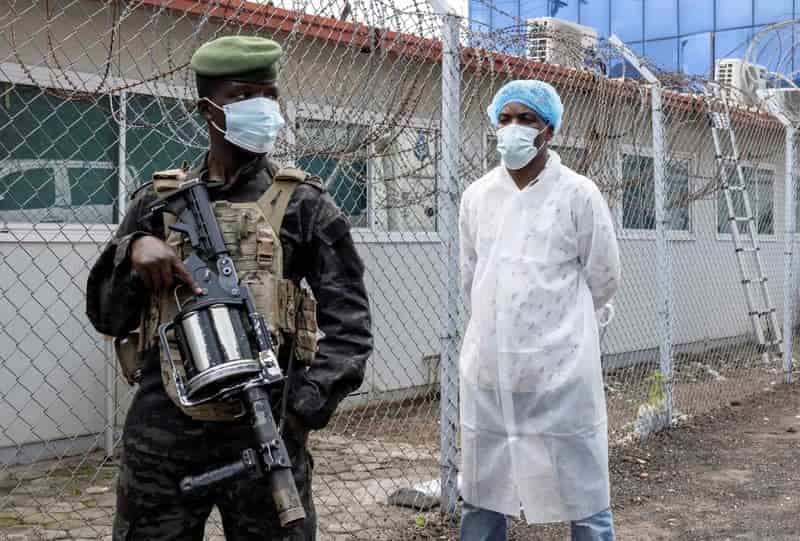
Seven American aid workers who had been in the Democratic Republic of Congo to assist with the Ebola outbreak are now quarantining in Kenya. The individuals are asymptomatic but will remain at a U.S.-built bio-isolation facility for 21 days, according to Franklin Graham, president and CEO of the U.S. charity Samaritan's Purse. This follows new U.S. travel restrictions requiring American citizens returning from Ebola-affected regions to spend three weeks in a third country before entering the United States. The U.S. government constructed the 50-bed isolation unit on a Kenyan air force base. The facility has faced significant opposition from some Kenyans who view it as offloading health risks, and its construction was previously subject to court orders halting work. A U.S. State Department official confirmed the group voluntarily moved to the facility for precautionary monitoring, with Kenyan authorities authorizing their movement and observation by U.S. public health clinicians. Some of the workers treated Ebola patients, while others were involved in construction. Kenyan authorities have authorized their movement into the facility under the observation of the U.S. Public Health Service clinicians. The seven who are at the facility in Kenya are being housed in large military tents in a fenced-in graveled area, sleeping on military cots, and their food is being provided by the U.S. military. Graham spoke with the aid workers Friday morning to thank them and encourage them while they wait to come home. He expressed gratitude to God for the incredible men and women who have been fighting Ebola on the front lines. It was not immediately clear if the seven people are thought to have been exposed to the virus. Another American working for Samaritan's Purse who contracted the virus is being treated in Germany after arriving there on Monday. The person is the second American to be sent to Germany for treatment after Peter Stafford, a missionary doctor working for the humanitarian group Serge was diagnosed with Ebola in May and successfully treated in Berlin. He was discharged in June. The Trump administration has faced criticism from infectious disease experts for not bringing Americans diagnosed with Ebola or exposed to it home to be isolated and treated in the nation’s specialized treatment units, such as the one in Nebraska where more than a dozen Americans were sent after being exposed to hantavirus on a cruise ship this spring. The U.S. spent more than a decade and hundreds of millions of dollars developing the National Emerging Special Pathogens Training and Education Center and the Regional Emerging Special Pathogen Treatment Centers, which sit idle as Americans diagnosed with or exposed to Ebola are cared for abroad, said Ronald Nahass, the president of the Infectious Diseases Society of America, in a statement Friday.