Key facts
- South Korea and the U.S. selected a Texas gas-fired power plant project as the first under Seoul's $350 billion investment commitment.
- The Texas project, "Project Star," will construct a 6,472-megawatt plant for AI data centers at a cost of $22.3 billion.
- The investment commitment includes $150 billion for shipbuilding and $200 billion for strategic sectors.
- South Korea also plans "Project Power" to build eight nuclear reactors and "Project North" for an LNG pipeline and terminal in Alaska.
- The U.S. has committed to maintaining tariffs on Korean goods at around 15 percent.
- Investments will not exceed $20 billion annually or $200 billion in total.
South Korea and the United States have formally selected a gas-fired power plant project in Texas as the first initiative under Seoul's $350 billion investment commitment to the U.S. The Ministry of Trade, Industry and Resources announced the selection of three projects, including the Texas plant, following a memorandum of understanding signed last November where South Korea pledged investment in exchange for lower U.S. tariffs on Korean imports.
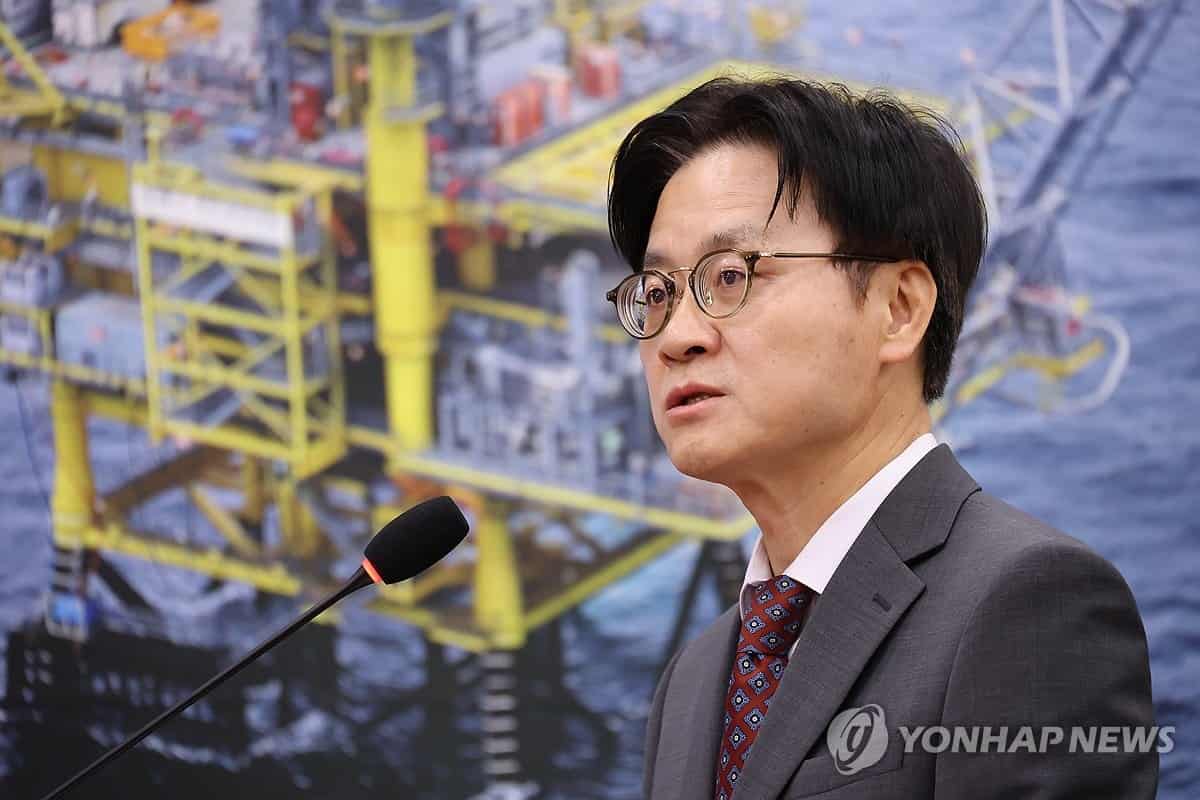
U.S. President Donald Trump announced South Korea's investment plans at the White House. The total investment comprises $150 billion for shipbuilding cooperation and $200 billion for projects in various strategic sectors. Industry Minister Kim Jung-kwan emphasized the priority placed on commercial viability and national interest, stating that consultations with the U.S. side carefully examined profitability, risks, and recovery prospects.
The selected Texas project, named "Project Star," involves constructing a 6,472-megawatt power plant for artificial intelligence (AI) data centers at a cost of $22.3 billion. Located in Encinal, Texas, the plant is slated to begin its first phase of commercial operations in 2029, with full operations targeted for 2032. Reputable companies such as Related Companies, a major real estate developer, and NextEra Energy, a leading U.S. power plant operator, are involved.
"Project Star" aims to jointly address growing U.S. energy demand driven by the AI data center industry, creating a new model for economic security cooperation in strategic areas like AI and energy infrastructure, according to the industry ministry.
Additionally, Seoul unveiled "Project Power," allocating up to $120 billion to build eight nuclear reactors, including two APR1400 units, through a bilateral cooperation framework. This project includes $100 billion for construction and a $20 billion contingency fund. It also aims to allow South Korean companies to acquire stakes in U.S. energy firm Westinghouse, with discussions underway for a stake between 5% and 10%, though Westinghouse is reportedly hesitant to have Korean companies on its board.
"Project North" centers on reviewing the potential construction of a liquefied natural gas (LNG) pipeline and terminal in Alaska. U.S. Commerce Secretary Howard Lutnick stated that South Korea is moving to invest over $50 billion in the Alaska LNG project alone, though he clarified that the project's progression is subject to commercial reasonableness and legal requirements.
Safeguards for South Korea's investments include an umbrella Investment Special Purpose Vehicle (I-SPV) and separate Project Special Purpose Vehicles (P-SPVs). A risk-pooling arrangement will divide proceeds equally between South Korea and the U.S. until Seoul recovers its principal and interest, with interest rates based on 20-year U.S. Treasury yields plus an agreed-upon spread. Annual investments are capped at $20 billion, with a total cap of $200 billion.
Minister Kim highlighted that these projects signify a new era of industrial cooperation in future industries and economic security, including energy, AI, nuclear power, and LNG, offering opportunities for South Korean companies to expand globally. The U.S. has indicated it intends to maintain tariffs on Korean goods at around 15 percent, despite previous USTR announcements of additional tariffs on several trading partners.