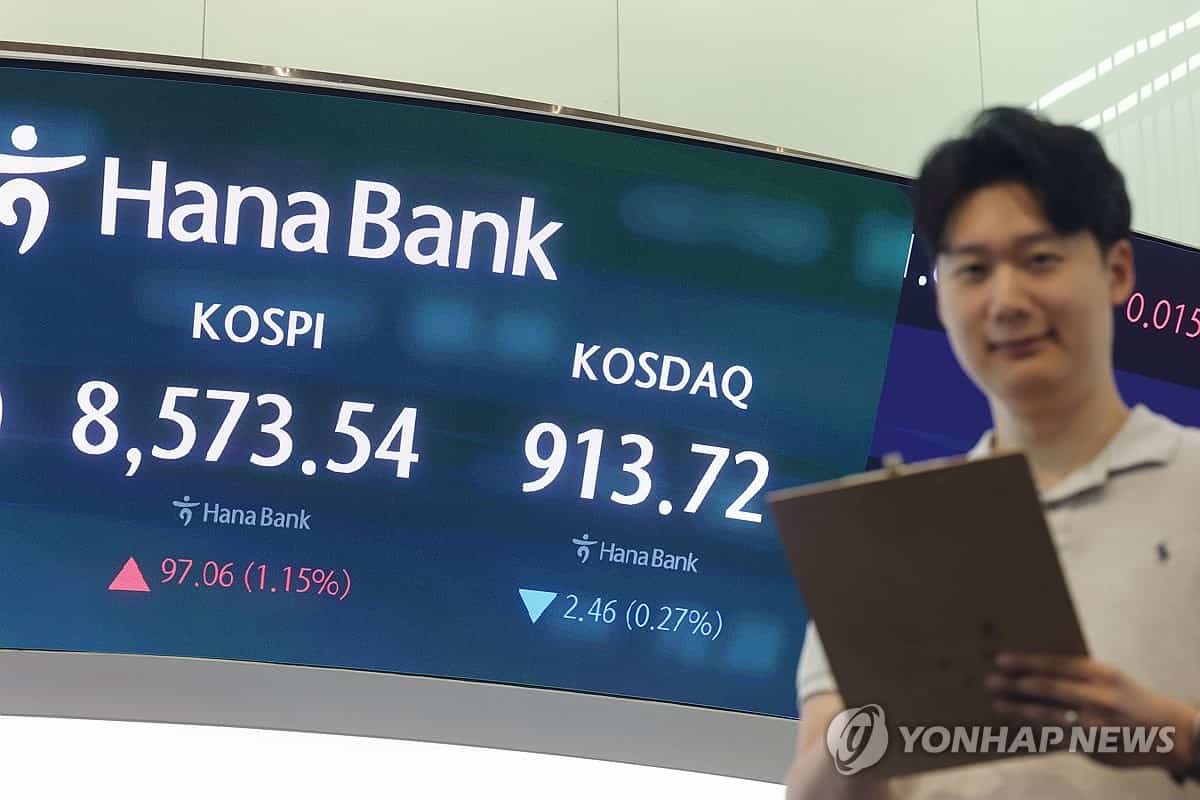
Key facts
- Seoul stocks opened sharply lower on Thursday, paring earlier losses to trade down nearly 3 percent.
- The benchmark Korea Composite Stock Price Index (KOSPI) fell 2.8 percent to 8,068.37.
- An overnight selloff in U.S. semiconductor stocks pressured Korean chipmakers.
- The Korea Exchange (KRX) activated a sell-side sidecar for the KOSPI due to a sharp drop.
- U.S. stocks retreated overnight, with the tech-heavy Nasdaq 100 falling 1.5 percent and the Philadelphia Semiconductor Index tumbling 6.3 percent.
- Federal Reserve Chair Kevin Warsh's comments on easing inflation risks bolstered hopes for a delay in interest rate hikes.
- Samsung Electronics declined 4.29 percent, and SK hynix lost 5.2 percent.
Seoul stocks opened sharply lower on Thursday morning, paring earlier losses to trade down nearly 3 percent as an overnight selloff in U.S. semiconductor stocks pressured Korean chipmakers.
After opening 4.46 percent lower, the benchmark Korea Composite Stock Price Index (KOSPI) fell 235.04 points, or 2.8 percent, to 8,068.37 as of 11:20 a.m. Due to the sharp drop, the bourse operator Korea Exchange (KRX) activated a sell-side sidecar for the KOSPI around 9:07 a.m., halting program trading for five minutes. A sell-side sidecar is triggered when the KOSPI 200 Futures index decreases 5 percent or more for at least one minute.
The index had plunged nearly 7 percent before 10 a.m. amid heavy foreign selling but recovered part of the losses as institutional and retail investors stepped in to buy.
U.S. stocks retreated overnight. The S&P 500 slipped 0.2 percent, while the tech-heavy Nasdaq 100 fell 1.5 percent. The Philadelphia Semiconductor Index, a key gauge of chip stocks, tumbled 6.3 percent.
Federal Reserve Chair Kevin Warsh said inflation expectations and inflation risks have eased in recent weeks, bolstering hopes for a delay in interest rate hike. Investors also remained cautious over the latest developments in U.S.-Iran talks after the two sides concluded another round of indirect negotiations on Wednesday without any clear signs of progress toward lasting peace.
Tech heavyweights weighed on the overall market. Samsung Electronics declined 4.29 percent, while chip giant SK hynix lost 5.2 percent. In contrast, Hanwha Group affiliates outperformed the broader market after Hanwha Ocean was selected as the preferred bidder for the Navy's 7.8 trillion-won (US$5.1 billion) next-generation destroyer project. Defense and aerospace company Hanwha Aerospace jumped 7.79 percent, while shipbuilder Hanwha Ocean gained 3.29 percent.
The Korean won was trading at 1,553.2 won per U.S. dollar as of 11:20 a.m., up 1.7 won from the previous session.