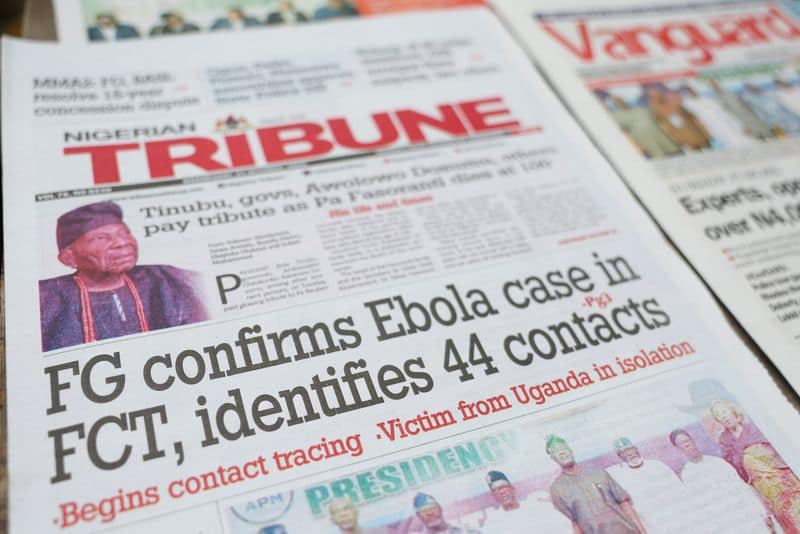
Key facts
- Nigeria's first Ebola patient in over a decade was not tested for the disease until 13 days after falling ill.
- The patient, a Ugandan-born diplomat's wife, arrived in Nigeria on October 3 and fell ill three days later.
- The outbreak, caused by the Bundibugyo Ebola species, has spread across Nigeria, Uganda, Kenya, and the Democratic Republic of Congo.
- Nigeria has identified 44 contacts so far, a number expected to rise.
- The epidemic has infected over 9,500 people and killed more than 4,600 in Congo alone.
Nigeria's first Ebola patient in over a decade was not tested for the disease until 13 days after falling ill, raising concerns about the ability to contain an outbreak that has now spread across four African nations. The patient, the Ugandan-born wife of a Swiss diplomat, arrived in Abuja on October 3 and sought treatment at several facilities before being tested for Ebola on October 19.
Dr Jean Kaseya, director-general of the Africa Centres for Disease Control and Prevention, stated that Nigeria was not initially on the list of at-risk countries but now must be considered, along with North and Southern Africa. He emphasized that "no-one is safe today" and that tracing contacts will be difficult due to the diagnostic delay.
The outbreak is caused by the Bundibugyo species of Ebola, which lacks a vaccine or treatment. The epidemic, first detected in the Democratic Republic of Congo in May, is the second-largest on record, having already affected Uganda and Kenya. Nigerian officials believe the case was likely contracted in Uganda, while Ugandan authorities suggest travel to eastern Congo prior to transiting through Uganda.