Key facts
- Kaynes Semicon targets 3 billion rupees ($31 million) in revenue for the fiscal year ending March 2027.
- The company is seeking foreign technology partnerships for expansion into wafer fabrication, compound semiconductors, advanced packaging, and materials manufacturing.
- Kaynes Semicon's OSAT facility in Gujarat has a capacity to produce over 2 billion units annually.
- The company has a pipeline of 22 customers, with 80% of its order pipeline for export.
- Kaynes Semicon has availed government incentives under state and central schemes.
- Kaynes Semicon plans to submit applications under the next phase of the India Semiconductor Mission (ISM 2.0).
Kaynes Semicon, an Indian chip packaging and testing company, is seeking greater involvement from foreign semiconductor firms to bolster India's chip ecosystem. CEO Raghu Panicker told Nikkei Asia that the company is targeting 3 billion rupees ($31 million) in revenue for the fiscal year ending March 2027 and is exploring expansion into new segments like the power industry.
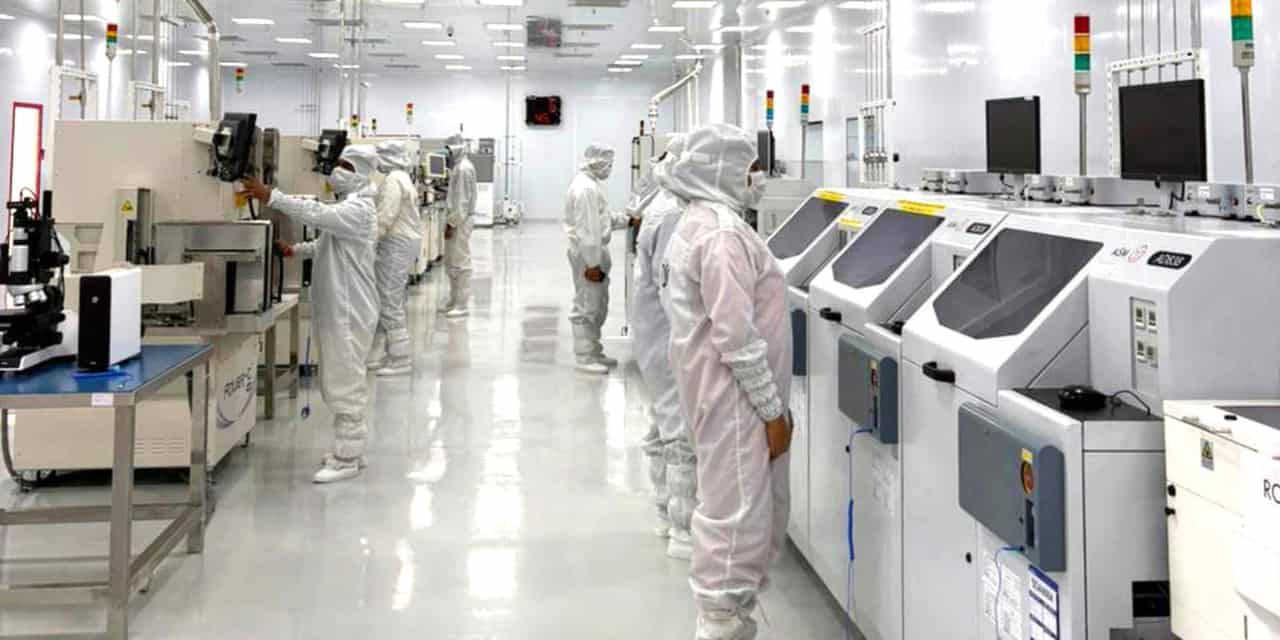
The company has launched an advanced outsourced semiconductor assembly and test (OSAT) facility in Sanand, Gujarat, which is already supplying intelligent power modules for electric vehicles and industrial applications, with a significant portion booked for export. The facility has the capacity to produce over 2 billion units annually.
Kaynes Semicon currently has a pipeline of 22 customers, with six signed, utilizing 30-35% of its production capacity. The company's order pipeline focuses on power MOSFETs and modules for automotive EVs, home appliances, energy, railway, outer space, and satellites. It is also setting up a silicon microphone line with Infineon for Indian customers. Approximately 80% of its current pipeline is for export, with 20% for the Indian market.
In an interview with Fortune India, Panicker noted that Kaynes Semicon received approval for its OSAT plant in September 2024 and began production in March 2026, significantly faster than the international average. The company's investment in Unit 1 is around ₹600 crore, with Unit 2 under development. They have also secured government incentives under both the India Semiconductor Mission (ISM) and state schemes.
Kaynes Semicon is in advanced discussions with global technology companies for joint ventures in semiconductor wafer fabrication, compound semiconductors, advanced packaging, and materials and equipment manufacturing, rather than developing these technologies independently. The company plans to submit project applications under the next phase of the India Semiconductor Mission (ISM 2.0) by mid-August, subject to the government opening the application window. A three-way strategic partnership with Japan's AOI Electronics and trading conglomerate Mitsui & Co has been announced to build semiconductor backend manufacturing operations in India, with AOI providing technology transfer and Mitsui facilitating procurement and sales.