Key facts
- Germany's far-right AfD party accounts for 84% of perpetrators of antisemitic hate crimes in Germany.
- The German government has passed a non-binding resolution against the Boycott, Divestment and Sanctions (BDS) movement.
- A 2025 poll found 80% of German voters believe Israel's actions in Gaza are unjustified.
- The concept of 'Staatsrason' (reason of state) has led to Germany's unequivocal support for Israeli security.
- Antisemitism Commissioners in Germany have been criticized for 'canceling' pro-Palestine movement figures.
Germany's political landscape is increasingly characterized by a conflation of antisemitism and anti-Zionism, a phenomenon dubbed 'Hyperzionism,' which critics argue allows the far-right Alternative fur Deutschland (AfD) party to mask its own antisemitic tendencies. This trend has intensified following the AfD's significant electoral gains in eastern Germany, marking its strongest result since World War II.
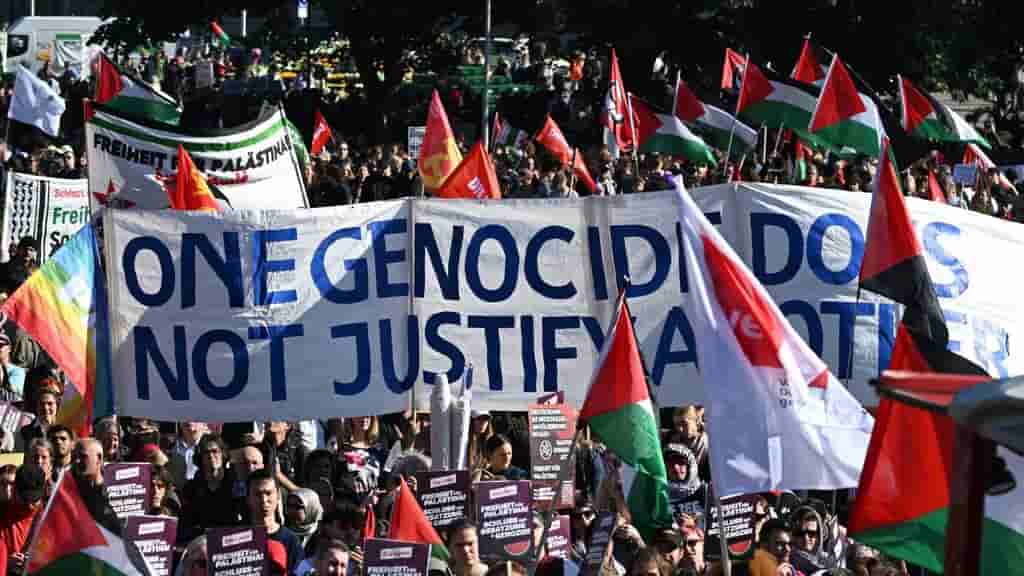
The discourse often equates criticism of Israel with antisemitism, even among some Jewish individuals, leading to the suppression of pro-Palestinian speech and protests. This dynamic was highlighted by an incident involving Free Democratic Party (FDP) politician Karoline Preisler, who posted a video of a confrontation on a Berlin U-Bahn. Preisler and a supporter, neither of whom are Jewish, accused a Jewish heckler wearing a 'Another Jew for a free Palestine' shirt of antisemitism, a claim that drew sharp criticism from UN Special Rapporteur Francesca Albanese.
Academics like Esra Ozyurek from the University of Cambridge explain that by downplaying their own antisemitism and emphasizing Zionism, far-right actors can present themselves as transformed. Ozyurek notes that the AfD, despite its rhetoric, follows a playbook of demonizing minority groups, scapegoating them for societal problems, and uniting a nation through exclusion, mirroring historical fascist tactics.
Germany's strong support for Israel, termed 'Staatsrason' or 'reason of state' by former Chancellor Angela Merkel, has evolved from a universalist understanding of the Nazi past to a more particularist focus on protecting the state of Israel. This shift, according to Hans Kundnani, editor of 'Hyper-Zionism,' aims to remove support for Israel from democratic debate. This loyalty to Israel now spans the political spectrum, with parties like the Greens and Die Linke also equating pro-Palestinian sentiment with Nazism.
However, this official stance is not mirrored by the general public, with polls indicating a majority of Germans believe Israel's actions in Gaza are unjustified and constitute genocide. Younger and immigrant Germans are also more likely to oppose Israel's policies. Historian Daniel Cohen of Rice University suggests that support for Israel is driven by a necessity to protect Germany's post-Holocaust redemption and national identity, labeling critics of Israel as 'unGerman.' The role of Antisemitism Commissioners, many of whom are not Jewish, in 'canceling' pro-Palestine figures has also drawn controversy, with some commissioners accused of misrepresenting Jewish voices and externalizing antisemitism onto immigrants.