Key facts
- Fed's Williams sees no urgency for next rate hike.
Federal Reserve Bank of New York President John Williams said on Tuesday that the U.S. central bank has time to weigh incoming data before deciding on its next interest rate hike. He indicated that one more increase may be appropriate late this year, but stressed there is no need for urgency.
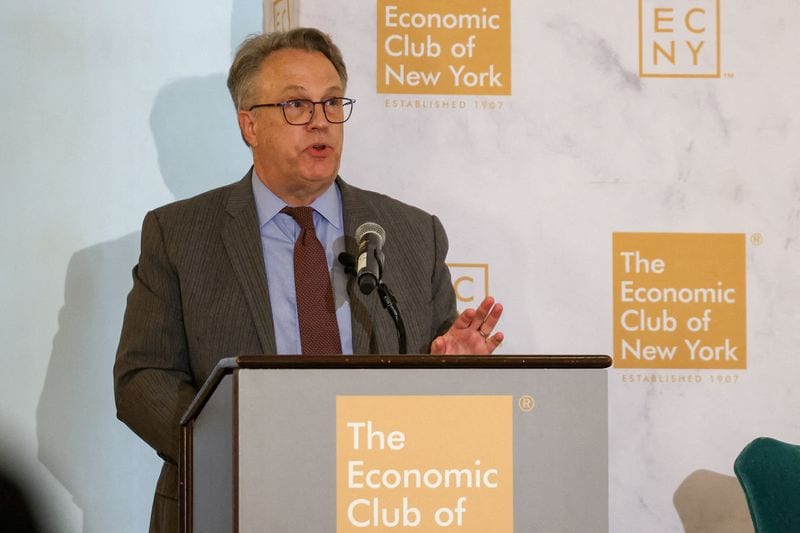
Federal Reserve officials' communications on interest rates are closely watched by markets for signals about future monetary policy, which can influence borrowing costs, investment decisions, and asset valuations across the economy.
Federal Reserve Bank of New York President John Williams stated on Tuesday that the U.S. central bank has time to assess incoming economic data before deciding on its next interest rate hike, suggesting that one more increase may be appropriate before the end of the year. "With the policy action we took at our September meeting, there is no need for urgency," Williams said in prepared remarks for an event at the University of Buffalo. He added that watching data should provide greater clarity on the economy's performance. Williams indicated that if the economy evolves as he forecasts, "one further upward adjustment of the federal funds target range may be appropriate late this year to support a timelier return of inflation to target." He cautioned, however, that this is his forecast and "time — and the totality of the data — will tell."
Financial markets are currently pricing in further increases as the year concludes, with futures markets showing a strong likelihood of a rate hike at the Fed's October meeting, a notion Williams appeared to push back against. He emphasized that with the economy growing robustly and the job market holding firm, price pressures can now be the main focus for monetary policy. "It is imperative that we return inflation to our 2% target on a sustained basis," Williams said, stressing the need to ensure that adverse inflationary disturbances do not become entrenched.
The Fed has been raising rates to combat inflation that has exceeded its 2% target for over five years, pressures exacerbated this year by President Donald Trump's trade tariffs and surging energy prices linked to the war in the Middle East. Fed officials are increasingly concerned that inflation may not return to target in a timely manner and that action is needed to prevent the public from accepting persistently high inflation as normal. Williams noted that artificial intelligence investment is contributing to price pressures, while tariff-related pressures have largely abated assuming no new import tax increases. He anticipates inflation will end the year around 3.5%, with price pressures easing next year toward the 2% target by 2028. Williams also projects this year's economic growth at 2.25%, citing immigration factors, an aging workforce, and modest productivity levels as constraints on growth. He forecasts the unemployment rate to be 4% next year.
Pick the topics you care about. Get only what matters, on your cadence.