Key facts
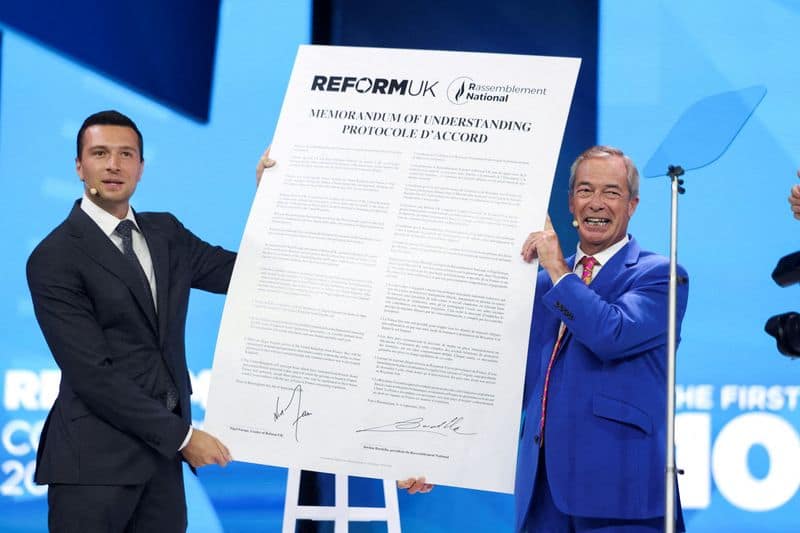
- Nigel Farage and Jordan Bardella signed a memorandum on immigration policy.
- Bardella is expected to support Farage's proposal to use the Royal Navy to repel immigrants.
- The plan faces internal opposition within Bardella's National Rally party.
- French officials and experts have criticized the proposed pact.
- The two leaders aim to present a united front on reducing cross-channel migration.
France's Jordan Bardella and Britain's Nigel Farage are set to present a united front on immigration policy, but their joint proposal faces significant hurdles and criticism. The leaders of the National Rally and Reform UK parties plan to unveil a memorandum at Reform UK's conference in Birmingham, outlining a strategy to tackle cross-channel migration.
Central to the proposed pact is Farage's controversial idea of using the Royal Navy to intercept and return migrants attempting to reach the UK on small boats. Bardella is expected to voice support for this plan in a speech. However, the proposal has generated opposition within Bardella's own party, the National Rally. Some officials within the party have cautioned that any such plan would require a treaty between France and the UK and a shared burden of returning migrants to their countries of origin.
Experts and French officials have expressed skepticism about the feasibility and implications of the proposed pushbacks. One National Rally adviser suggested that a future National Rally government would drastically reduce immigration, rendering the issue of small boats moot. However, analysts like Mark Leonard of the European Council on Foreign Relations doubt the National Rally's willingness to accept migrants trying to enter the UK. Jean-Yves Camus, a far-right specialist, described Bardella's promises as "science fiction," particularly given the political significance of the Calais region for Marine Le Pen's support base.
Despite these challenges, both Farage and Bardella are attempting to project ideological alignment on the need for stringent immigration controls. For Farage, this alliance offers a potential win on his party's key issue, especially after recent scrutiny of his financial affairs. For Bardella, it serves as an opportunity to enhance his international profile and bolster Le Pen's presidential campaign.
The two populist leaders, despite their age difference and distinct political styles, share a common goal of professionalizing their respective movements. They first met in December and reportedly hit it off, discussing "Saving the West." Their teams have expressed a desire for closer cooperation, with Bardella's advisers noting Farage's success in achieving Brexit and altering the UK's political landscape. Bardella's decision to deliver his remarks in English is also seen as a move to further please Farage's supporters and signal Reform UK's alignment with a broader "global political movement."